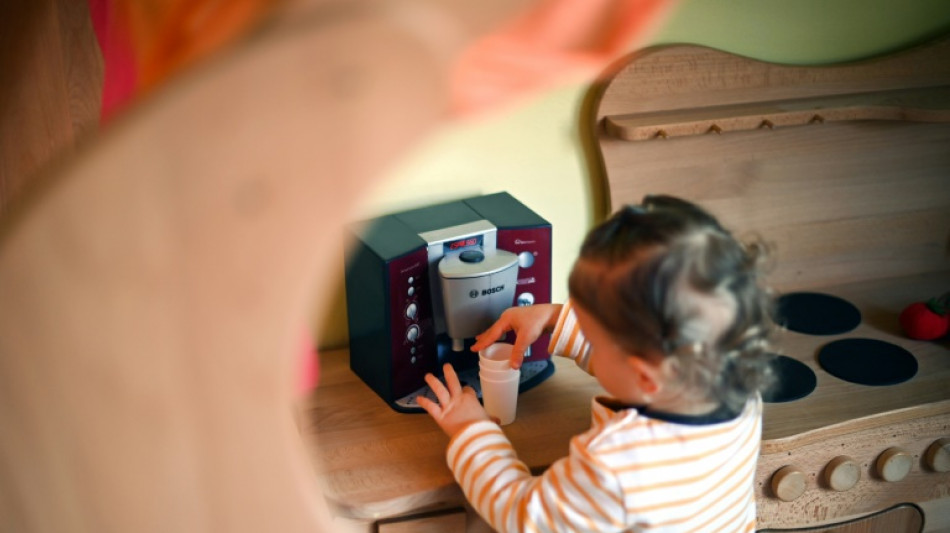
Infants remember more than you think, new study reveals / Photo: © AFP/File

Our earliest years are a time of rapid learning, yet we typically cannot recall specific experiences from that period -- a phenomenon known as infantile amnesia.
A new study published in Science on Thursday challenges assumptions about infant memory, showing that young minds do indeed form memories. The question remains, however, why these memories become difficult to retrieve later in life.
"I've always been fascinated by this mysterious blank spot we have in our personal history," Nick Turk-Browne, professor of psychology at Yale and the study's senior author, told AFP.
Around the age of one, children become extraordinary learners -- acquiring language, walking, recognizing objects, understanding social bonds, and more. "Yet we remember none of those experiences -- so there's a sort of mismatch between this incredible plasticity and learning ability that we have," he said.
Sigmund Freud, the founder of psychoanalysis, hypothesized that early memories are repressed, though science has since largely dismissed the idea of an active suppression process. Instead, modern theories focus on the hippocampus, a part of the brain critical for episodic memory, which is not fully developed in infancy.
Turk-Browne, however, was intrigued by clues from previous behavioral research. Since babies cannot verbally report memories before acquiring language, their tendency to gaze longer at familiar things provides important hints.
Recent rodent studies monitoring brain activity have also shown that engrams -- patterns of cells that store memories -- form in the infant hippocampus but become inaccessible over time -- though they can be artificially reawakened through a technique that uses light to stimulate neurons.
But until now, pairing observations of infants with brain imaging had been out of reach, as babies are famously uncooperative when it comes to sitting still inside a Functional Magnetic Resonance Imaging (fMRI) machine -- the device that tracks blood flow to "see" brain activity.
- Psychedelic patterns -
To overcome this challenge, Turk-Browne's team used methods his lab has refined over the years -- working with families to incorporate pacifiers, blankets, and stuffed animals; holding babies still with pillows; and using psychedelic background patterns to keep them engaged.
Still, inevitable wiggling led to blurry images that had to be discarded, but the team accounted for this by running hundreds of sessions.
In total, 26 infants participated -- half under a year old, half over -- while their brains were scanned during a memory task adapted from adult studies.
First, they were shown images of faces, scenes, or objects. Later, after viewing other images, they were presented with a previously seen image alongside a new one.
"We quantify how much time they spend looking at the old thing they've seen before, and that's a measure of their memory for that image," said Turk-Browne.
By comparing brain activity during successful memory formation versus forgotten images, the researchers confirmed that the hippocampus is active in memory encoding from a young age.
This was true for 11 of 13 infants over a year old but not for those under one. They also found that babies who performed best on memory tasks showed greater hippocampal activity.
"What we can conclude accurately from our study is that infants have the capacity to encode episodic memories in the hippocampus starting around one year of age," said Turk-Browne.
- Forgotten Memories -
"The ingenuity of their experimental approach should not be understated," researchers Adam Ramsaran and Paul Frankland wrote in an accompanying Science editorial.
But what remains unresolved is what happens to these early memories. Perhaps they are never fully consolidated into long-term storage -- or perhaps they persist but become inaccessible.
Turk-Browne suspects the latter and is now leading a new study testing whether infants, toddlers, and children can recognize video clips recorded from their own perspective as younger babies.
Early, tentative results suggest these memories might persist until around age three before fading. Turk-Browne is particularly intrigued by the possibility that such fragments could one day be reactivated later in life.
N.Patterson--TFWP