The real-life violence that inspired South Korea's 'Squid Game' / Photo: © AFP/File

A factory turned into a battlefield, riot police armed with tasers and an activist who spent 100 days atop a chimney -- the unrest that inspired Netflix's most successful show ever has all the hallmarks of a TV drama.
This month sees the release of the second season of "Squid Game", a dystopian vision of South Korea where desperate people compete in deadly versions of traditional children's games for a massive cash prize.
But while the show itself is a work of fiction, Hwang Dong-hyuk, its director and writer, has said the experiences of the main character Gi-hun, a laid-off worker, were inspired by the violent Ssangyong strikes in 2009.
"I wanted to show that any ordinary middle-class person in the world we live in today can fall to the bottom of the economic ladder overnight," he has said.
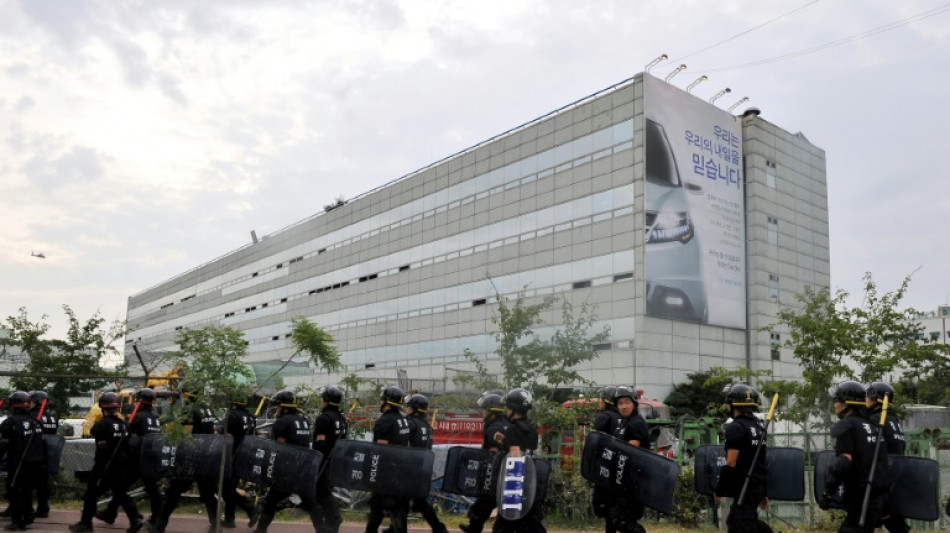
In May 2009, Ssangyong, a struggling car giant taken over by a consortium of banks and private investors, announced it was laying off more than 2,600 people, or nearly 40 percent of its workforce.
That was the beginning of an occupation of the factory and a 77-day strike that ended in clashes between strikers armed with slingshots and steel pipes and riot police wielding rubber bullets and tasers.
Many union members were severely beaten and some were jailed.
- 'Many lost their lives' -
The conflict did not end there.
Five years later, union leader Lee Chang-kun held a sit-in for 100 days on top of one of the factory's chimneys to protest a sentence in favour of Ssangyong against the strikers.
He was supplied with food from a basket attached to a rope by supporters and endured hallucinations of a tent rope transformed into a writhing snake.
Some who experienced the unrest struggled to discuss "Squid Game" because of the trauma they endured, Lee told AFP.
The repercussions of the strike, compounded by protracted legal battles, caused significant financial and mental strain for workers and their families, resulting in around 30 deaths by suicide and stress-related issues, Lee said.
"Many have lost their lives. People had to suffer for too long," he said.
He vividly remembers the police helicopters circling overhead, creating intense winds that ripped away workers' raincoats.
Lee said he felt he could not give up.
"We were seen as incompetent breadwinners and outdated labour activists who had lost their minds," he said.
"Police kept beating us even after we fell unconscious -- this happened at our workplace, and it was broadcast for so many to see."
Lee said he had been moved by scenes in the first season of "Squid Game" where Gi-hun struggles not to betray his fellow competitors.
But he wished the show had spurred real-life change for workers in a country marked by economic inequality, tense industrial relations and deeply polarised politics.
"Despite being widely discussed and consumed, it is disappointing that we have not channelled these conversations into more beneficial outcomes," he said.
- 'Shadow of state violence' -
The success of "Squid Game" in 2021 left him feeling "empty and frustrated".
"At the time, it felt like the story of the Ssangyong workers had been reduced to a commodity in the series," Lee told AFP.
"Squid Game", the streaming platform's most-watched series of all time, is seen as embodying the country's rise to a global cultural powerhouse, part of the "Korean wave" alongside the Oscar-winning "Parasite" and K-pop stars such as BTS.
But its second season comes as the Asian democracy finds itself embroiled in some of its worst political turmoil in decades, triggered by conservative President Yoon Suk Yeol's failed bid to impose martial law this month.
Yoon has since been impeached and suspended from duties pending a ruling by the Constitutional Court.
That declaration of martial law risked sending the Korean wave "into the abyss", around 3,000 people in the film industry, including "Parasite" director Bong Joon-ho, said in a letter following Yoon's shocking decision.
Vladimir Tikhonov, a Korean studies professor at the University of Oslo, told AFP that some of South Korea's most successful cultural products highlight state and capitalist violence.
"It is a noteworthy and interesting phenomenon -- we still live in the shadow of state violence, and this state violence is a recurrent theme in highly successful cultural products."
C.Dean--TFWP