The Fort Worth Press - NASA solar probe to make its closest ever pass of Sun

USD -
AED 3.6725
AFN 63.00038
ALL 82.999692
AMD 377.502084
ANG 1.790083
AOA 916.999706
ARS 1394.9458
AUD 1.41215
AWG 1.8025
AZN 1.709472
BAM 1.704371
BBD 2.014946
BDT 122.754882
BGN 1.709309
BHD 0.377515
BIF 2970
BMD 1
BND 1.283525
BOB 6.913501
BRL 5.221203
BSD 1.000436
BTN 93.206388
BWP 13.651833
BYN 3.093542
BYR 19600
BZD 2.012088
CAD 1.373895
CDF 2274.99966
CHF 0.78896
CLF 0.023122
CLP 912.990238
CNY 6.90045
CNH 6.88346
COP 3692.84
CRC 468.079358
CUC 1
CUP 26.5
CVE 97.050479
CZK 21.13599
DJF 177.720442
DKK 6.454685
DOP 58.82502
DZD 132.247782
EGP 52.242495
ERN 15
ETB 157.196752
EUR 0.864002
FJD 2.20855
FKP 0.750673
GBP 0.74497
GEL 2.715025
GGP 0.750673
GHS 10.902706
GIP 0.750673
GMD 73.999819
GNF 8777.496008
GTQ 7.652926
GYD 209.305771
HKD 7.83355
HNL 26.5702
HRK 6.509301
HTG 131.227832
HUF 337.239014
IDR 16892.25
ILS 3.12734
IMP 0.750673
INR 93.082899
IQD 1310
IRR 1315125.000263
ISK 124.239685
JEP 0.750673
JMD 157.168937
JOD 0.709
JPY 157.955497
KES 129.600818
KGS 87.447903
KHR 4010.000137
KMF 428.000024
KPW 899.987979
KRW 1487.330162
KWD 0.30624
KYD 0.833751
KZT 481.121429
LAK 21475.00044
LBP 89549.999874
LKR 311.846652
LRD 183.403144
LSL 16.829536
LTL 2.95274
LVL 0.60489
LYD 6.379877
MAD 9.35875
MDL 17.532561
MGA 4164.999938
MKD 53.251039
MMK 2099.739449
MNT 3585.842291
MOP 8.07209
MRU 40.110251
MUR 46.510025
MVR 15.450326
MWK 1736.999834
MXN 17.74603
MYR 3.938961
MZN 63.901861
NAD 16.830036
NGN 1356.793742
NIO 36.720074
NOK 9.50185
NPR 149.125498
NZD 1.703125
OMR 0.384501
PAB 1.000471
PEN 3.454498
PGK 4.301978
PHP 59.808119
PKR 279.150074
PLN 3.68705
PYG 6500.777741
QAR 3.644606
RON 4.4004
RSD 101.502989
RUB 86.148928
RWF 1459
SAR 3.75441
SBD 8.048583
SCR 14.453064
SDG 600.999823
SEK 9.29741
SGD 1.278005
SHP 0.750259
SLE 24.649867
SLL 20969.510825
SOS 571.503007
SRD 37.502033
STD 20697.981008
STN 21.5
SVC 8.753927
SYP 110.528765
SZL 16.829581
THB 32.489939
TJS 9.579415
TMT 3.5
TND 2.911251
TOP 2.40776
TRY 44.3078
TTD 6.781035
TWD 31.816803
TZS 2597.503137
UAH 43.994632
UGX 3781.362476
UYU 40.523406
UZS 12195.000032
VES 454.68563
VND 26290
VUV 119.408419
WST 2.73222
XAF 571.660014
XAG 0.013695
XAU 0.000215
XCD 2.70255
XCG 1.803034
XDR 0.710959
XOF 571.501976
XPF 103.600254
YER 238.550025
ZAR 16.737435
ZMK 9001.206465
ZMW 19.584125
ZWL 321.999592
  • RBGPF

    -13.5000

    69

    -19.57%

  • CMSD

    0.0100

    22.9

    +0.04%

  • CMSC

    0.0200

    22.85

    +0.09%

  • RYCEF

    -0.5900

    16.01

    -3.69%

  • NGG

    -1.8700

    85.53

    -2.19%

  • RELX

    -0.0400

    33.82

    -0.12%

  • GSK

    0.3100

    52.37

    +0.59%

  • RIO

    -2.0700

    85.65

    -2.42%

  • BTI

    0.6300

    58.72

    +1.07%

  • BCE

    -0.0200

    25.73

    -0.08%

  • BCC

    -1.9800

    69.86

    -2.83%

  • VOD

    0.0500

    14.42

    +0.35%

  • JRI

    -0.1630

    12.16

    -1.34%

  • AZN

    0.5100

    188.93

    +0.27%

  • BP

    1.2500

    45.86

    +2.73%

NASA solar probe to make its closest ever pass of Sun
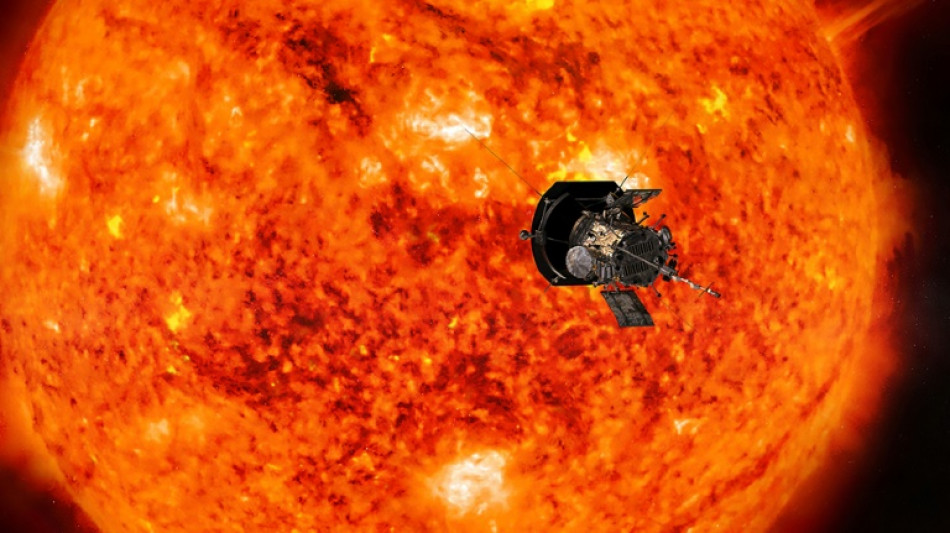
NASA solar probe to make its closest ever pass of Sun / Photo: © NASA/Johns Hopkins APL/AFP/File

NASA solar probe to make its closest ever pass of Sun

NASA's pioneering Parker Solar Probe is poised to make its closest-ever approach of the Sun on Christmas Eve, a record-setting 3.8 million miles (6.2 million kilometers) from the surface.

Text size:

Launched in August 2018, the spaceship is on a seven-year mission to deepen scientific understanding of our star and help forecast space-weather events that can affect life on Earth.

Its closest approach to date will happen on Tuesday, December 24, at 6:53 am (11:53 GMT).

If the distance between Earth and the Sun is the equivalent to the length of an American football field, the spacecraft would be about four yards (meters) from the end zone at that point.

"This is one example of NASA's bold missions, doing something that no one else has ever done before to answer longstanding questions about our universe," said Arik Posner, Parker Solar Probe program scientist, in a statement.

"We can't wait to receive that first status update from the spacecraft and start receiving the science data in the coming weeks."

During this closest approach -- known as perihelion -- mission teams will lose direct contact with Parker, relying on a "beacon tone" this Friday to confirm the spacecraft's status.

Although the heat shield will endure scorching temperatures of about 1,600 to 1,700 degrees Fahrenheit (870 to 930 degrees Celsius), the probe's internal instruments will remain near room temperature -- around 85F (29C) -- as it explores the Sun's outer atmosphere, called the corona.

Not only will the temperatures be extreme, but Parker will also be moving at a blistering pace of around 430,000 mph (690,000 kph), fast enough to fly from the US capital Washington to Tokyo in under a minute.

"No human-made object has ever passed this close to a star, so Parker will truly be returning data from uncharted territory," said Nick Pinkine, Parker Solar Probe mission operations manager at the Johns Hopkins Applied Physics Laboratory (APL) in Laurel, Maryland.

"We're excited to hear back from the spacecraft when it swings back around the Sun."

By venturing into these extreme conditions, Parker has been helping scientists tackle some of the Sun's biggest mysteries: how the solar wind originates, why the corona is hotter than the surface below, and how coronal mass ejections -- massive clouds of plasma that hurl through space -- are formed.

This Christmas Eve flyby is the first of three record-setting close passes, with the next two -- on March 22, 2025, and June 19, 2025 -- both expected to bring Parker Solar Probe back to a similarly close distance from the Sun.

J.P.Estrada--TFWP