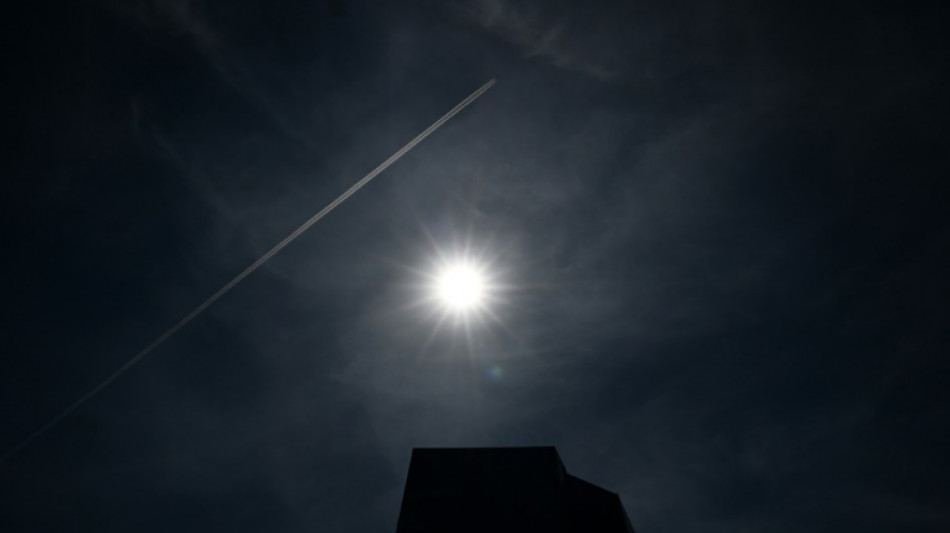
Plane contrails: white fluffy contributors to global warming / Photo: © AFP

The white, feathery lines behind airplanes that look like bits of harmless cloud are anything but, warn experts, who say they could have a greater environmental impact than the aviation sector's CO2 emissions.
The condensation trails -- contrails, for short -- are being increasingly studied as scientists work with the industry to find technological solutions to the problem.
Classified as non-CO2 emissions from aircraft, in September they were the subject of a symposium in Montreal organized by the International Civil Aviation Organization, a UN agency.
- What are contrails? -
Contrails are clouds that form at high altitudes in cold, humid areas called ice supersaturated regions (ISSRs).
When jet fuel is burned by engines, water vapor condenses on to soot particles to form ice crystals.
Enough ice crystals, and they begin to form cirrus clouds -- high-altitude, wispy white filaments that, when created this way, trail out behind planes as they cross the sky.
These trails trap some of the heat that rises from the Earth at night, preventing it from radiating back out of the atmosphere -- thus acting as a greenhouse gas, causing warming, explains Donald Wuebbles, a professor at the University of Illinois.
Contrails that stay in the sky for a few minutes are not very worrisome, he says.
"But if they form at night, they'll maybe last a little longer, and at night they can cause a warming effect," he adds.
- What is the impact? -
Non-CO2 emissions could account for up to two-thirds of aviation's impact on global warming, which "gives you an idea of how important they are to consider," Wuebbles said.
And contrails could form up to 57 percent of that impact -- far more than the C02 emissions from burning fuel, according to a 2021 study.
However, such emissions are short-lived compared to carbon dioxide and their impact on global warming could be quickly eroded if solutions were found to avoid them, experts say.
- So what can be done? -
Not all flights create contrails -- it can depend on weather conditions and the aircraft's trajectory.
For example, at Air France, just four percent of flights are responsible for some 80 percent of the airline's contrail impact on global warming, notes Irene Boyer-Souchet, who is leading up the company's efforts to mitigate the damage.
The long-term strategy is to modify the trajectory of a fraction of flights.
Air France pilots made more than 3,000 observations over 18 months with the aim of helping Meteo-France improve its forecasts for at-risk areas so that pilots could eventually avoid them.
"The main risk is that by thinking you're avoiding an area, you could end up flying there because it's slightly off the weather forecast," Boyer-Souchet points out, illustrating the importance of fine-tuning the research.
Pilots from American Airlines conducted 70 test flights above or below at-risk areas, guided by satellite images, weather data, software models and AI prediction tools.
A 54-percent reduction in contrails was observed, along with a two-percent increase in fuel consumption.
Accelerating the deployment of a global contrail avoidance system could reduce aviation's impact on the climate by 40 percent, according to a Cambridge University report published in September.
The more flights in the air, however, the more complicated the implementation of such a system would be, notes Boyer-Souchet, who hopes that it will be a reality by 2030.
G.George--TFWP