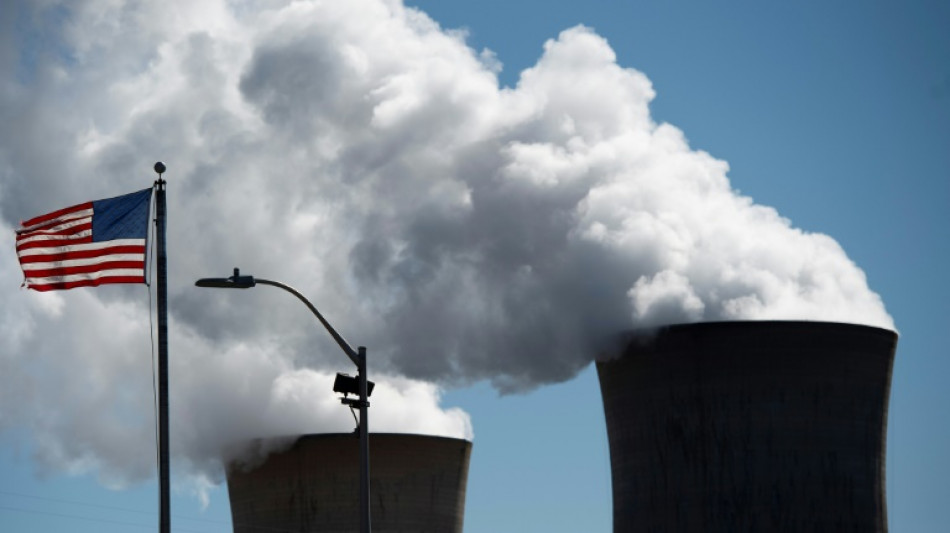
Restarting nuclear power plants: the unprecedented gamble in the US / Photo: © AFP

Two American energy companies are each preparing to bring a nuclear power station back into service, an unprecedented operation which should help meet the growing need for electricity in the United States.
With demand for nuclear energy rising in the wake of Russia's invasion of Ukraine and the US government eager to transition to carbon-free resources, the calculus has changed on the shuttered nuclear plants.
On Friday, Constellation Energy unveiled plans to restart a reactor at Pennsylvania's Three Mile Island, which was closed for economic reasons in 2019. The plant was the site of the worst commercial nuclear power accident in US history in 1979.
The relaunch initiative is part of a 20-year electricity supply contract with Microsoft.
Last October, Holtec started the ball rolling by filing an application with the US Nuclear Regulatory Commission (NRC) to resume operation of the Palisades nuclear plant in Michigan, which was shut down in 2022.
According to several specialists, restarting this plant would be a world first.
"Everyone's kind of watching what we're doing with this project and seeing how viable it is," said Holtec spokesperson Patrick O'Brien. "So it's something that if we can show it's done, the international stage might start looking at the same kind of thing."
Contacted by AFP, the NRC said that only one application for restart had been submitted to it to date, that of Holtec, which is aiming for the end of 2025.
The dismantling of a power plant takes several decades, and in the case of Holtec's Palisades site it had not begun in full.
At Three Mile Island the fuel was removed from the reactor, but "major equipment removal or demolition activities have not started," a Constellation spokesperson told AFP.
"There is a lot that you can reuse at a site, even if you have to rebuild the nuclear plant," said Jacopo Buongiorno, professor of nuclear science and engineering at the Massachusetts Institute of Technology (MIT).
Holtec estimates the cost of the operation at around $2 billion, according to its spokesman, while Constellation puts the bill for the Three Mile Island restart at $1.6 billion.
By comparison, the construction of the two most recent reactors in the US, to be connected to the grid in 2023 and 2024 at the Vogtle site in Georgia, cost more than $30 billion.
- More to come? -
With the global energy balance affected by Russia's war in Ukraine and energy transition policies now incorporating nuclear fission more frequently and more widely, nuclear energy is gaining momentum.
Around 56 percent of Americans are in favor of developing nuclear energy in the US, compared with 43 percent just four years ago, according to a survey by the Pew Research Center published in August.
The future seemed reserved for the new generation of small modular reactors (SMRs), with their shorter construction times and the possibility of mass production.
But the initial design and construction of these pocket-sized power plants is proving costly because they are still prototypes.
The first Natrium from start-up TerraPower, currently positioned to be the first operational SMR in the US in 2030, is expected to cost around $4 billion.
Thus, restarting an existing power station appears to be the quickest and cheapest route, which could inspire other projects -- where possible.
"I don't think there are that many mothballed nuclear plants out there that you'll be able to restart," said Jacopo Buongiorno from MIT.
In response to a query from AFP, NextEra Energy Resources said it was "evaluating this opportunity" of restarting the Duane Arnold power station in the midwestern US state of Iowa, which closed in 2020, but that it "needed to make an informed decision about resuming operations at the facility."
As for the Indian Point nuclear site north of New York City which was shut down in 2021 under pressure from the state's then-governor, Andrew Cuomo, "nothing is impossible with time and resources," according to Holtec's Patrick O'Brien.
But, he added, it would be much more complicated to resurrect than Palisades or Three Mile Island.
Reactivating an existing facility raises the question of safety for plants that were originally intended to have a 40-year lifespan.
While people may think "it must be unsafe, it must be crumbling," that's simply not true, he said.
"Because, with the exception of the concrete containment, which is of course monitored and the reactor pressure vessel, again, heavily monitored, virtually everything else in these plants has been replaced at one point or another," he added.
And the project has the backing of the federal government, with the Biden-Harris administration earlier this year agreeing to provide a $1.5 billion loan to Holtec for the Palisades project "for our nation's historic transition to a safe and secure clean energy future," according to an Department of Energy spokesperson.
T.Mason--TFWP