The Fort Worth Press - Methane rising faster than other greenhouse gases: researchers

USD -
AED 3.672495
AFN 63.000154
ALL 82.897749
AMD 377.498158
ANG 1.790083
AOA 916.999935
ARS 1394.755099
AUD 1.420808
AWG 1.8025
AZN 1.701395
BAM 1.689727
BBD 2.01353
BDT 122.670076
BGN 1.709309
BHD 0.377776
BIF 2959.238332
BMD 1
BND 1.278587
BOB 6.90829
BRL 5.296504
BSD 0.999767
BTN 93.464137
BWP 13.632554
BYN 3.033193
BYR 19600
BZD 2.010678
CAD 1.373505
CDF 2274.999864
CHF 0.78954
CLF 0.023323
CLP 920.710475
CNY 6.90045
CNH 6.90464
COP 3704.11
CRC 466.966746
CUC 1
CUP 26.5
CVE 95.264631
CZK 21.235701
DJF 178.029289
DKK 6.4754
DOP 59.344438
DZD 132.12998
EGP 52.242202
ERN 15
ETB 157.561968
EUR 0.86672
FJD 2.216898
FKP 0.749058
GBP 0.751095
GEL 2.715009
GGP 0.749058
GHS 10.898095
GIP 0.749058
GMD 73.999651
GNF 8762.888825
GTQ 7.658082
GYD 209.166703
HKD 7.83415
HNL 26.461796
HRK 6.526901
HTG 131.155614
HUF 340.910505
IDR 16951
ILS 3.119565
IMP 0.749058
INR 93.724003
IQD 1309.655458
IRR 1315124.999866
ISK 124.639709
JEP 0.749058
JMD 157.066706
JOD 0.709026
JPY 159.122974
KES 129.519967
KGS 87.447901
KHR 3994.988984
KMF 428.000076
KPW 899.950845
KRW 1504.19502
KWD 0.30645
KYD 0.833125
KZT 480.643127
LAK 21468.74595
LBP 89536.308264
LKR 311.869854
LRD 182.950746
LSL 16.864973
LTL 2.95274
LVL 0.60489
LYD 6.400194
MAD 9.342013
MDL 17.410687
MGA 4168.646594
MKD 53.436835
MMK 2099.773051
MNT 3569.674815
MOP 8.069756
MRU 40.019353
MUR 46.510173
MVR 15.450048
MWK 1733.638602
MXN 17.920205
MYR 3.939025
MZN 63.900738
NAD 16.864827
NGN 1355.730068
NIO 36.787131
NOK 9.569905
NPR 149.542319
NZD 1.71334
OMR 0.384512
PAB 0.999784
PEN 3.456418
PGK 4.315447
PHP 59.979501
PKR 279.125852
PLN 3.708775
PYG 6529.758871
QAR 3.655818
RON 4.4171
RSD 101.778982
RUB 83.368828
RWF 1454.663268
SAR 3.75512
SBD 8.048583
SCR 13.736729
SDG 600.999638
SEK 9.36871
SGD 1.28219
SHP 0.750259
SLE 24.649779
SLL 20969.510825
SOS 571.342175
SRD 37.487502
STD 20697.981008
STN 21.166855
SVC 8.747565
SYP 110.76532
SZL 16.870416
THB 32.859697
TJS 9.602575
TMT 3.5
TND 2.952659
TOP 2.40776
TRY 44.318702
TTD 6.782897
TWD 31.997499
TZS 2586.664029
UAH 43.796556
UGX 3778.931635
UYU 40.286315
UZS 12188.70549
VES 454.68563
VND 26312
VUV 119.036336
WST 2.744165
XAF 566.725992
XAG 0.01438
XAU 0.000219
XCD 2.70255
XCG 1.801775
XDR 0.705856
XOF 566.7162
XPF 103.032842
YER 238.54997
ZAR 17.02116
ZMK 9001.199938
ZMW 19.520498
ZWL 321.999592
  • RYCEF

    -0.6100

    15.99

    -3.81%

  • CMSC

    -0.1400

    22.71

    -0.62%

  • NGG

    -2.7700

    82.76

    -3.35%

  • RELX

    -0.3100

    33.51

    -0.93%

  • CMSD

    -0.2600

    22.64

    -1.15%

  • BCE

    0.0900

    25.82

    +0.35%

  • RIO

    -2.3700

    83.28

    -2.85%

  • VOD

    -0.0650

    14.355

    -0.45%

  • RBGPF

    -13.5000

    69

    -19.57%

  • BCC

    -0.9800

    68.88

    -1.42%

  • GSK

    -0.3400

    52.03

    -0.65%

  • JRI

    -0.1650

    11.995

    -1.38%

  • AZN

    -4.3750

    184.555

    -2.37%

  • BTI

    -1.1600

    57.56

    -2.02%

  • BP

    -0.7300

    45.13

    -1.62%

Methane rising faster than other greenhouse gases: researchers
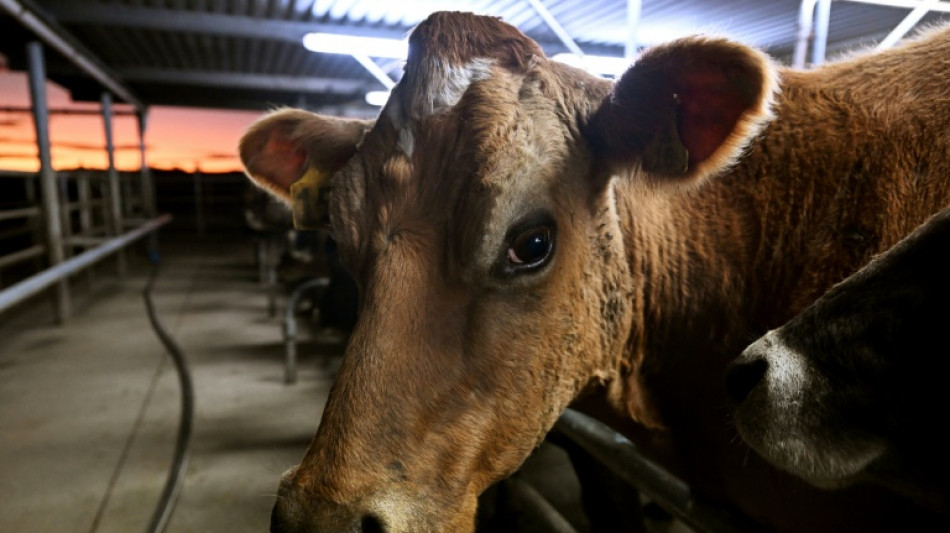
Methane rising faster than other greenhouse gases: researchers / Photo: © AFP/File

Methane rising faster than other greenhouse gases: researchers

Concentrations in the atmosphere of the powerful greenhouse gas methane are rising at an accelerating pace, threatening efforts by countries to meet their climate targets, researchers warned on Tuesday.

Text size:

"Methane is rising faster in relative terms than any major greenhouse gas and is now 2.6-fold higher than in pre-industrial times," said an international group of researchers under the aegis of the Global Carbon Project in a study published in Environmental Research Letters.

Methane is the second most abundant greenhouse gas produced by human activity after carbon dioxide, with agriculture, energy production and organic waste rotting in landfills the major sources.

In the first 20 years, its impact on the atmosphere is about 80 times more powerful that of carbon dioxide but it breaks down more quickly than CO2.

That opens a possibility to sharply reduce climate impact in the short term. But the researchers found that despite efforts to cut methane emissions, atmospheric concentrations of the gas are still rising.

- Rising in most countries -

An average of 6.1 million tonnes of methane were added to atmosphere per year in the 2000s.

That rose to 20.9 million tonnes per year in the 2010s. It hit 41.8 million tonnes in 2020.

"Anthropogenic (human-made) emissions have continued to increase in almost every other country in the world, with the exception of Europe and Australia, which show a slow declining trend," Global Carbon Project executive director Pep Canadell, one of the study's co-authors, told AFP.

The largest increases have come from China and southeast Asia and have been primarily linked to coal extraction, oil and gas production and landfills, the researchers found.

The La Nina weather phenomenon has also led to an increase in methane from natural sources, they said.

A drop in nitrogen oxides pollution in 2020, when use of transport plunged due to the Covid-19 pandemic, had a paradoxical impact. It is key in preventing methane from accumulating in the atmosphere.

- 'Mirage' -

Rising methane pollution is undermining efforts to keep the Earth's average temperature from rising by more than 2.0 degrees Celsius above pre-industrial levels.

A "Global Methane Pledge" was launched in 2021 by the European Union and United States to cut global methane emissions by 30 percent from 2020 levels, by the cutoff date of 2030.

More than 150 countries have signed up -- but not China, India or Russia.

"Right now, the goals of the Global Methane Pledge seem as distant as a desert oasis," said lead author of the Environmental Research Letters paper, Stanford University scientist Rob Jackson.

"We all hope they aren't a mirage."

China and the United States are preparing to host a summit on greenhouse gasses other than CO2 later this year, potentially raising the prospect of further pledges by governments.

H.Carroll--TFWP