The Fort Worth Press - 'Astonishing': Eaten eels recorded escaping from fish guts

USD -
AED 3.6725
AFN 63.515111
ALL 81.813592
AMD 370.642956
ANG 1.789884
AOA 918.000277
ARS 1402.006102
AUD 1.394758
AWG 1.8025
AZN 1.756157
BAM 1.673763
BBD 2.014848
BDT 122.744486
BGN 1.668102
BHD 0.378259
BIF 2976.953556
BMD 1
BND 1.277439
BOB 6.912222
BRL 4.950503
BSD 1.000406
BTN 95.268333
BWP 13.595091
BYN 2.832032
BYR 19600
BZD 2.011938
CAD 1.361515
CDF 2316.00032
CHF 0.784205
CLF 0.023145
CLP 910.940167
CNY 6.83025
CNH 6.830895
COP 3728.45
CRC 455.103656
CUC 1
CUP 26.5
CVE 94.363762
CZK 20.862003
DJF 178.141394
DKK 6.39453
DOP 59.605058
DZD 132.430977
EGP 53.742498
ERN 15
ETB 157.299296
EUR 0.855802
FJD 2.197403
FKP 0.738858
GBP 0.738825
GEL 2.68501
GGP 0.738858
GHS 11.214281
GIP 0.738858
GMD 73.503045
GNF 8779.444171
GTQ 7.636122
GYD 209.292176
HKD 7.83645
HNL 26.592098
HRK 6.447992
HTG 130.92574
HUF 310.449499
IDR 17455
ILS 2.943045
IMP 0.738858
INR 95.186798
IQD 1310.455489
IRR 1315000.000414
ISK 122.710279
JEP 0.738858
JMD 157.422027
JOD 0.709038
JPY 157.799034
KES 129.169806
KGS 87.420498
KHR 4012.802629
KMF 420.494418
KPW 900.003193
KRW 1473.449864
KWD 0.30815
KYD 0.833626
KZT 464.848397
LAK 21968.14747
LBP 89583.7434
LKR 320.121521
LRD 183.567107
LSL 16.741448
LTL 2.95274
LVL 0.60489
LYD 6.346517
MAD 9.245917
MDL 17.266433
MGA 4166.844956
MKD 52.707418
MMK 2099.706641
MNT 3578.607048
MOP 8.074899
MRU 39.944374
MUR 46.949791
MVR 15.455016
MWK 1734.687765
MXN 17.44055
MYR 3.962499
MZN 63.910292
NAD 16.741734
NGN 1368.6098
NIO 36.815644
NOK 9.24674
NPR 152.429814
NZD 1.700835
OMR 0.384504
PAB 1.000419
PEN 3.507156
PGK 4.350003
PHP 61.663971
PKR 278.776321
PLN 3.64042
PYG 6061.565584
QAR 3.656451
RON 4.4665
RSD 100.453998
RUB 75.496787
RWF 1462.717478
SAR 3.752423
SBD 8.025868
SCR 13.359108
SDG 600.49739
SEK 9.27558
SGD 1.27714
SHP 0.746601
SLE 24.649919
SLL 20969.496166
SOS 571.753772
SRD 37.456007
STD 20697.981008
STN 20.966603
SVC 8.752915
SYP 110.530725
SZL 16.738482
THB 32.643975
TJS 9.353536
TMT 3.505
TND 2.916547
TOP 2.40776
TRY 45.216002
TTD 6.781199
TWD 31.609197
TZS 2602.500263
UAH 43.963252
UGX 3776.555915
UYU 40.282241
UZS 12039.109133
VES 488.94275
VND 26323
VUV 118.524529
WST 2.715931
XAF 561.361905
XAG 0.013565
XAU 0.000219
XCD 2.70255
XCG 1.802894
XDR 0.697635
XOF 561.361905
XPF 102.06029
YER 238.625025
ZAR 16.690498
ZMK 9001.204285
ZMW 18.882166
ZWL 321.999592
  • JRI

    0.0550

    12.965

    +0.42%

  • BCC

    0.8800

    75.31

    +1.17%

  • BTI

    0.2950

    58.66

    +0.5%

  • RYCEF

    -0.0200

    16.33

    -0.12%

  • BP

    -0.5450

    46.395

    -1.17%

  • BCE

    0.0100

    23.95

    +0.04%

  • RIO

    0.6950

    99.31

    +0.7%

  • NGG

    -0.3900

    87.11

    -0.45%

  • AZN

    -2.8500

    180.66

    -1.58%

  • VOD

    -0.3450

    15.705

    -2.2%

  • RELX

    -0.2500

    36.105

    -0.69%

  • GSK

    -0.6400

    50.25

    -1.27%

  • CMSD

    -0.0300

    23.25

    -0.13%

  • RBGPF

    1.6000

    64.7

    +2.47%

  • CMSC

    -0.0100

    22.87

    -0.04%

'Astonishing': Eaten eels recorded escaping from fish guts
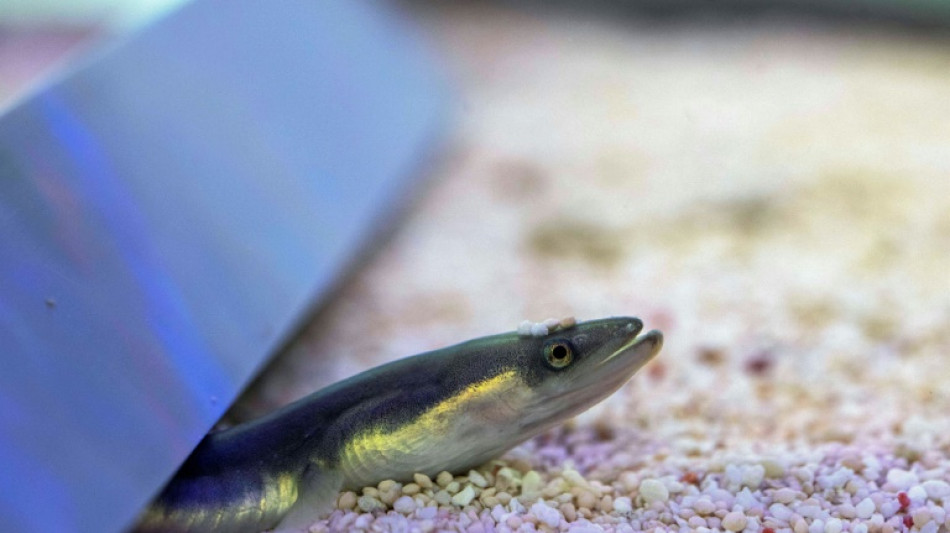
'Astonishing': Eaten eels recorded escaping from fish guts / Photo: © AFP/File

'Astonishing': Eaten eels recorded escaping from fish guts

Eels that have been swallowed by fish have been recorded for the first time sliding tail-first back out of their would-be predators' stomach and escaping out of their gills, a study said Monday.

Text size:

The remarkable last-gasp getaway also marks the first time this kind of defensive tactic has been caught on video across the animal kingdom, according to the Japanese researchers.

The team behind the new study had already observed young Japanese eels surviving being eaten by sliding out of the gills of fish -- rather than out of the mouths that had swallowed them.

Nonetheless, the researchers had assumed the eels had been somewhat near the mouths of the fish when they broke free.

But the team was "really surprised" to find that the eels were all the way in the stomach of their predators before starting their escape bid, lead study author Yuha Hasegawa of Nagasaki University told AFP.

- Stomach turning -

Some eels even circled around the stomach several times before wriggling free, according to the study in the journal Current Biology.

To see what was happening inside the bodies of the predatory dark sleeper fish, the researchers injected them with fluid to increase the contrast for recording the results on an X-ray video system.

Out of 32 eels swallowed into the stomachs of the fish, all but four tried to escape by backing out through the digestive tract, towards the esophagus and eventually out the side door of the gills, the study said.

Thirteen managed to get at least some of their tails out of the gills, while nine went all the way and escaped with their lives.

The young eels, which were around seven centimetres (three inches) long, always went tail first. Unlike most fish, eels are skilled at swimming backwards, the researchers pointed out.

The whole process took around a minute. The eels could only survive around three minutes in the stomach acid.

The fish were not harmed when the eels burst free from their gills, Yuha Hasegawa said.

It was a "difficult" experiment, he added, and it took the team a year to capture convincing footage.

Previous research has shown that some invertebrates like worms can escape from the digestive system of frogs, but the inner workings have not been recorded on X-ray video.

Study co-author Yuuki Kawabata, also from Nagasaki University, said that scientists were only beginning to understand the "mysterious, astonishing" strategies that animals use to escape from predators.

He pointed out that Japanese eels are still offering up surprises despite being quite well known.

Fish are not the only animals with a taste for these eels -- they are a popular and expensive delicacy among many humans.

Japanese eels, called Unagi when cooked, make up the vast majority of commercially sold eel in Japan.

Overfishing has led the eels to be considered an endangered species by the International Union for Conservation of Nature.

J.P.Cortez--TFWP