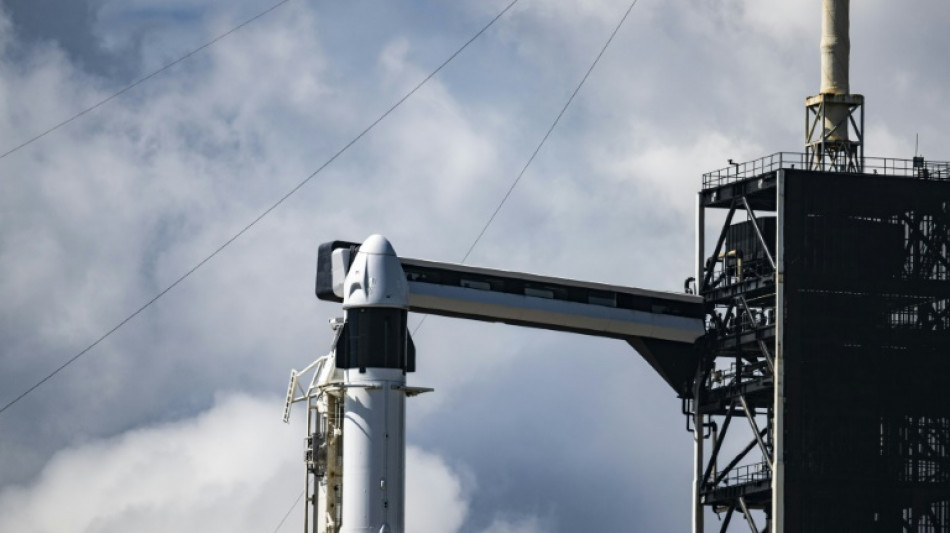
SpaceX Polaris Dawn launch pushed back after helium leak / Photo: © AFP

SpaceX on Monday pushed back the historic launch of an all-civilian crew on an orbital expedition set to mark a new chapter in space exploration with the first spacewalk by private citizens.
The Polaris Dawn mission, organized by billionaire entrepreneur Jared Isaacman, was set to lift off early Tuesday from NASA's Kennedy Space Center, but is now targeting early Wednesday after a late technical hitch.
"Teams are taking a closer look at a ground-side helium leak on the Quick Disconnect umbilical," Elon Musk's company wrote on X. Umbilicals connect a tower with a rocket, while helium is a non-flammable gas often used to pressurize fuel lines.
Riding atop a Falcon 9 rocket, the SpaceX Dragon capsule is set to reach a peak altitude of 870 miles (1,400 kilometers) -- higher than any crewed mission in over half a century, since the Apollo era.
Mission commander Isaacman will guide his four-member team through the mission's centerpiece: the first-ever commercial spacewalk, equipped with sleek, newly developed SpaceX extravehicular activity (EVA) suits.
Rounding out the team are mission pilot Scott Poteet, a retired US Air Force Lieutenant Colonel; mission specialist Sarah Gillis, a lead space operations engineer at SpaceX; and mission specialist and medical officer Anna Menon, also a lead space operations engineer at SpaceX.
- High radiation zone -
The quartet underwent more than two years of training in preparation for the landmark mission, logging hundreds of hours on simulators as well as skydiving, centrifuge training, scuba diving, and summiting an Ecuadoran volcano.
Polaris Dawn is set to be the first of three missions under the Polaris program, a collaboration between Isaacman, the founder of tech company Shift4 Payments, and SpaceX.
"The idea is to develop (and) test new technology and operations in furtherance of SpaceX's bold vision to enable humankind to journey among the stars," Isaacman said during a recent press conference.
Isaacman declined to reveal his total investment in the project, though reports suggest he paid around $200 million for the SpaceX Inspiration4 mission in September 2021, the first all-civilian orbital mission.
Polaris Dawn will reach its highest altitude on its first day, venturing briefly into the Van Allen radiation belt, a region teeming with high-energy charged particles that can pose health risks to humans over extended periods.
The crew will orbit nearly three times higher than the International Space Station, yet will remain far short of the record-breaking distance of over 248,000 miles set by the Apollo 13 crew in 1970.
Apollo 13's astronauts journeyed that far to slingshot around the far side of the Moon after an explosion crippled their spacecraft, aborting their planned lunar landing and necessitating a return to Earth without major propulsive maneuvers.
- New spacesuits -
On day three, the crew will don their state-of-the-art EVA spacesuits -- outfitted with heads-up displays, helmet cameras, and advanced joint mobility systems -- and take turns to venture outside their spacecraft in twos. Each will spend 15 to 20 minutes in space, 435 miles above Earth's surface.
Notably, however, even the pair strapped into their seats will be exposed to the vacuum of space as the Dragon capsule doesn't have an airlock.
The following day will be dedicated to testing laser-based satellite communication between the spacecraft and Starlink, SpaceX's more than 6,000-strong constellation of internet satellites, in a bid to boost space communication speeds.
The crew is also set to conduct nearly 40 experiments aimed at advancing our understanding of human health during long-duration spaceflights. Among these are tests with contact lenses embedded with microelectronics to continuously monitor changes in eye pressure and shape.
After six days in space, the mission will conclude with a splashdown off the coast of Florida, where a SpaceX recovery ship will await.
The second Polaris mission will also utilize a Dragon capsule, while the third and final mission is slated to be the maiden crewed flight of Starship, SpaceX's prototype next-generation rocket that is key to Musk's vision of one day colonizing Mars.
H.Carroll--TFWP