One year on 'Mars': Inside NASA's ultra-realistic isolation study / Photo: © NASA TV/AFP/File

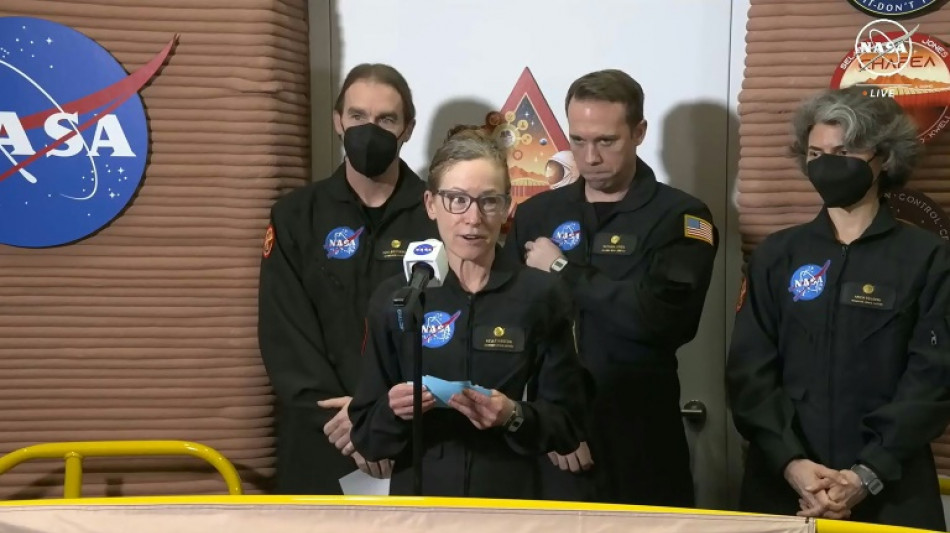
Sealed inside a habitat in Texas and cut off from the outside world for over a year, Kelly Haston was the commander of a first-of-its-kind simulation for NASA to prepare for a future mission to Mars.
From conducting mock "Marswalks" to tending to a vertical garden, and occasionally grappling with boredom -- Haston expressed pride in advancing the cause of space exploration while admitting the experience made her reconsider the reality of life on the Red Planet.
"Going to space would be an amazing opportunity," the 53-year-old biologist told AFP. "But I would say that it would be harder having experienced this, to know how it feels to leave your people."
The overarching goal of the experiment, called CHAPEA (Crew Health and Performance Exploration Analog) Mission 1, is to better understand the impacts of isolation on a crew's performance and health.
The project lasted 378 days and concluded in early July.
After all, a round-trip to Mars could easily take more than two years, factoring in the transit time of six-to-nine months and the time NASA hopes to spend on the planet.
For Haston, the hardest part was clear: "I could have been in that habitat for another year and survived with all of the other restrictions, but your people -- you miss your people so much."
Communications with the outside world were delayed by twenty minutes each way, simulating how long it takes a radio signal to travel between Earth and Mars.
They were also some limits on sending and receiving videos, to account for bandwidth restrictions.
The worst feeling was when relatives or friends were experiencing rough times, said Haston. "You couldn't be there for them in real time."
Her only direct human contacts were her three teammates and fellow Mars colonists -- but she insists they never went stir-crazy.
"Of course, there were times where you had crabby days, or something was bothering us, either as a crew or as an individual," she explained.
"But the communication was extremely good in this group," she said and besides, such problems were few and far between. "Up until the very end, we ate meals together."
Their 1,700-square-foot (160-square-meter) home included crew quarters, common areas and even an area for crops like tomatoes and peppers.
Called "Mars Dune Alpha" the 3D-printed habitat was installed inside a hangar at the NASA Johnson Space Center in Houston.
Simulated "Marswalks" took place in an exterior area that recreated the Martian environment with red soil and cliffs painted along the walls.
Crew members donned spacesuits and passed through an airlock to reach the "sandbox," as it was nicknamed, with tasks coordinated by their colleagues inside.
- Boredom -
"There were days where you did really wish you were outside, I can't lie," says the Canadian who now lives in California. But, to her surprise, these pangs only intensified towards the end.
Periods of boredom are an inevitable part of long space expeditions, and it was precisely this extended isolation that set CHAPEA apart from most prior "analog" missions.
Halston staved off ennui by embroidering mission symbols and images of Mars.
Of course, "analogs can't address all problems or all issues of an eventual mission to Mars," she said, though the lessons learned will aid in planning.
Each team member's food intake was meticulously documented, their blood, saliva and urine samples were collected, and their sleep habits, physical and cognitive performance analyzed.
"The food system is one of the greatest mass drivers on a human mission for human logistics, and we are going to be resource-constrained on these missions," NASA scientist Grace Douglas said on a podcast.
This makes it critical to determine the minimum necessary provisions to maintain astronauts' health and ensure the mission's success.
For now, NASA is keeping the details of the crew's tasks under wraps to preserve the element of surprise for the next two iterations of the mission. CHAPEA 2 is set for 2025.
C.Rojas--TFWP