The Fort Worth Press - Musk's superhuman vision promise is dangerous: researchers

USD -
AED 3.672498
AFN 64.999991
ALL 79.955
AMD 362.980675
ANG 1.790365
AOA 917.999694
ARS 1510.004205
AUD 1.403391
AWG 1.8025
AZN 1.701015
BAM 1.703666
BBD 2.01385
BDT 122.787991
BGN 1.683441
BHD 0.376916
BIF 3008.101045
BMD 1
BND 1.275784
BOB 10.173389
BRL 5.129098
BSD 0.999826
BTN 95.870627
BWP 13.559233
BYN 3.039547
BYR 19600
BZD 2.010976
CAD 1.400305
CDF 2310.999952
CHF 0.824555
CLF 0.024327
CLP 960.57992
CNY 6.70755
CNH 6.696298
COP 3168.76
CRC 447.299652
CUC 1
CUP 26.5
CVE 96.05007
CZK 21.18945
DJF 178.04878
DKK 6.51026
DOP 59.224739
DZD 133.786743
EGP 52.1204
ERN 15
ETB 160.975031
EUR 0.87087
FJD 2.216396
FKP 0.749304
GBP 0.747995
GEL 2.600677
GGP 0.749304
GHS 11.508761
GIP 0.749304
GMD 73.503879
GNF 8774.999954
GTQ 7.628953
GYD 209.155963
HKD 7.84506
HNL 26.919825
HRK 6.562498
HTG 130.679443
HUF 316.529411
IDR 17737
ILS 3.03095
IMP 0.749304
INR 95.90015
IQD 1310.5
IRR 1374599.999625
ISK 121.397068
JEP 0.749304
JMD 157.787456
JOD 0.708977
JPY 157.772992
KES 129.500761
KGS 87.449854
KHR 4052.999981
KMF 428.000332
KPW 900.000318
KRW 1384.23036
KWD 0.30833
KYD 0.833275
KZT 445.391986
LAK 22375.000465
LBP 89549.999735
LKR 331.62892
LRD 174.562923
LSL 16.24006
LTL 2.95274
LVL 0.60489
LYD 6.344981
MAD 9.523996
MDL 17.553136
MGA 4390.000107
MKD 53.593439
MMK 2099.69268
MNT 3599.361607
MOP 8.079878
MRU 40.050284
MUR 47.570314
MVR 15.450233
MWK 1736.999858
MXN 17.141102
MYR 4.080991
MZN 63.910189
NAD 16.240239
NGN 1332.130221
NIO 36.670292
NOK 9.434305
NPR 153.391986
NZD 1.74766
OMR 0.384505
PAB 0.99983
PEN 3.374496
PGK 4.445038
PHP 62.779005
PKR 277.174972
PLN 3.79743
PYG 5914.634146
QAR 3.64501
RON 4.583702
RSD 102.238988
RUB 84.249283
RWF 1471
SAR 3.713396
SBD 8.000512
SCR 13.855713
SDG 601.489005
SEK 9.813725
SGD 1.276805
SHP 0.747524
SLE 24.649782
SLL 20969.491881
SOS 571.00023
SRD 37.746502
STD 20697.981008
STN 21.6
SVC 8.749129
SYP 13002.000254
SZL 16.315003
THB 33.291032
TJS 9.223821
TMT 3.51
TND 2.9125
TOP 2.40776
TRY 48.78458
TTD 6.788328
TWD 31.792497
TZS 2651.607958
UAH 44.680662
UGX 3929.459623
UYU 40.200524
UZS 11825.000048
VES 847.485101
VND 26015
VUV 118.29149
WST 2.754822
XAF 571.253001
XAG 0.014858
XAU 0.000227
XCD 2.70255
XCG 1.802003
XDR 0.707052
XOF 571.253001
XPF 104.000144
YER 236.550031
ZAR 16.25044
ZMK 9001.20123
ZMW 19.622822
ZWL 321.999592
SSP 5664.022588
MXV 1.943321
  • NGG

    1.5700

    77.6

    +2.02%

  • GSK

    0.7700

    51.06

    +1.51%

  • AZN

    3.2500

    166.14

    +1.96%

  • BCE

    -0.2200

    22.28

    -0.99%

  • BCC

    0.2200

    75.53

    +0.29%

  • JRI

    0.1100

    11.61

    +0.95%

  • CMSC

    0.1900

    20.67

    +0.92%

  • RIO

    2.2500

    98.04

    +2.29%

  • BTI

    -0.0700

    56.02

    -0.12%

  • BP

    0.0400

    45.42

    +0.09%

  • RYCEF

    0.5200

    19.81

    +2.62%

  • RBGPF

    0.0000

    69.99

    0%

  • CMSD

    0.1600

    20.45

    +0.78%

  • VOD

    0.0600

    17.52

    +0.34%

  • RELX

    0.1100

    34.38

    +0.32%

Musk's superhuman vision promise is dangerous: researchers
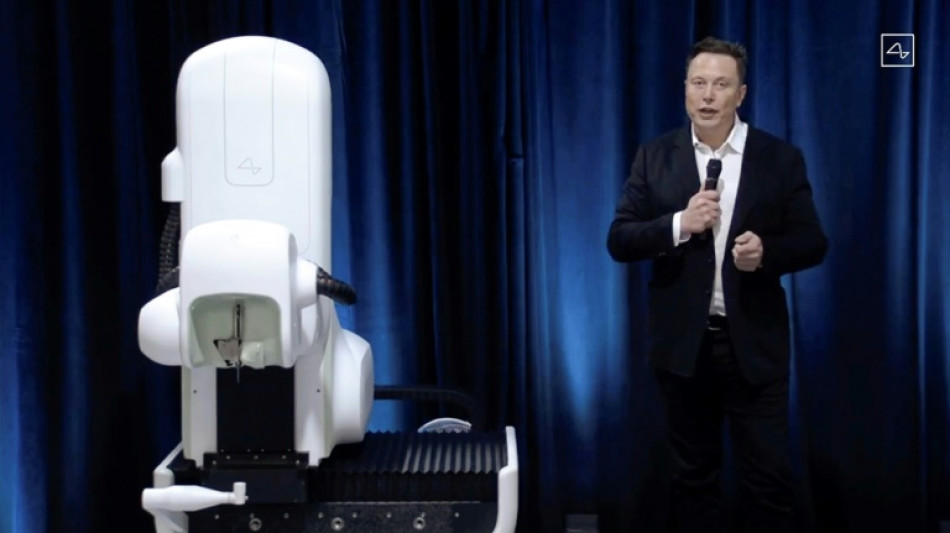
Musk's superhuman vision promise is dangerous: researchers / Photo: © Neuralink/AFP/File

Musk's superhuman vision promise is dangerous: researchers

Researchers have criticised billionaire Elon Musk for promising that his brain implant technology could eventually provide patients with vision superior to normal human sight.

Text size:

Musk has long promised that his Neuralink company was working on implants that could restore sight to blind people, telling his 190 million followers on X in March that the product would be called "Blindsight".

He said the product was already working in monkeys, adding: "Resolution will be low at first, like early Nintendo graphics, but ultimately may exceed normal human vision."

But Ione Fine, psychology professor at the University of Washington, said it was "a dangerous thing to say".

Fine co-authored a paper published Monday in the journal Scientific Reports that used models known as "virtual patients" to simulate how such implants could work.

The article argues that the impact of novel implants including Musk's are likely to be limited by human biology.

Fine said Musk's idea rested on a flawed premise that high-resolution vision could be created by implanting millions of tiny electrodes into the visual cortex, the region of the brain that processes information received from the eye.

"Engineers often think of electrodes as producing pixels, but that is simply not how biology works," she said in a statement.

Creating an image in the brain involves not only stimulating individual cells in the way an implant can do, but also then generating a "neural code" that fires across thousands of cells.

She said scientists were not even close to finding the correct neural code in a blind person -- meaning the impact of implants would be limited.

"Blindness doesn't make people vulnerable, but becoming blind late in life can make some people vulnerable," she said.

"So, when Elon Musk says things like 'this is going to better than human vision', that is a dangerous thing to say."

G.George--TFWP