The Fort Worth Press - NASA Mars rover captures rock that could hold fossilized microbes

USD -
AED 3.672504
AFN 66.265317
ALL 82.40468
AMD 381.537936
ANG 1.790403
AOA 917.000367
ARS 1449.250402
AUD 1.508523
AWG 1.8025
AZN 1.70397
BAM 1.670125
BBD 2.014261
BDT 122.309039
BGN 1.670125
BHD 0.377012
BIF 2957.004398
BMD 1
BND 1.292857
BOB 6.910892
BRL 5.541304
BSD 1.000043
BTN 89.607617
BWP 14.066863
BYN 2.939243
BYR 19600
BZD 2.011357
CAD 1.37965
CDF 2558.50392
CHF 0.800557
CLF 0.023213
CLP 910.640396
CNY 7.04095
CNH 7.033604
COP 3860.210922
CRC 499.466291
CUC 1
CUP 26.5
CVE 94.159088
CZK 20.779904
DJF 178.088041
DKK 6.380104
DOP 62.644635
DZD 130.069596
EGP 47.704197
ERN 15
ETB 155.362794
EUR 0.853804
FJD 2.283704
FKP 0.747408
GBP 0.752191
GEL 2.68504
GGP 0.747408
GHS 11.486273
GIP 0.747408
GMD 73.000355
GNF 8741.72751
GTQ 7.663208
GYD 209.231032
HKD 7.78155
HNL 26.346441
HRK 6.434404
HTG 131.121643
HUF 330.190388
IDR 16697
ILS 3.20705
IMP 0.747408
INR 89.577504
IQD 1310.106315
IRR 42100.000352
ISK 125.630386
JEP 0.747408
JMD 160.018787
JOD 0.70904
JPY 157.75504
KES 128.909953
KGS 87.450384
KHR 4013.492165
KMF 420.00035
KPW 899.999767
KRW 1475.720383
KWD 0.30723
KYD 0.83344
KZT 517.535545
LAK 21660.048674
LBP 89556.722599
LKR 309.636651
LRD 177.012083
LSL 16.776824
LTL 2.95274
LVL 0.60489
LYD 5.420776
MAD 9.166901
MDL 16.930959
MGA 4548.055164
MKD 52.559669
MMK 2100.286841
MNT 3551.115855
MOP 8.015542
MRU 40.023056
MUR 46.150378
MVR 15.450378
MWK 1734.170189
MXN 18.034604
MYR 4.077039
MZN 63.903729
NAD 16.776824
NGN 1460.160377
NIO 36.804577
NOK 10.138704
NPR 143.372187
NZD 1.704304
OMR 0.385423
PAB 1.000043
PEN 3.367832
PGK 4.254302
PHP 58.571038
PKR 280.195978
PLN 3.59225
PYG 6709.363392
QAR 3.645959
RON 4.335404
RSD 100.234832
RUB 80.483327
RWF 1456.129115
SAR 3.750651
SBD 8.146749
SCR 15.161607
SDG 601.503676
SEK 9.268304
SGD 1.293304
SHP 0.750259
SLE 24.050371
SLL 20969.503664
SOS 570.513642
SRD 38.441504
STD 20697.981008
STN 20.921395
SVC 8.750267
SYP 11058.461434
SZL 16.774689
THB 31.425038
TJS 9.215661
TMT 3.5
TND 2.927287
TOP 2.40776
TRY 42.746504
TTD 6.787925
TWD 31.518904
TZS 2495.196618
UAH 42.285385
UGX 3577.131634
UYU 39.263908
UZS 12022.543871
VES 282.15965
VND 26312.5
VUV 121.02974
WST 2.787828
XAF 560.144315
XAG 0.014888
XAU 0.000231
XCD 2.70255
XCG 1.8024
XDR 0.69664
XOF 560.144315
XPF 101.840229
YER 238.403589
ZAR 16.77901
ZMK 9001.203584
ZMW 22.626703
ZWL 321.999592
  • RBGPF

    0.0000

    80.22

    0%

  • SCS

    0.0200

    16.14

    +0.12%

  • CMSC

    -0.1200

    23.17

    -0.52%

  • BCC

    -2.9300

    74.77

    -3.92%

  • CMSD

    -0.0300

    23.25

    -0.13%

  • GSK

    0.3200

    48.61

    +0.66%

  • NGG

    -0.2800

    76.11

    -0.37%

  • RYCEF

    0.2800

    15.68

    +1.79%

  • RIO

    0.6900

    78.32

    +0.88%

  • BTI

    -0.5900

    56.45

    -1.05%

  • BCE

    -0.0100

    22.84

    -0.04%

  • JRI

    -0.0500

    13.38

    -0.37%

  • VOD

    0.0400

    12.84

    +0.31%

  • AZN

    0.7500

    91.36

    +0.82%

  • RELX

    0.0800

    40.73

    +0.2%

  • BP

    0.6300

    33.94

    +1.86%

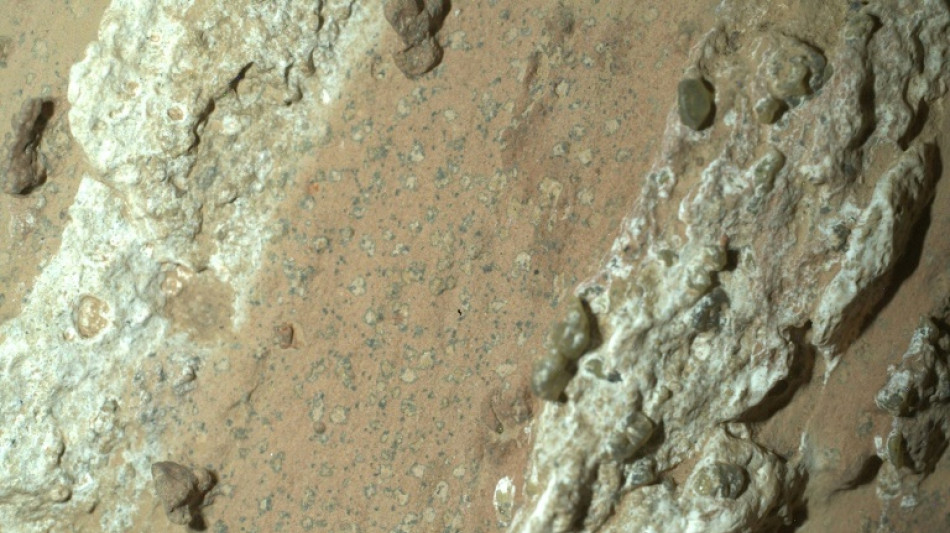
NASA Mars rover captures rock that could hold fossilized microbes
NASA Mars rover captures rock that could hold fossilized microbes / Photo: © NASA/JPL-Caltech/MSSS/AFP

NASA Mars rover captures rock that could hold fossilized microbes

NASA's Perseverance Mars rover has made what could be its most astonishing discovery to date: possible signs of ancient life on the Red Planet.

Text size:

The six-wheeled robotic explorer came across an intriguing, arrow-shaped rock dubbed "Cheyava Falls" that may harbor fossilized microbes from billions of years ago, when Mars was a watery world.

Perseverance drilled into the enigmatic rock to collect a core sample on July 21, as it traversed Neretva Vallis, an ancient river valley.

The samples carefully stowed beneath the rover's belly are destined to eventually return to Earth, where they will undergo more comprehensive analysis.

"Cheyava Falls is the most puzzling, complex, and potentially important rock yet investigated by Perseverance," project scientist Ken Farley of Caltech said Thursday.

Three compelling clues have scientists buzzing.

White calcium sulfate veins run the length of the rock, a telltale sign that water once flowed through it.

Between these veins is a reddish middle area, teeming with organic compounds, as detected by the rover's SHERLOC (Scanning Habitable Environments with Raman and Luminescence for Organics and Chemicals) instrument.

Finally, tiny off-white splotches ringed with black, reminiscent of leopard spots, contain chemicals that suggest energy sources for ancient microbes, according to scans by the PIXL (Planetary Instrument for X-ray Lithochemistry) instrument.

"On Earth, these types of features in rocks are often associated with the fossilized record of microbes living in the subsurface," said David Flannery, an astrobiologist and member of the Perseverance science team from the Queensland University of Technology in Australia.

The quest to confirm ancient Martian life is far from over, however.

The real test will come when Perseverance's precious rock samples are returned to Earth as part of the Mars Sample Return Program, a collaboration between NASA and the European Space Agency slated for the 2030s.

While there are alternative explanations for these findings that do not involve microbes, there is a tantalizing chance that Perseverance's core sample might contain actual fossilized microbes -- potentially making history as the first proof of life beyond Earth.

"We have zapped that rock with lasers and X-rays and imaged it literally day and night from just about every angle imaginable," said Farley.

"Scientifically, Perseverance has nothing more to give. To fully understand what really happened in that Martian river valley at Jezero Crater billions of years ago, we'd want to bring the Cheyava Falls sample back to Earth, so it can be studied with the powerful instruments available in laboratories."

X.Silva--TFWP