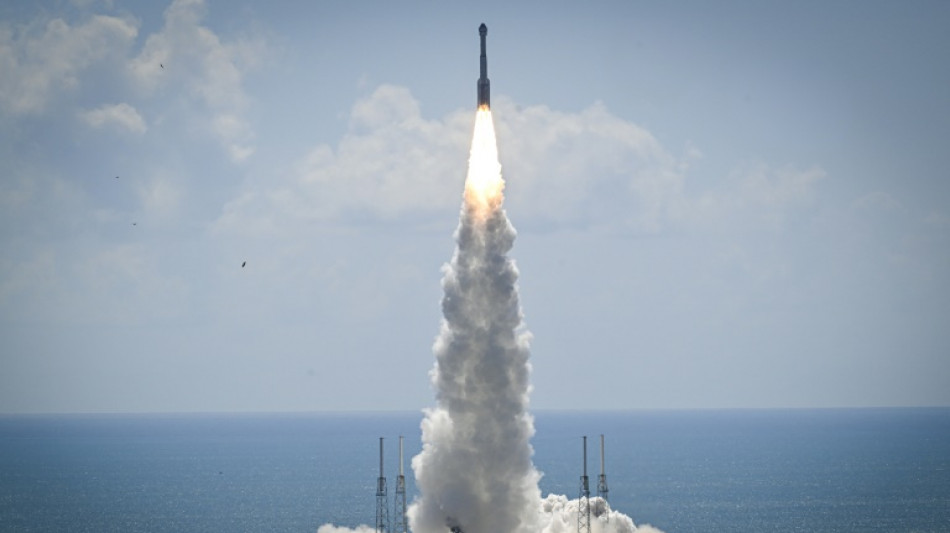
Liftoff, finally: Boeing Starliner launches first crew to space station / Photo: © AFP

Boeing on Wednesday launched its very first astronauts bound for the International Space Station aboard a Starliner capsule, which joins a select club of spacecraft to carry humans beyond Earth.
The third time turned out to be the charm for the aerospace giant, after two previous bids to fly were aborted with the crew strapped in and ready to go.
Astronauts Butch Wilmore and Suni Williams, both of whom have two previous spaceflights under their belts, blasted off at 10:52 am (1452 GMT) atop a United Launch Alliance Atlas V rocket from the Cape Canaveral Space Force Station in Florida.
Their Starliner, named "Calypso" after famed oceanographer Jacques Cousteau's ship, is now chasing the ISS in orbit. It should rendezvous with the research lab at 12:15 pm (1615 GMT) Sunday to begin a roughly one-week stay.
"Suni and I are honored to share this dream of spaceflight with each and every one of you," Wilmore, who is commander of the test flight, said just before liftoff. "Let's put some fire in this rocket, and let's push it to the heavens."
Starliner becomes just the sixth type of US-built spaceship to fly NASA astronauts, following the Mercury, Gemini and Apollo programs in the 1960s and 1970s, the Space Shuttle from 1981 to 2011, and SpaceX's Crew Dragon from 2020.
"This is another milestone in this extraordinary history of NASA," the space agency's chief Bill Nelson told reporters.
"And I want to give my personal congratulations to the whole team that went through a lot of trial and tribulation. But they had perseverance. And that's what we do at NASA, we don't launch until it's right."
- Boeing looks to turn a corner -
A successful mission will help dispel the bitter taste left by years of safety scares and delays, and provide Boeing a much-needed reprieve from the intense safety concerns surrounding its passenger jets.
"I think about over the years how many bad headlines I read about the Shuttle program, about the International Space Station -- and I look back now at how successful they were," said Mark Nappi, Boeing's vice president and program manager of Commercial Crew Program.
"Someday, we'll be looking back at this program the same way."
NASA meanwhile is seeking to certify Boeing as a second commercial operator to ferry crews to the ISS -- something Elon Musk's SpaceX has already been doing for the US space agency for four years.
Both companies received multibillion-dollar contracts in 2014 to develop their crew capsules, following the end of the Space Shuttle program that left the US temporarily reliant on Russian rockets for rides.
Boeing, with its 100-year history, was heavily favored, but its program fell badly behind.
Setbacks ranged from a software bug that put the spaceship on a bad trajectory on its first uncrewed test, to the discovery that the cabin was filled with flammable electrical tape after the second.
The first crewed launch attempt on May 6 was scuppered in the final hours due to a buzzy valve on the Atlas V rocket the capsule is fixed atop.
Saturday's launch attempt was even more dramatic, aborted with just minutes left on the countdown due to a ground launch computer issue.
- Put to the test -
Ex-Navy test pilots Wilmore and Williams are now charged with probing Starliner "from izzard to gizzard," in Nelson's words -- from piloting it manually, to tracking the stars around them to recover the spacecraft's orientation.
During their stay on the orbital outpost, they will continue to evaluate the spacecraft, including simulating whether the ship can be used as a safe haven in the event of problems.
NASA's Steve Stich said teams were monitoring just one issue so far: excessive water use in a spacecraft cooling system called a sublimator, but expected there was enough in reserve for a safe return.
After undocking from the ISS, Starliner will re-enter the atmosphere, with the crew experiencing 3.5G as they slow down from 17,500 miles per hour (28,000 kph) to a gentle parachute and airbag-assisted touchdown on land in the western United States.
J.M.Ellis--TFWP