Fortress Europe? The Nazi 'wall' that failed to prevent D-Day / Photo: © AFP

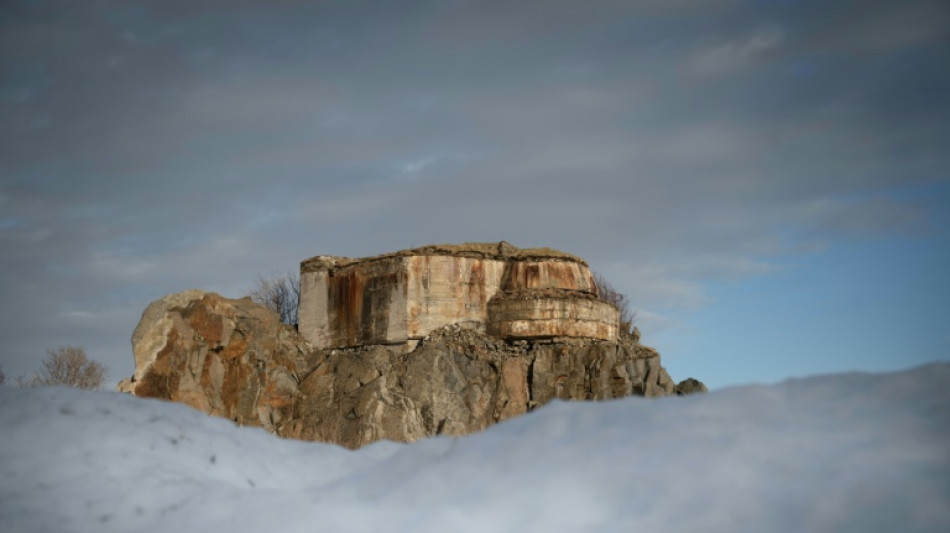
For the 80th D-Day landings anniversary, AFP travelled the coastlines from northern Norway to southern France to find out what became of the German-built Atlantic Wall defences aimed at keeping the Allies at bay.
Fearing an Allied invasion of occupied Europe, Adolf Hitler ordered in 1942 the building of a 5,000-kilometre (3,100-mile) coastal defence system studded with bunkers, gun emplacements, tank traps and other obstacles.
AFP photojournalist Olivier Morin spent three weeks documenting the remnants of the supposedly impregnable fortifications, which were breached by the Allies on D-Day.
Here is a brief recap of the wall:
- 300,000 labourers -
More than 20 million cubic metres of concrete and 1.2 million tonnes of steel went into building thousands of fortifications linked by barbed wire along the Atlantic and North Sea shores, from France through Belgium, the Netherlands and Denmark to Norway.
Over 300,000 workers of all nationalities worked on the French part alone, some of them prisoners press-ganged into labour but also hard-up people desperate for work, or German factory workers.
Entire communities were forced off their land to make way for Hitler's biggest defence project, which took over two years to build.
In the Dutch capital of Amsterdam, thousands of homes, seven schools, three churches and two hospitals were demolished in the name of defending "Fortress Europe".
- 'Hedgehogs' and 'asparagus' -
In 1944, with an Allied invasion appearing imminent, German Field Marshal Erwin Rommel was entrusted with boosting the defences.
The Allies had managed to dupe the Nazis into thinking that they were planning a landing on France's north coast, near Calais, which meant they had left long stretches of the coast wide open for invasion, including what would become the Normandy landing beaches.
Rommel rushed to station more than 2,000 tanks, assault cannons and tank destroyers along the Normandy coastline, including "Czech hedgehogs" -- spiky steel anti-tank obstacles -- and wooden poles nicknamed "Rommel's Asparagus" used to try to prevent gliders and paratroops from landing.
Over five million mines were planted along the beaches. But it was too little, too late.
- Breached within hours -
The Atlantic Wall proved woefully inadequate in the face of the planning that went into the D-Day landings of June 6, 1944.
That evening, 156,000 Allied soldiers punched a hole in the defences of 80,000 German soldiers.
The United States suffered heavy losses, especially on Omaha beach, where its soldiers found themselves trapped on the narrow strip beneath high cliffs of sand and stone.
Despite the challenges, the British, French, Americans and Canadians took just days to establish a beachhead in Normandy, which they used to land 800,000 troops and over 100,000 vehicles by the end of June.
Within 11 months, Germany had surrendered.
- Airbnb rentals -
Remnants of the Atlantic Wall remain scattered along the coast of Europe but many have been swallowed by the sand or sunk into the sea.
Some have been converted into museums, as at Batz-sur-Mer in France, Ostend in Belgium and Noordwijk in the Netherlands.
In the northern French city of Cherbourg, graffiti artists have transformed one bunker into a spaceship, while in the Brittany village of Saint-Pabu another has been renovated and turned into a Airbnb rental.
The Dutch government launched in 2014 an annual "Bunker Day" when the walls of the fortifications are thrown open to the public.
N.Patterson--TFWP