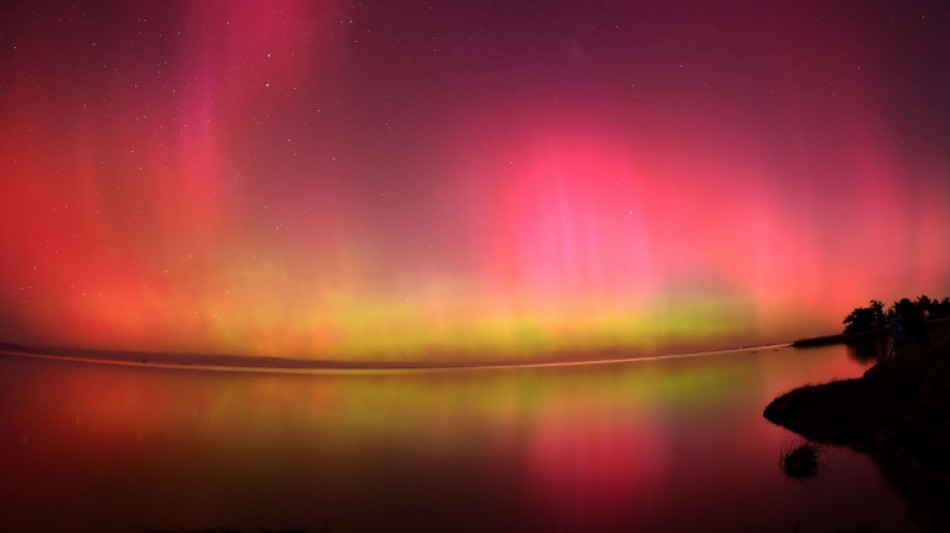
'Danger behind the beauty': more solar storms could be heading our way / Photo: © AFP/File

Tourists normally have to pay big money and brave cold climates for a chance to see an aurora, but last weekend many people around the world simply had to look up to see these colourful displays dance across the sky.
Usually banished to the poles of Earth, the auroras strayed as far as Mexico, southern Europe and South Africa on the evening of May 10, delighting skygazers and filling social media with images of exuberant pinks, greens and purples.
But for those charged with protecting Earth from powerful solar storms such as the one that caused the auroras, a threat lurks beneath the stunning colours.
"We need to understand that behind this beauty, there is danger," Quentin Verspieren, the European Space Agency's space safety programme coordinator, told AFP.
Mike Bettwy of the US Space Weather Prediction Center said that "we're focused on the more sinister potential impacts" of solar storms, such as taking out power grids and satellites, or exposing astronauts to dangerous levels of radiation.
The latest auroras were caused by the most powerful geomagnetic storm since the "Halloween Storms" of October 2003, which sparked blackouts in Sweden and damaged power infrastructure in South Africa.
There appears to have been less damage from the latest solar storms, though it often takes weeks for satellite companies to reveal problems, Bettwy said.
There were reports that some self-driving farm tractors in the United States stopped in their tracks when their GPS guidance systems went out due to the storm, he told AFP.
- 'Definitely not over' -
These strange effects are caused by massive explosions on the surface of the Sun that shoot out plasma, radiation and even magnetic fields at incredibly fast speeds born on the solar wind.
The recent activity has come from a sunspot cluster 17 times the size of Earth which has continued raging over the week. On Tuesday it blasted out the strongest solar flare seen in years.
The sunspot has been turning towards the edge of the Sun's disc, so activity is expected to die down in the short term as its outbursts aim away from our planet.
But in roughly two weeks the sunspot will swing back around, again turning its gaze towards Earth.
In the meantime, another sunspot is "coming into view right now" which could trigger "major activity in the coming days", ESA space weather service coordinator Alexi Glover told AFP.
So the solar activity is "definitely not over", she added.
It is difficult to predict how violent these sunspots could be -- or whether they could spark further auroras.
But solar activity is only just approaching the peak of its roughly 11-year cycle, so the odds of another major storm are highest "between now and the end of next year", Bettwy said.
- What threat do solar storms pose? -
Geomagnetic storms such as the recent one create a magnetic charge of voltage and current, "essentially overloading" things like satellites and power grids, according to Bettwy.
The most famous example came in 1859 during the worst solar storm in recorded history, called the Carrington Event.
As well as stunning auroras, the storm caused sparks to fly off of telegraph stations. The charge that originated from the Sun was so strong that some telegraphs worked without being plugged into a power source.
So what would happen if such a powerful geomagnetic storm struck Earth again?
Bettwy said most countries have improved their power grids, which should prevent prolonged outages like those that hit Sweden in 2003 or Canada in 1989.
Still, he suggested people have an emergency kit in case electricity is knocked out for a day or two. Fresh water might also help in case filtration plants go offline.
Astronauts are particularly at risk from radiation during extreme solar activity. Those on the International Space Station usually take the best shelter they can when a bad storm is expected.
Bettwy said a massive solar storm could expose astronauts to an "unhealthy dose" of radiation, but he did not think it would be lethal.
Emphasising that he did not want to "instil fear", Bettwy added that radiation can also potentially "get through the fuselage" of planes flying near the north pole.
Airlines sometimes change routes during extreme solar storms to avoid this happening, he added.
Several upcoming missions are expected to improve forecasting of the Sun's intense and unpredictable weather, aiming to give Earth more time to prepare.
T.M.Dan--TFWP