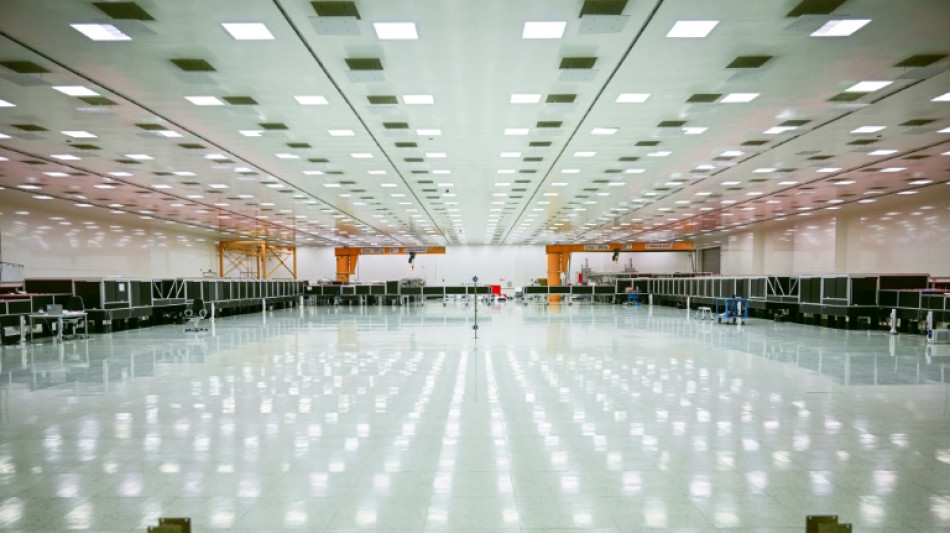
Romania centre explores world's most powerful laser / Photo: © AFP

"Ready? Signal sent!"
In the control room of a research centre in Romania, engineer Antonia Toma activates the world's most powerful laser, which promises revolutionary advances in everything from the health sector to space.
The laser at the centre, near the Romanian capital Bucharest, is operated by French company Thales, using Nobel prize-winning inventions.
France's Gerard Mourou and Donna Strickland of Canada won the 2018 Nobel Physics Prize for harnessing the power of lasers for advanced precision instruments in corrective eye surgery and in industry.
"The sharp beams of laser light have given us new opportunities for deepening our knowledge about the world and shaping it," said the Nobel Academy's citation.
At the centre, in front of a wall of screens displaying light beams, Toma checks a series of indicators before starting the countdown.
On the other side of the glass, long rows of red and black boxes house two laser systems.
"I will not lie. From time to time, things can get a little stressful," 29-year-old Toma told AFP during a recent on-site press visit.
"But it's also very joyful to work here. And we are very happy that we have results" as teams of international researchers come to the centre, she added.
- 'Incredible odyssey' -
Nobel prize winner Mourou confessed he was "very moved" by his "incredible odyssey" -- from the United States where he spent 30 years, to bringing this project to fruition in Europe.
It was born in the 2000s out of the European Union's Infrastructure ELI project.
"We start from a small luminous seed with very, very little energy, which will be amplified millions and millions of times," said Mourou, 79, trying to give a sense of the "huge step taken", the "phenomenal powers" achieved.
Scientists have always pushed to create more powerful lasers.
By the mid-1980s however, they had hit a wall, as they could not increase the power without destroying what was amplifying the beam.
That was when Mourou and his then-student Strickland invented a technique called Chirped-Pulse Amplification (CPA), which managed to boost power while keeping the intensity safe.
It works by stretching an ultra-short laser pulse in time, amplifying it, and squeezing it together again, creating the shortest and most intense laser pulses the world has ever seen.
Already it has been applied in corrective eye surgery, but it has also opened the way for scientists to continue pushing the boundaries of laser power.
"We will use these ultra-intense pulses to produce much more compact and less expensive particle accelerators" to destroy cancer cells, said Mourou.
- Age of the laser -
Other possible applications include treating nuclear waste by reducing the duration of its radioactivity, or cleaning up the debris accumulating out in space, he added.
For Mourou, just as the last century was that of the electron, the 21st century will be that of the laser.
The scale of the operation at the research centre is dizzying.
The system is capable of reaching a peak of 10 petawatts (10 to the power of 15 watts) for an ultra-short time, in the order of a femtosecond (one millionth of a billionth of a second).
It took "450 tons of equipment" -- carefully installed -- to get an "exceptional level of performance", said Franck Leibreich, laser solution managing director at Thales.
The high-tech building housing the centre cost 320 million euros ($350 million), mainly financed by the EU.
Thales bills it as the largest investment ever made in scientific research in Romania.
Meanwhile, countries including France, China and the United States are already advancing their own projects to manufacture even more powerful lasers.
J.Ayala--TFWP