The Fort Worth Press - Studying the otherworldly sounds in Antarctic waters

USD -
AED 3.672804
AFN 66.000368
ALL 82.403989
AMD 381.470403
ANG 1.790403
AOA 917.000367
ARS 1449.114041
AUD 1.51255
AWG 1.8025
AZN 1.70397
BAM 1.670125
BBD 2.014261
BDT 122.305906
BGN 1.668435
BHD 0.37702
BIF 2960
BMD 1
BND 1.292857
BOB 6.910715
BRL 5.541804
BSD 1.000043
BTN 89.605322
BWP 14.066863
BYN 2.939243
BYR 19600
BZD 2.01128
CAD 1.37996
CDF 2558.50392
CHF 0.79539
CLF 0.023202
CLP 910.203912
CNY 7.04095
CNH 7.034625
COP 3814.88
CRC 499.453496
CUC 1
CUP 26.5
CVE 94.450394
CZK 20.78625
DJF 177.720393
DKK 6.379075
DOP 62.603884
DZD 129.67604
EGP 47.595804
ERN 15
ETB 155.103874
EUR 0.85385
FJD 2.286504
FKP 0.746974
GBP 0.74763
GEL 2.68504
GGP 0.746974
GHS 11.48039
GIP 0.746974
GMD 73.000355
GNF 8686.000355
GTQ 7.663012
GYD 209.225672
HKD 7.78137
HNL 26.410388
HRK 6.432604
HTG 131.121643
HUF 329.91204
IDR 16700
ILS 3.20705
IMP 0.746974
INR 89.572904
IQD 1310
IRR 42100.000352
ISK 125.620386
JEP 0.746974
JMD 160.014687
JOD 0.70904
JPY 157.68204
KES 128.903801
KGS 87.450384
KHR 4011.00035
KMF 420.00035
KPW 899.985447
KRW 1475.995039
KWD 0.30721
KYD 0.83344
KZT 517.522287
LAK 21650.000349
LBP 89550.000349
LKR 309.628719
LRD 177.250382
LSL 16.760381
LTL 2.95274
LVL 0.60489
LYD 5.420381
MAD 9.155039
MDL 16.930526
MGA 4525.000347
MKD 52.553168
MMK 2099.831872
MNT 3551.409668
MOP 8.015336
MRU 39.740379
MUR 46.150378
MVR 15.450378
MWK 1737.000345
MXN 18.029265
MYR 4.077039
MZN 63.903729
NAD 16.760377
NGN 1460.750377
NIO 36.703722
NOK 10.13715
NPR 143.368515
NZD 1.736545
OMR 0.384499
PAB 1.000004
PEN 3.366039
PGK 4.257039
PHP 58.595038
PKR 280.303701
PLN 3.59056
PYG 6709.105581
QAR 3.641038
RON 4.344104
RSD 100.214294
RUB 80.501392
RWF 1456.129115
SAR 3.750876
SBD 8.146749
SCR 15.12369
SDG 601.503676
SEK 9.270704
SGD 1.292904
SHP 0.750259
SLE 24.050371
SLL 20969.503664
SOS 571.503662
SRD 38.441504
STD 20697.981008
STN 21.3
SVC 8.750043
SYP 11057.107339
SZL 16.760369
THB 31.403646
TJS 9.215425
TMT 3.5
TND 2.915038
TOP 2.40776
TRY 42.802204
TTD 6.787751
TWD 31.509504
TZS 2495.000335
UAH 42.285385
UGX 3577.131634
UYU 39.263238
UZS 12020.000334
VES 282.15965
VND 26312.5
VUV 121.400054
WST 2.789362
XAF 560.122791
XAG 0.014883
XAU 0.00023
XCD 2.70255
XCG 1.802353
XDR 0.695787
XOF 559.503593
XPF 102.250363
YER 238.403589
ZAR 16.773704
ZMK 9001.203584
ZMW 22.626123
ZWL 321.999592
  • RBGPF

    0.0000

    80.22

    0%

  • CMSC

    -0.1200

    23.17

    -0.52%

  • VOD

    0.0400

    12.84

    +0.31%

  • RYCEF

    0.2100

    15.61

    +1.35%

  • RIO

    0.6900

    78.32

    +0.88%

  • BP

    0.6300

    33.94

    +1.86%

  • GSK

    0.3200

    48.61

    +0.66%

  • BTI

    -0.5900

    56.45

    -1.05%

  • AZN

    0.7500

    91.36

    +0.82%

  • NGG

    -0.2800

    76.11

    -0.37%

  • SCS

    0.0200

    16.14

    +0.12%

  • RELX

    0.0800

    40.73

    +0.2%

  • CMSD

    -0.0300

    23.25

    -0.13%

  • JRI

    -0.0500

    13.38

    -0.37%

  • BCC

    -2.9300

    74.77

    -3.92%

  • BCE

    -0.0100

    22.84

    -0.04%

Studying the otherworldly sounds in Antarctic waters
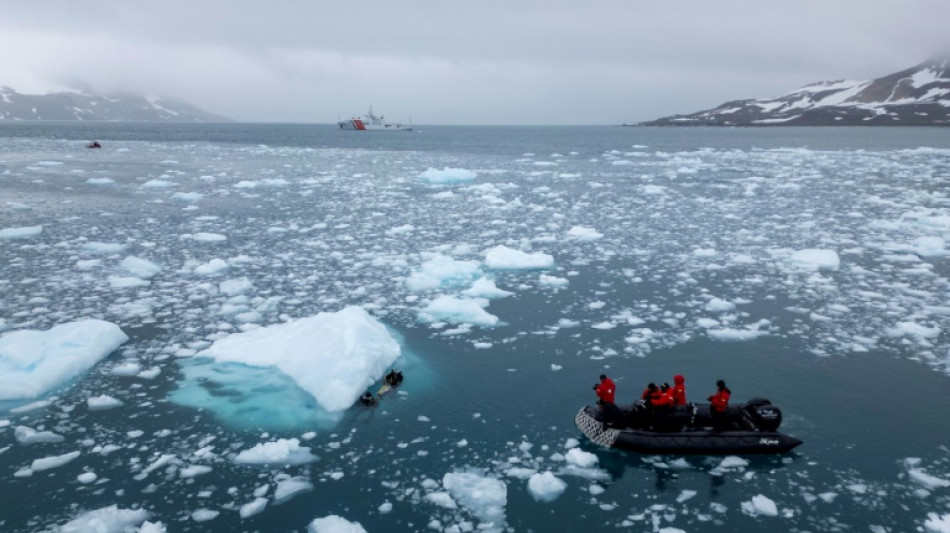
Studying the otherworldly sounds in Antarctic waters / Photo: © AFP

Studying the otherworldly sounds in Antarctic waters

In freezing Antarctic waters, amid bobbing chunks of floating ice, the hums, pitches and echoes of life in the deep are helping scientists understand the behavior and movements of marine mammals.

Text size:

"There are species which make impressive sounds, literally like Star Wars, they sound like spaceships," said Colombian scientist Andrea Bonilla, who is carrying out research with underwater microphones off Antarctica's coast.

The biologist from Cornell University in New York submerges a hydrophone covered in titanium and attached to a buoy, into the frigid water. The device is like a camera trap in the wild, except it picks up aquatic sounds.

Her team, part of a Colombian scientific expedition to the Southern Ocean, also picks up devices they left a year prior for analysis.

The research also gives scientists data on how human activity and environmental pollution affect sea life in one of the best conserved parts of the planet.

Nearby, a colony of penguins waddle along a giant block of floating ice.

A humpback whale comes to the surface for some air during a stint in the region for the austral summer -- a time for feeding and building up energy before their massive trek to warmer climes around the equator in the breeding season.

- 'Sound is essential' -

Bonilla describes the first time she heard whale song underwater as having "changed her life."

Scientists have warned that rising ocean temperatures are impacting whales' body clock and migration cycles, as well as killing off krill, the tiny crustaceans they need to fatten up for annual journeys of thousands of kilometers.

Whale communication has also been found to be impacted by noise at sea from shipping and other activity, which can disorient them.

"In a marine environment sound is essential," said Bonilla, adding that any interruption can affect some species ability to hunt.

Weddell seals and leopard seals also emit high-pitched songs in different tones and often harmonious compositions.

During their expedition the scientists install three underwater microphones, two in the Bransfield Strait and one in the Drake Passage.

The team also follows a set of coordinates to find the buoy left by Bonilla a year ago. When they are within 300 meters (1,000 feet) of it, she can send remote signals to find its exact location.

Her delighted teammates pat her on the back as she successfully retrieves the hydrophone from 500 meters deep.

"I am so excited because it was the first time we did this manuever in these waters. It all went super well," said Bonilla.

The scientist will use spectrograms -- a visual representation of sound -- to extract information not only about the movement of marine mammals, but also geophysics.

The hydrophones also capture low frequencies that can pick up the sounds of earthquakes or melting ice.

The research has another goal, supporting a proposal pushed by Chile and Argentina since 2012 to convert the Antarctic Peninsula into a protected marine area.

M.T.Smith--TFWP