The Fort Worth Press - Colombian mission to Antarctica analyzes climate change footprints

USD -
AED 3.672496
AFN 63.497922
ALL 81.990173
AMD 370.903715
ANG 1.789884
AOA 917.999977
ARS 1402.000105
AUD 1.394613
AWG 1.8025
AZN 1.696655
BAM 1.67146
BBD 2.014355
BDT 122.739548
BGN 1.668102
BHD 0.377399
BIF 2975
BMD 1
BND 1.275858
BOB 6.936925
BRL 4.985599
BSD 1.000128
BTN 95.070143
BWP 13.576443
BYN 2.828953
BYR 19600
BZD 2.011854
CAD 1.362151
CDF 2315.999874
CHF 0.784075
CLF 0.023178
CLP 912.219755
CNY 6.83025
CNH 6.83165
COP 3729.63
CRC 454.739685
CUC 1
CUP 26.5
CVE 94.649686
CZK 20.864803
DJF 177.720468
DKK 6.39024
DOP 59.603327
DZD 132.41735
EGP 53.5302
ERN 15
ETB 157.074999
EUR 0.855197
FJD 2.19835
FKP 0.736222
GBP 0.73895
GEL 2.685023
GGP 0.736222
GHS 11.195034
GIP 0.736222
GMD 73.497124
GNF 8777.50232
GTQ 7.643867
GYD 209.252937
HKD 7.833298
HNL 26.629715
HRK 6.443302
HTG 130.892468
HUF 312.104996
IDR 17389.95
ILS 2.943995
IMP 0.736222
INR 95.25965
IQD 1310
IRR 1315000.000455
ISK 122.630283
JEP 0.736222
JMD 157.565709
JOD 0.708981
JPY 157.213494
KES 129.180244
KGS 87.420504
KHR 4011.999662
KMF 420.496617
KPW 899.999998
KRW 1477.330179
KWD 0.30802
KYD 0.833593
KZT 463.980036
LAK 21962.455345
LBP 89401.229103
LKR 319.60688
LRD 183.625005
LSL 16.830299
LTL 2.95274
LVL 0.60489
LYD 6.335061
MAD 9.246977
MDL 17.22053
MGA 4155.000186
MKD 52.712151
MMK 2099.74975
MNT 3576.675528
MOP 8.070745
MRU 39.950066
MUR 46.759565
MVR 15.454978
MWK 1741.499275
MXN 17.515402
MYR 3.961988
MZN 63.910277
NAD 16.83002
NGN 1370.929908
NIO 36.719442
NOK 9.274995
NPR 152.110449
NZD 1.702665
OMR 0.384503
PAB 1.000329
PEN 3.506024
PGK 4.332504
PHP 61.789759
PKR 278.749897
PLN 3.64225
PYG 6218.192229
QAR 3.643026
RON 4.440969
RSD 100.395981
RUB 75.000791
RWF 1460.5
SAR 3.752195
SBD 8.025868
SCR 13.730136
SDG 600.509134
SEK 9.292965
SGD 1.276801
SHP 0.746601
SLE 24.650183
SLL 20969.496166
SOS 571.500819
SRD 37.455995
STD 20697.981008
STN 21.15
SVC 8.752948
SYP 110.524984
SZL 16.829985
THB 32.729749
TJS 9.363182
TMT 3.505
TND 2.885499
TOP 2.40776
TRY 45.216302
TTD 6.794204
TWD 31.677017
TZS 2594.999722
UAH 44.075497
UGX 3753.577989
UYU 40.286638
UZS 11998.00019
VES 488.94275
VND 26339.5
VUV 118.778782
WST 2.715188
XAF 560.591908
XAG 0.013731
XAU 0.000221
XCD 2.70255
XCG 1.8029
XDR 0.69563
XOF 558.499323
XPF 102.374992
YER 238.625007
ZAR 16.790105
ZMK 9001.194926
ZMW 18.731492
ZWL 321.999592
  • RBGPF

    0.5000

    63.1

    +0.79%

  • BCE

    -0.0300

    23.93

    -0.13%

  • CMSC

    -0.0100

    22.87

    -0.04%

  • AZN

    -1.2800

    183.46

    -0.7%

  • RELX

    0.0100

    36.36

    +0.03%

  • NGG

    -0.9800

    87.5

    -1.12%

  • BP

    0.5300

    46.94

    +1.13%

  • GSK

    -0.7100

    50.9

    -1.39%

  • BTI

    -0.3600

    58.35

    -0.62%

  • RIO

    -1.9500

    98.63

    -1.98%

  • RYCEF

    -0.3000

    16

    -1.88%

  • JRI

    -0.0500

    12.93

    -0.39%

  • CMSD

    -0.0300

    23.25

    -0.13%

  • BCC

    -3.8000

    74.33

    -5.11%

  • VOD

    -0.1000

    16.05

    -0.62%

Colombian mission to Antarctica analyzes climate change footprints
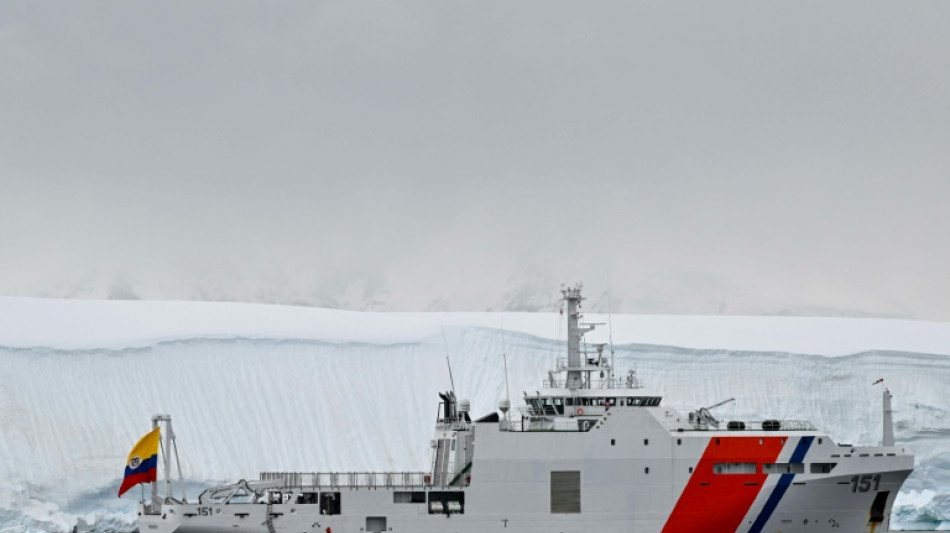
Colombian mission to Antarctica analyzes climate change footprints / Photo: © AFP

Colombian mission to Antarctica analyzes climate change footprints

Colombia's 10th Antarctic Expedition is making its way to the far reaches of the continent, exploring remote and almost untouched places inhabited by penguins, whales and the occasional seal.

Text size:

The Colombian Navy's ARC Simon Bolivar is taking aquatic samples in Antarctica and advancing scientific research on climate change amid huge blocks of ice and frost.

"Antarctica is the world's refrigerator," Pablo Araujo, a researcher at the Central University of Ecuador, told AFP on board the ship, which is home to 39 researchers, 11 Colombian projects and nine international cooperation projects with four countries.

"What we want to see is how climate change is affecting the world's refrigerator and how that affects the whole quantity of nutrients (in the sea)," says the white-coated scientist.

On board the ship, the Ecuadoran researcher is carrying out a project to model Antarctic ecosystems using machine learning techniques, a branch of artificial intelligence focused on the study of statistical algorithms.

With the application of these models and the use of satellite images, researchers are studying the dynamics of greenhouse gas fluxes in Antarctic ecosystems.

One Colombian team is launching a battery of Niskin bottles, used to take water samples, into the ocean.

"Once (they) come to the surface, we proceed to take these samples for later analysis," said Alexis Grattz, a researcher from the Directorate General of Maritime Affairs, wearing a thick red mackintosh, gloves and a hat.

At the Ecuadoran scientific station, located at Punta Fort Williams on Greenwich Island, the maritime authority installed a portable weather station to record atmospheric pressure oscillations in the area.

These measurements are taken to "determine and help us understand more about these variations in sea level, understanding it as... an important indicator in the evolution of climate change," said Maritza Moreno, another researcher at the Directorate General of Maritime Affairs.

A Turkish mission, meanwhile, is studying the levels of polycyclic aromatic hydrocarbons (PAHs) -- which result from burning fossil fuels, wood, trash and tobacco -- in Antarctic soil.

Burak Karacik, a professor at Istanbul Technical University, said he is collecting sediment samples.

"I will analyze these sediment samples for persistent organic pollutants, and we will look at the effects of humans, here, in this environment," he added.

N.Patterson--TFWP