The Fort Worth Press - NASA begins critical final test on mega Moon rocket

USD -
AED 3.672504
AFN 66.000368
ALL 81.003771
AMD 364.66866
AOA 918.000367
ARS 1485.695228
AUD 1.430206
AWG 1.8
AZN 1.70397
BAM 1.695315
BBD 2.008061
BDT 123.113596
BHD 0.375937
BIF 2958.60963
BMD 1
BND 1.279591
BOB 11.838946
BRL 5.080504
BSD 0.997009
BTN 95.046158
BWP 13.594244
BYN 2.900273
BYR 19600
BZD 2.005201
CAD 1.40195
CDF 2275.000362
CHF 0.807714
CLF 0.023563
CLP 930.403912
CNY 6.751304
CNH 6.753015
COP 3166.44
CRC 452.823647
CUC 1
CUP 26.5
CVE 95.579248
CZK 21.012104
DJF 177.540849
DKK 6.48427
DOP 57.8425
DZD 132.884324
EGP 51.156763
ERN 15
ETB 159.322411
EUR 0.866804
FJD 2.21395
FKP 0.742527
GBP 0.741702
GEL 2.61504
GGP 0.742527
GHS 11.655181
GIP 0.742527
GMD 73.503851
GNF 8752.221211
GTQ 7.60716
GYD 208.555454
HKD 7.842204
HNL 26.714341
HRK 6.534304
HTG 130.360161
HUF 316.550388
IDR 18029
ILS 3.06295
IMP 0.742527
INR 95.390504
IQD 1306.115373
IRR 1375125.000352
ISK 123.140386
JEP 0.742527
JMD 157.838166
JOD 0.70904
JPY 157.43504
KES 128.964591
KGS 87.450384
KHR 4040.00035
KMF 427.00035
KRW 1442.960383
KWD 0.30914
KYD 0.830841
KZT 472.43098
LAK 22578.771725
LBP 89284.705067
LKR 334.694231
LRD 179.95926
LSL 16.490877
LTL 2.95274
LVL 0.60489
LYD 6.378884
MAD 9.313657
MDL 17.422962
MGA 4263.858189
MKD 53.330733
MMK 2099.706665
MNT 3595.091393
MOP 8.054349
MRU 40.069345
MUR 47.000345
MVR 15.460378
MWK 1728.773892
MXN 17.347504
MYR 4.085204
MZN 63.910377
NAD 16.490877
NGN 1364.360377
NIO 36.692238
NOK 9.471104
NPR 152.073853
NZD 1.700247
OMR 0.384553
PAB 0.997009
PEN 3.378841
PGK 4.464092
PHP 61.255038
PKR 276.891432
PLN 3.73795
PYG 5944.610584
QAR 3.644606
RON 4.548604
RSD 101.848038
RUB 79.263208
RWF 1463.615481
SAR 3.745176
SBD 8.081105
SCR 13.507563
SDG 600.000339
SEK 9.522704
SGD 1.282604
SLE 24.703667
SOS 569.756859
SRD 37.781504
STD 20697.981008
STN 21.236944
SVC 8.723616
SZL 16.488536
THB 33.525038
TJS 9.202271
TMT 3.51
TND 2.930958
TRY 47.512504
TTD 6.769818
TWD 32.309104
TZS 2642.013038
UAH 44.499112
UGX 3743.769774
UYU 40.116153
UZS 11934.295497
VES 745.696404
VND 26300.5
VUV 119.309562
WST 2.734517
XAF 568.592727
XAG 0.017363
XAU 0.000247
XCD 2.70255
XCG 1.796819
XDR 0.707147
XOF 568.592727
XPF 103.376241
YER 238.303589
ZAR 16.55773
ZMK 9001.203584
ZMW 18.728384
ZWL 321.999592
  • CMSC

    0.0300

    21.84

    +0.14%

  • BCE

    -0.0200

    21.68

    -0.09%

  • BCC

    1.0000

    76.38

    +1.31%

  • RIO

    -0.3300

    96.85

    -0.34%

  • RELX

    -1.1900

    35.42

    -3.36%

  • JRI

    0.0900

    12.96

    +0.69%

  • NGG

    -0.4200

    79.97

    -0.53%

  • RBGPF

    0.0000

    69.21

    0%

  • RYCEF

    -0.3100

    19.55

    -1.59%

  • CMSD

    0.0900

    22.11

    +0.41%

  • VOD

    -0.3600

    15.78

    -2.28%

  • BTI

    -1.0400

    60.65

    -1.71%

  • AZN

    -1.7000

    169.64

    -1%

  • GSK

    -0.3800

    51.69

    -0.74%

  • BP

    1.0000

    45.22

    +2.21%

NASA begins critical final test on mega Moon rocket


NASA begins critical final test on mega Moon rocket

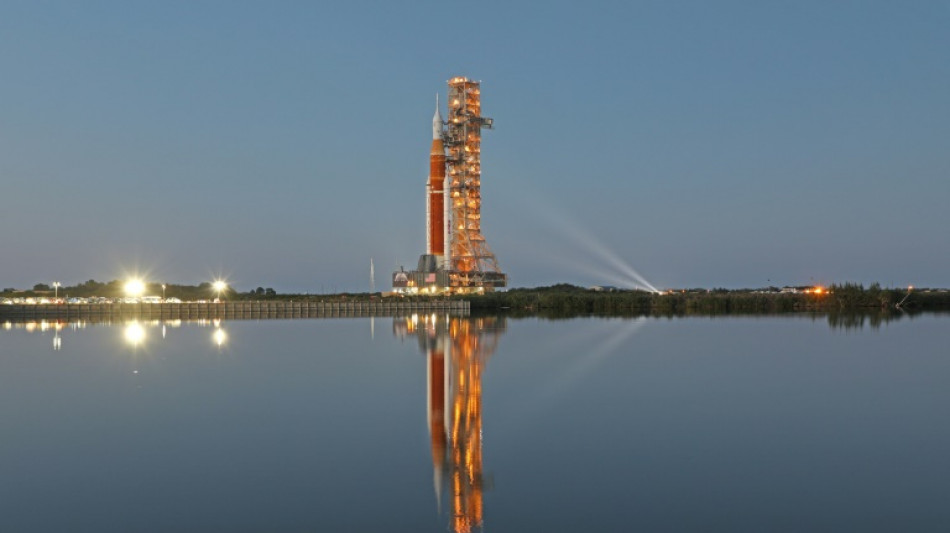
NASA on Friday begins a critical two-day-long test of its giant Space Launch System (SLS) rocket complete with a mock countdown, as the agency gears up to return humans to the Moon.

Text size:

Known as the "wet dress rehearsal," it is the final major test before the Artemis-1 mission this summer: an uncrewed lunar flight that will eventually be followed by boots on the ground, likely no sooner than 2026.

"It is our last design verification prior to our launch," senior NASA official Tom Whitmeyer said in a call with reporters this week.

Data collected from the test will be used to finalize a date for Artemis-1 -- NASA had said May could be the first window, but later now seems likely.

It is called a "wet" dress rehearsal because super-cooled liquid hydrogen and liquid oxygen will be loaded into SLS from ground systems, just as they would be in a real launch.

The 322 feet (98 meters) tall rocket -- expected to be the most powerful in history at the time it is operational -- was rolled out to Launch Complex 39B at the Kennedy Space Center in Florida around two weeks ago.

The test begins at 5:00 pm Eastern Time (2100 GMT) with a "call to stations," as members of the launch control team arrive at their firing rooms and start a countdown of more than 45 hours.

With the SLS rocket and Orion crew capsule fixed on top powered on, teams will proceed to load 700,000 gallons (3.2 million liters) of propellant, and practice procedures such as pauses in countdown and other checks.

They won't actually ignite the rocket's RS-25 engines, which were tested previously. Instead they will halt the countdown about 10 seconds before liftoff, in order to simulate a "scrub," when launch is aborted due to technical or weather related issues.

The fuel will be drained, and a few days later SLS and Orion will be rolled back to the vehicle assembly building to carry out checks on how everything went.

Test milestones will be posted on NASA's blog for the Artemis mission, but the agency won't let the public listen to live internal audio, as it did in the past for Space Shuttle missions.

Whitmeyer explained this was because certain key information, including timing sequences, could assist other countries looking to develop long range missiles.

"We're really, really super sensitive to cryogenic launch vehicles that are of this size and capability, (and) are very analogous to ballistic type capabilities that our countries are very interested in," he said, but added that the agency could re-evaluate the position in future.

D.Ford--TFWP