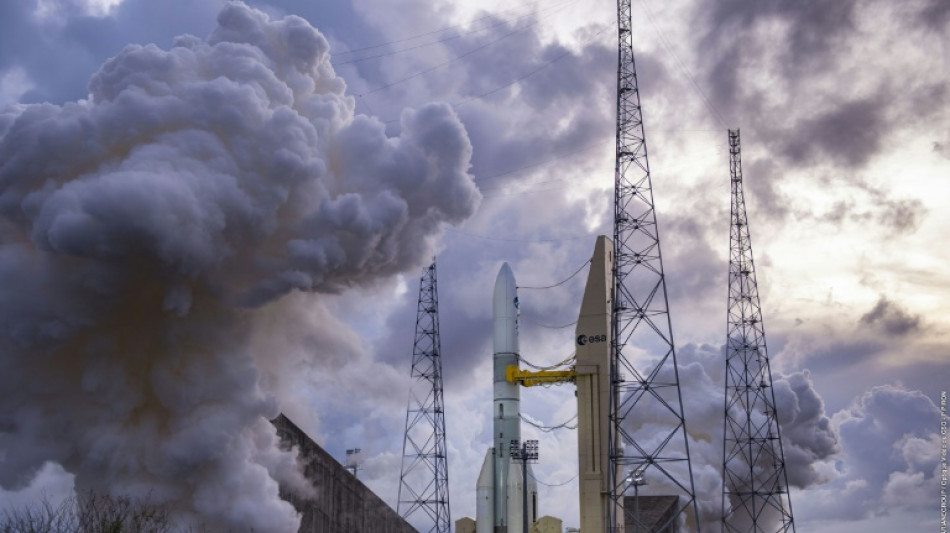
New rockets set to launch in 2024 / Photo: © ArianeGroup/AFP/File

Several new European and American rockets are set for blast off in 2024, at a time the aerospace industry faces a shortage of launch vehicles fueled by the rise of satellite constellations.
Here are the maiden flights space watchers can look forward to next year.
- Countdown for Ariane 6 -
The Ariane 6 rocket, which carries Europe's hopes for space autonomy from the United States and Russia, is set to make its inaugural voyage between June 15 and July 31, after four years of delays due to the pandemic and other difficulties.
The project was launched in 2014 in response to the rise of SpaceX's Falcon 9. Building on Ariane 5, Ariane 6 should be half as expensive as its predecessor thanks to new production methods.
With a planned 28 launches even before its first flight, the rocket, available in two versions, will carry payloads to both geostationary orbit (11.5 metric tons) and low Earth orbit (21.6 metric tons), using reignitable upper-stage engines.
Once launched, the challenge for Ariane Group will be to successfully ramp up its output. "It is a real industrial challenge to go from building two to nine launchers per year," said executive president Martin Sion.
- End of limbo for Vega C? -
Banned from flying since December 2022 after the failure of its first commercial flight, the Vega C rocket manufactured by Italian space company Avio, is supposed to launch again in the fourth quarter, according to the European Space Agency (ESA).
The unavailability of Europe's premier small rocket forced the ESA to rely on the US company SpaceX to launch several European scientific and GPS satellites.
The accident was caused by the failure of a rocket motor nozzle, forcing a redesign.
- Ambitious missions for Vulcan Centaur -
United Launch Alliance (ULA), a joint venture between Boeing and Lockheed Martin, has developed the Vulcan Centaur rocket to replace its Atlas V and Delta IV launch vehicles.
After getting past the first few flights, ULA will begin recovering and reusing the first stage boosters.
This and other innovations make the Vulcan platform "much more affordable" than its predecessors, ULA CEO Tory Bruno told AFP.
Vulcan Centaur will be able to carry up to 27.2 metric tons into low Earth orbit, comparable to Falcon 9. The first launch of Vulcan Centaur is scheduled for early January. This ambitious mission will carry a private lunar lander which could become the first American spacecraft to land on the Moon since the end of the Apollo program.
A second mission, which will carry Sierra Space's new "Dream Chaser" spacecraft, is planned for the second quarter of 2024. This mini-space shuttle will be responsible in particular for resupplying the International Space Station.
- New Starship tests -
SpaceX will continue to test its Starship mega-rocket in 2024, after the first two flights in its fully-integrated configuration ended in them blowing up. SpaceX has insisted that explosions during the early stages of rocket development are welcome and help inform design choices faster.
Starship is both the largest and most powerful rocket ever built, standing 397 feet (121 meters) tall.
Its development is being closely scrutinized by NASA, which has contracted a version of Starship as a lunar lander for its Artemis missions to the Moon.
In the second voyage, the two stages of the rocket successfully separated before exploding -- and didn't cause massive damage to the launchpad.
SpaceX boss Elon Musk predicted the next launch could take place in weeks, but he's known for his optimistic forecasts, and the next flight won't take place until there's a greenlight from the Federal Aviation Administration.
- Big debut for New Glenn? -
Blue Origin already flies tourists to space on short hops carried out by its New Shepard suborbital rocket. But the company headed by Jeff Bezos is also working on a bigger rocket, New Glenn, which at 98 meters tall will be able to carry payloads of 45 metric tons to low Earth orbit.
That's more than double that of Falcon 9, but still less than SpaceX's Falcon Heavy, which manages 63.8 metric tons.
"We expect to fly in 2024," a spokesperson told AFP.
One of the first flights will launch the NASA probe EscaPADE on a mission to study the magnetosphere of Mars.
New Glenn is also an essential element of the lunar landing system ordered by NASA for the Artemis 5 lunar mission.
H.M.Hernandez--TFWP