The Fort Worth Press - Japanese experimental nuclear fusion reactor inaugurated

USD -
AED 3.67325
AFN 62.999762
ALL 83.000036
AMD 377.497895
ANG 1.790083
AOA 917.000245
ARS 1395.024201
AUD 1.410517
AWG 1.8025
AZN 1.705074
BAM 1.704371
BBD 2.014946
BDT 122.754882
BGN 1.709309
BHD 0.377549
BIF 2970
BMD 1
BND 1.283525
BOB 6.913501
BRL 5.222398
BSD 1.000436
BTN 93.206388
BWP 13.651833
BYN 3.093542
BYR 19600
BZD 2.012088
CAD 1.37365
CDF 2275.000229
CHF 0.788201
CLF 0.023113
CLP 912.630163
CNY 6.90045
CNH 6.879945
COP 3694.49
CRC 468.079358
CUC 1
CUP 26.5
CVE 97.050199
CZK 21.129799
DJF 177.720433
DKK 6.44712
DOP 58.824981
DZD 132.250059
EGP 52.230699
ERN 15
ETB 157.178124
EUR 0.8627
FJD 2.207602
FKP 0.750673
GBP 0.74438
GEL 2.715001
GGP 0.750673
GHS 10.904939
GIP 0.750673
GMD 73.999737
GNF 8777.520298
GTQ 7.652926
GYD 209.305771
HKD 7.83415
HNL 26.569408
HRK 6.501702
HTG 131.227832
HUF 337.265023
IDR 16879.25
ILS 3.12734
IMP 0.750673
INR 93.11955
IQD 1310
IRR 1315124.999983
ISK 124.090259
JEP 0.750673
JMD 157.168937
JOD 0.708977
JPY 157.726002
KES 129.597209
KGS 87.447894
KHR 4010.000131
KMF 428.000281
KPW 899.987979
KRW 1490.860217
KWD 0.30618
KYD 0.833751
KZT 481.121429
LAK 21475.000295
LBP 89549.999965
LKR 311.846652
LRD 183.403468
LSL 16.830535
LTL 2.95274
LVL 0.60489
LYD 6.380059
MAD 9.35875
MDL 17.532561
MGA 4164.999945
MKD 53.364671
MMK 2099.739449
MNT 3585.842291
MOP 8.07209
MRU 40.109918
MUR 46.504975
MVR 15.450384
MWK 1736.999889
MXN 17.720499
MYR 3.939032
MZN 63.897936
NAD 16.830128
NGN 1357.499912
NIO 36.719703
NOK 9.483896
NPR 149.125498
NZD 1.700598
OMR 0.384509
PAB 1.000471
PEN 3.454498
PGK 4.30206
PHP 59.035961
PKR 279.149821
PLN 3.68307
PYG 6500.777741
QAR 3.644599
RON 4.396012
RSD 101.351007
RUB 86.153448
RWF 1459
SAR 3.754419
SBD 8.048583
SCR 15.185997
SDG 600.999576
SEK 9.290701
SGD 1.277602
SHP 0.750259
SLE 24.650213
SLL 20969.510825
SOS 571.501827
SRD 37.501992
STD 20697.981008
STN 21.5
SVC 8.753927
SYP 110.528765
SZL 16.829774
THB 32.459803
TJS 9.579415
TMT 3.5
TND 2.91125
TOP 2.40776
TRY 44.275902
TTD 6.781035
TWD 31.791502
TZS 2597.497632
UAH 43.994632
UGX 3781.362476
UYU 40.523406
UZS 12195.000296
VES 454.68563
VND 26290
VUV 119.408419
WST 2.73222
XAF 571.660014
XAG 0.013727
XAU 0.000215
XCD 2.70255
XCG 1.803034
XDR 0.710959
XOF 571.50261
XPF 103.578349
YER 238.549896
ZAR 16.747503
ZMK 9001.201274
ZMW 19.584125
ZWL 321.999592
  • CMSC

    0.0200

    22.85

    +0.09%

  • RYCEF

    -0.5900

    16.01

    -3.69%

  • BCE

    -0.0200

    25.73

    -0.08%

  • RBGPF

    -13.5000

    69

    -19.57%

  • NGG

    -1.8700

    85.53

    -2.19%

  • CMSD

    0.0100

    22.9

    +0.04%

  • GSK

    0.3100

    52.37

    +0.59%

  • BTI

    0.6300

    58.72

    +1.07%

  • RELX

    -0.0400

    33.82

    -0.12%

  • RIO

    -2.0700

    85.65

    -2.42%

  • VOD

    0.0500

    14.42

    +0.35%

  • BCC

    -1.9800

    69.86

    -2.83%

  • JRI

    -0.1630

    12.16

    -1.34%

  • AZN

    0.5100

    188.93

    +0.27%

  • BP

    1.2500

    45.86

    +2.73%

Japanese experimental nuclear fusion reactor inaugurated
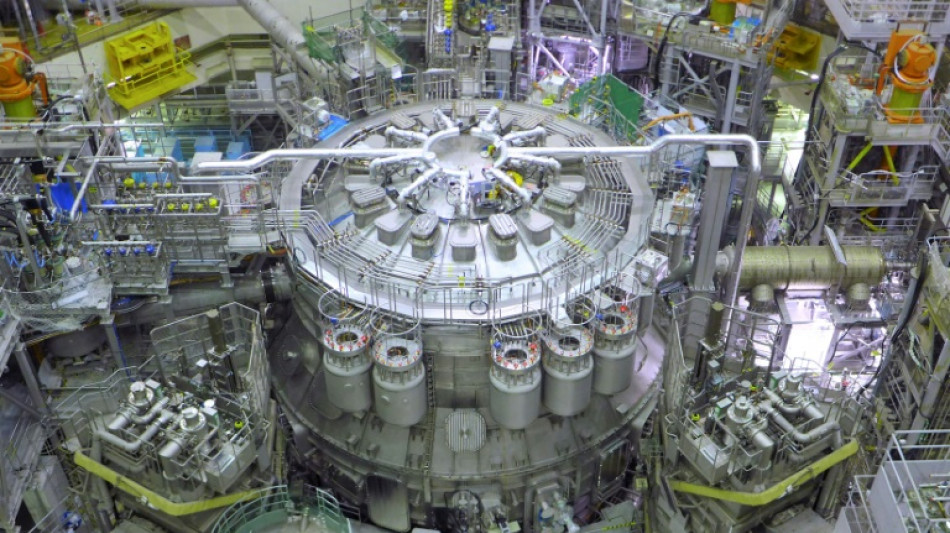
Japanese experimental nuclear fusion reactor inaugurated / Photo: © National Institutes for Quantum Science and Technology (QST)/AFP

Japanese experimental nuclear fusion reactor inaugurated

The world's biggest experimental nuclear fusion reactor in operation was inaugurated in Japan on Friday, a technology in its infancy but billed by some as the answer to humanity's future energy needs.

Text size:

Fusion differs from fission, the technique currently used in nuclear power plants, by fusing two atomic nuclei instead of splitting one.

The goal of the JT-60SA reactor is to investigate the feasibility of fusion as a safe, large-scale and carbon-free source of net energy -- with more energy generated than is put into producing it.

The six-storey-high machine, in a hangar in Naka north of Tokyo, comprises a donut-shaped "tokamak" vessel set to contain swirling plasma heated up 200 million degrees Celsius (360 million degrees Fahrenheit).

It is a joint project between the European Union and Japan, and is the forerunner for its big brother in France, the under-construction International Thermonuclear Experimental Reactor (ITER).

The ultimate aim of both projects is to coax hydrogen nuclei inside to fuse into one heavier element, helium, releasing energy in the form of light and heat, and mimicking the process that takes place inside the Sun.

Researchers at ITER, which is over budget, behind schedule and facing major technical problems, hope to achieve nuclear fusion technology's holy grail, net energy.

Sam Davis, deputy project leader for the JT-60SA, said the device will "bring us closer to fusion energy".

"It's the result of a collaboration between more than 500 scientists and engineers and more than 70 companies throughout Europe and Japan," Davis said at Friday's inauguration.

EU energy commissioner Kadri Simson said the JT-60SA was "the most advanced tokamak in the world", calling the start of operations "a milestone for fusion history".

"Fusion has the potential to become a key component for energy mix in the second half of this century," Simson added.

The feat of "net energy gain" was managed last December at the National Ignition Facility at Lawrence Livermore National Laboratory in the United States, home to the world's largest laser.

The US facility uses a different method to ITER and the JT-60SA known as inertial confinement fusion, in which high-energy lasers are directed simultaneously into a thimble-sized cylinder containing hydrogen.

The US government called the result a "landmark achievement" in the quest for a source of unlimited, clean power and an end to reliance on carbon-emitting fossil fuels that cause climate change as well as geopolitical upheaval.

Unlike fission, fusion carries no risk of catastrophic nuclear accidents -- like that seen in Fukushima in Japan in 2011 -- and produces far less radioactive waste than current power plants, its exponents say.

P.Navarro--TFWP