The Fort Worth Press - Russian ISS segment springs third leak in under a year

USD -
AED 3.6725
AFN 66.163223
ALL 82.178011
AMD 380.793362
ANG 1.790403
AOA 916.999634
ARS 1450.743899
AUD 1.515381
AWG 1.8025
AZN 1.699323
BAM 1.66612
BBD 2.009004
BDT 121.89647
BGN 1.66619
BHD 0.377045
BIF 2948.778015
BMD 1
BND 1.289026
BOB 6.892615
BRL 5.520101
BSD 0.997432
BTN 90.213099
BWP 13.173867
BYN 2.945358
BYR 19600
BZD 2.006108
CAD 1.378425
CDF 2264.999799
CHF 0.795305
CLF 0.023399
CLP 917.9198
CNY 7.04325
CNH 7.03778
COP 3865.5
CRC 496.969542
CUC 1
CUP 26.5
CVE 93.933289
CZK 20.773301
DJF 177.619334
DKK 6.36324
DOP 62.781377
DZD 129.458021
EGP 47.597403
ERN 15
ETB 155.065976
EUR 0.851703
FJD 2.28425
FKP 0.744905
GBP 0.747885
GEL 2.695005
GGP 0.744905
GHS 11.4911
GIP 0.744905
GMD 73.49576
GNF 8720.392873
GTQ 7.63972
GYD 208.695208
HKD 7.780065
HNL 26.279698
HRK 6.417902
HTG 130.648857
HUF 331.358971
IDR 16716.95
ILS 3.229895
IMP 0.744905
INR 90.37765
IQD 1306.658943
IRR 42109.999343
ISK 126.040163
JEP 0.744905
JMD 159.602697
JOD 0.708991
JPY 155.7155
KES 128.580005
KGS 87.449659
KHR 3995.195543
KMF 418.999623
KPW 900.011412
KRW 1478.040242
KWD 0.30678
KYD 0.831243
KZT 513.04833
LAK 21605.574533
LBP 89322.26491
LKR 308.916356
LRD 176.553522
LSL 16.705284
LTL 2.95274
LVL 0.60489
LYD 5.408398
MAD 9.140319
MDL 16.831784
MGA 4506.288786
MKD 52.427838
MMK 2100.219412
MNT 3548.424678
MOP 7.992265
MRU 39.658749
MUR 46.049669
MVR 15.450032
MWK 1729.597117
MXN 18.016702
MYR 4.090504
MZN 63.895554
NAD 16.705355
NGN 1453.250291
NIO 36.706235
NOK 10.212605
NPR 144.335596
NZD 1.733865
OMR 0.384502
PAB 0.997474
PEN 3.360253
PGK 4.241363
PHP 58.604987
PKR 279.486334
PLN 3.588735
PYG 6699.803648
QAR 3.636364
RON 4.337398
RSD 99.984005
RUB 80.501386
RWF 1452.319802
SAR 3.750857
SBD 8.130216
SCR 13.4583
SDG 601.510374
SEK 9.298405
SGD 1.29206
SHP 0.750259
SLE 24.103806
SLL 20969.503664
SOS 569.036089
SRD 38.678017
STD 20697.981008
STN 20.870336
SVC 8.728097
SYP 11057.156336
SZL 16.70138
THB 31.495502
TJS 9.206851
TMT 3.5
TND 2.911152
TOP 2.40776
TRY 42.733299
TTD 6.766306
TWD 31.549502
TZS 2468.950971
UAH 42.336966
UGX 3555.775153
UYU 38.863072
UZS 12075.031306
VES 276.231204
VND 26337.5
VUV 121.327724
WST 2.791029
XAF 558.777254
XAG 0.015066
XAU 0.000231
XCD 2.70255
XCG 1.797668
XDR 0.69494
XOF 558.777254
XPF 101.59601
YER 238.350235
ZAR 16.77865
ZMK 9001.201998
ZMW 22.866221
ZWL 321.999592
  • SCS

    0.0200

    16.14

    +0.12%

  • RBGPF

    -1.7900

    80.22

    -2.23%

  • RYCEF

    0.2200

    14.86

    +1.48%

  • BCC

    0.4500

    76.29

    +0.59%

  • CMSC

    -0.0800

    23.26

    -0.34%

  • CMSD

    -0.1000

    23.28

    -0.43%

  • NGG

    1.3900

    77.16

    +1.8%

  • RELX

    -0.2600

    40.56

    -0.64%

  • VOD

    0.1100

    12.81

    +0.86%

  • RIO

    1.2000

    77.19

    +1.55%

  • BCE

    -0.1800

    23.15

    -0.78%

  • JRI

    -0.0800

    13.43

    -0.6%

  • BTI

    -0.1200

    57.17

    -0.21%

  • GSK

    -0.0700

    48.71

    -0.14%

  • AZN

    -1.4900

    89.86

    -1.66%

  • BP

    0.7100

    34.47

    +2.06%

Russian ISS segment springs third leak in under a year
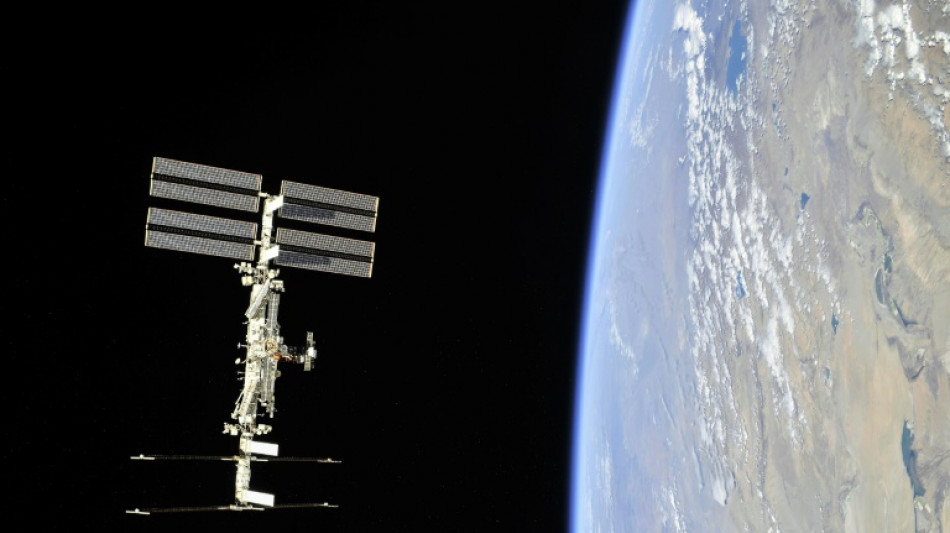
Russian ISS segment springs third leak in under a year / Photo: © NASA/AFP/File

Russian ISS segment springs third leak in under a year

The Russian segment of the International Space Station (ISS) sprung its third coolant leak in under a year Monday, raising new questions about the reliability of the country's space program even as officials said crew members weren't in danger.

Text size:

Flakes of frozen coolant spraying into space were seen in an official live feed of the orbital lab provided by NASA around 1:30 pm Eastern Time (1730 GMT), and confirmed in radio chatter between US mission control and astronauts.

"The Nauka module of the Russian segment of the ISS has suffered a coolant leak from the external (backup) radiator circuit, which was delivered to the station in 2012," Russian space agency Roscosmos said on Telegram, adding temperatures remained normal in the affected unit.

"Nothing is threatening the crew and the station," added the statement.

Nauka, which means "science" in Russian and is also known as the Multipurpose Laboratory Module-Upgrade (MLM), launched in 2021.

US mission control in Houston could be heard asking astronauts on the American side to investigate.

"Hi, we're seeing flakes outside, we need a crew to go to the cupola, we think windows five or six, and confirm any visual flakes," an official said to the astronauts.

"There's a leak coming from the radiator on MLM," Jasmin Moghbeli replied a little later.

NASA has yet to release an official statement.

- 'Something systematic' -

This is the third coolant leak to hit the Russian side of the ISS in less than a year. On December 15, 2022, dramatic NASA TV images showed white particles resembling snowflakes streaming out of the rear of a docked Soyuz MS-22 spacecraft for several hours.

Speculation about the cause centered on an unlucky strike by a tiny space rock, or micro meteorite.

That spaceship returned to Earth uncrewed, and then another uncrewed Soyuz was sent to replace it a few months later. Two Russians and an American crew member had to stay for a year-long mission as a result, returning home only last month.

A similar leak in mid-February also affected the Russian Progress MS-21 cargo ship, which had been docked to the ISS since October 2022.

The succession of leaks lowers the probability they were caused by meteorites.

Space analyst Jonathan McDowell told AFP: "You've got three coolant systems leaking -- there's a common thread there. One is whatever, two is a coincidence, three is something systematic," he said, speculating that a subcontractor company may be at fault.

"It really just emphasizes the degrading reliability of Russian space systems. When you add it to the context of their failed Moon probe in August, they're not looking great."

The Russian space sector, which has historically been the pride of the country, has been facing difficulties for years, between lack of funding, failures and corruption scandals.

The ISS constitutes one of the few areas of cooperation still ongoing between Moscow and Washington since the start of the Russian offensive in Ukraine and the international sanctions that followed.

J.M.Ellis--TFWP