The Fort Worth Press - 36-million-year-old whale fossil found in Peruvian desert

USD -
AED 3.6725
AFN 63.49826
ALL 81.649957
AMD 368.209891
ANG 1.790403
AOA 917.503082
ARS 1436.737304
AUD 1.414007
AWG 1.8
AZN 1.699145
BAM 1.685177
BBD 2.015096
BDT 122.817901
BGN 1.69088
BHD 0.377104
BIF 2991
BMD 1
BND 1.281762
BOB 6.938712
BRL 5.090801
BSD 1.000526
BTN 94.560525
BWP 13.406112
BYN 2.76997
BYR 19600
BZD 2.012252
CAD 1.40288
CDF 2320.000121
CHF 0.793295
CLF 0.022506
CLP 885.759871
CNY 6.75745
CNH 6.759615
COP 3435
CRC 455.716489
CUC 1
CUP 26.5
CVE 95.350078
CZK 20.80205
DJF 177.719866
DKK 6.43614
DOP 58.599944
DZD 132.878973
EGP 49.908197
ERN 15
ETB 158.375021
EUR 0.862749
FJD 2.2337
FKP 0.744126
GBP 0.74643
GEL 2.644999
GGP 0.744126
GHS 11.2977
GIP 0.744126
GMD 72.999684
GNF 8777.499016
GTQ 7.626359
GYD 209.290102
HKD 7.83499
HNL 26.697197
HRK 6.500497
HTG 130.666299
HUF 300.649642
IDR 17748.6
ILS 2.92176
IMP 0.744126
INR 94.309498
IQD 1310
IRR 1374999.999942
ISK 124.330031
JEP 0.744126
JMD 158.238482
JOD 0.709019
JPY 160.262999
KES 129.520178
KGS 87.449762
KHR 4012.493065
KMF 424.999812
KPW 900.00035
KRW 1511.864997
KWD 0.308098
KYD 0.8338
KZT 487.920041
LAK 22029.999804
LBP 89550.000054
LKR 335.185855
LRD 182.14983
LSL 16.194858
LTL 2.95274
LVL 0.60489
LYD 6.37502
MAD 9.245017
MDL 17.459223
MGA 4199.999949
MKD 53.086638
MMK 2099.446961
MNT 3577.325824
MOP 8.072446
MRU 40.080045
MUR 47.130241
MVR 15.460244
MWK 1736.000257
MXN 17.19051
MYR 4.064804
MZN 63.902105
NAD 16.201917
NGN 1359.119651
NIO 36.6101
NOK 9.50645
NPR 151.295881
NZD 1.719365
OMR 0.384498
PAB 1.000526
PEN 3.41251
PGK 4.38775
PHP 60.373009
PKR 278.298187
PLN 3.64767
PYG 6105.515298
QAR 3.640502
RON 4.507036
RSD 101.071054
RUB 72.971546
RWF 1488
SAR 3.751894
SBD 8.061424
SCR 14.115123
SDG 600.499323
SEK 9.40215
SGD 1.28203
SHP 0.746601
SLE 24.750291
SLL 20969.503664
SOS 571.507527
SRD 37.332026
STD 20697.981008
STN 21.4
SVC 8.754244
SYP 110.532098
SZL 16.19688
THB 32.534501
TJS 9.274765
TMT 3.51
TND 2.91175
TOP 2.40776
TRY 46.31574
TTD 6.796543
TWD 31.558502
TZS 2625.00297
UAH 44.808889
UGX 3701.565583
UYU 40.393596
UZS 12004.999858
VES 596.036397
VND 26326
VUV 119.252825
WST 2.739714
XAF 565.192704
XAG 0.014141
XAU 0.000229
XCD 2.70255
XCG 1.803205
XDR 0.703697
XOF 565.000179
XPF 103.250281
YER 238.625025
ZAR 16.16843
ZMK 9001.19479
ZMW 17.684109
ZWL 321.999592
  • CMSC

    -0.0450

    22.32

    -0.2%

  • CMSD

    0.0300

    22.29

    +0.13%

  • RBGPF

    0.0000

    62.87

    0%

  • AZN

    -0.8200

    177.89

    -0.46%

  • NGG

    -1.6000

    80.68

    -1.98%

  • GSK

    -0.0700

    52.15

    -0.13%

  • RIO

    -3.0700

    102.67

    -2.99%

  • BTI

    -1.8900

    59.49

    -3.18%

  • BCE

    -0.5400

    23.28

    -2.32%

  • BCC

    -0.7500

    70.81

    -1.06%

  • RELX

    -0.7900

    32.01

    -2.47%

  • BP

    -1.0100

    40.14

    -2.52%

  • JRI

    -0.1900

    12.62

    -1.51%

  • RYCEF

    -0.0800

    18.55

    -0.43%

  • VOD

    -0.3600

    14.53

    -2.48%

36-million-year-old whale fossil found in Peruvian desert


36-million-year-old whale fossil found in Peruvian desert

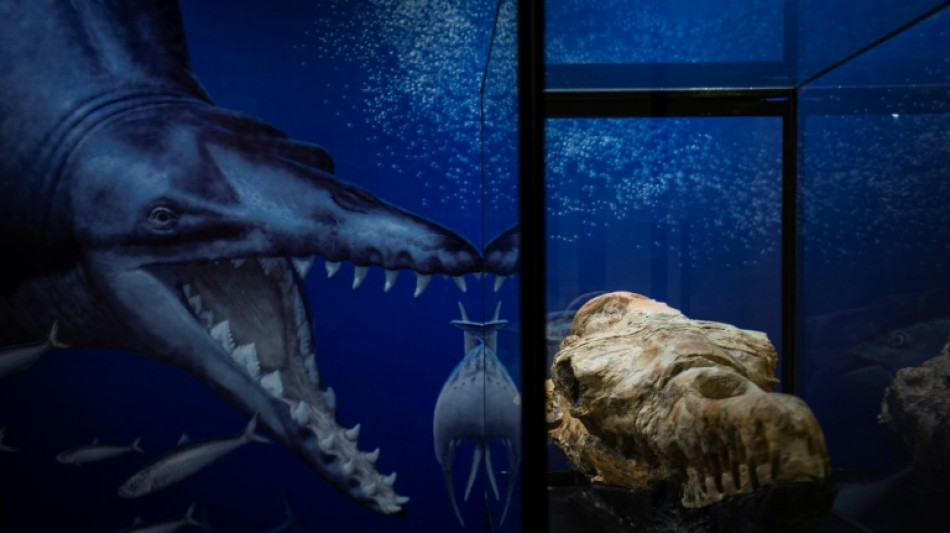
Paleontologists on Thursday unveiled the fossilized remains of an ancient whale that inhabited the seas 36 million years ago, found last year in a Peruvian desert.

Text size:

"We have presented the new Peruvian basilosaurus, it is the complete skull of an archaic whale that lived 36 million years ago," paleontologist Mario Urbina, head of the team that discovered the skeleton, told AFP.

Urbina said the basilosaurus was found at the end of 2021 in the Ocucaje Desert in the Ica department, about 350 kilometers (215 miles) south of Lima. The desolate landscape was a shallow sea millions of years ago, and its dunes have yielded large numbers of striking primitive sea mammal remains.

The "Ocucaje Predator," as the researchers dubbed it, was about 17 meters (55 feet) long and used its massive, powerful teeth to feed on tuna, sharks and schools of sardines.

"This finding is very important because there are no other similar specimens discovered in the world," said Urbina, a researcher at the National University of San Marcos, in Lima.

Team member Rodolfo Salas-Gismondi explained the basilosaurus differs from other known ancient whale species by its size and the development of its teeth, both of which indicate the animal was likely at the top of the food chain.

"This is an extraordinary find because of its great state of preservation," he told AFP. "This animal was one of the largest predators of its time."

"At that time the Peruvian sea was warm," added Salas-Gismondi, who heads the Department of Vertebrate Paleontology at the Natural History Museum in Lima. "Thanks to this type of fossil, we can reconstruct the history of the Peruvian sea."

The first cetaceans, like the basilosaurus, evolved from land animals some 55 million years ago.

By the late Eocene period (between 56 million and 34 million years ago), cetaceans had fully adapted to marine life.

Whales had not yet evolved, and almost all cetaceans were marine macropredators, according to the research team.

The Ocucaje Desert is rich in fossils, the researchers said, providing scientists with 42 million years' worth of evolutionary evidence.

Other fossils found there include four-legged dwarf whales, dolphins, sharks and other species from the Miocene period (between 23 million and five million years ago).

S.Jordan--TFWP