SpaceX Dragon crew to blast off for ISS / Photo: © GETTY IMAGES/AFP

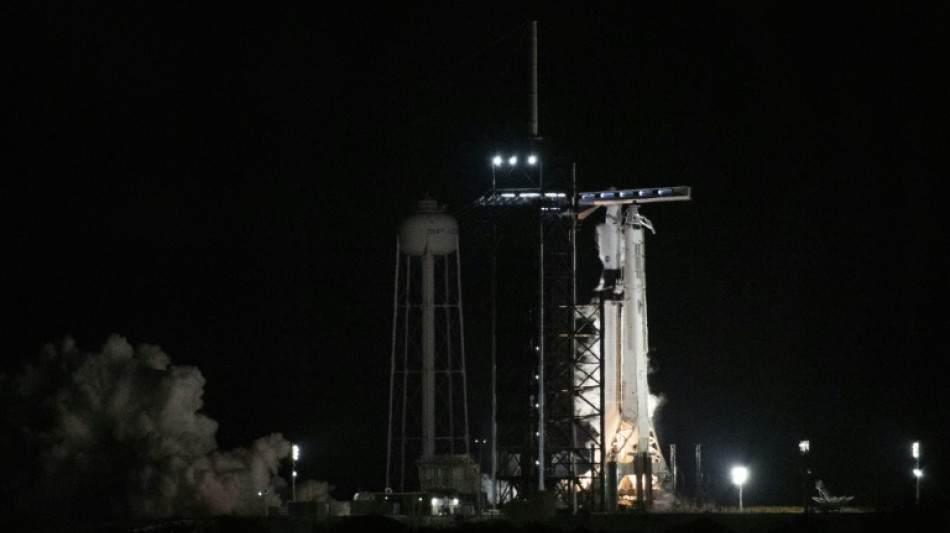
A SpaceX Falcon 9 rocket is to blast off early Monday for the International Space Station carrying two NASA astronauts, a Russian cosmonaut and the second Emirati to voyage to space.
The SpaceX Dragon Crew-6 mission is set to lift off from the Kennedy Space Center in Florida at 1:45 am (0645 GMT). Weather conditions are expected to be near perfect.
The Crew Dragon capsule, dubbed Endeavour, is scheduled to dock with the ISS at 2:38 am (0738 GMT) on Tuesday if all goes as planned.
NASA's Stephen Bowen and Warren Hoburg, Russia's Andrey Fedyaev and Sultan al-Neyadi of the United Arab Emirates are to spend six months on the orbiting space station.
Neyadi, 41, will be the fourth astronaut from an Arab country and the second from the oil-rich United Arab Emirates to journey to space; his countryman Hazzaa al-Mansoori flew an eight-day mission in 2019.
Neyadi described the upcoming mission as a "great honor."
Hoburg, the Endeavour pilot, and Fedyaev, the Russian mission specialist, will also be making their first space flights.
Fedyaev is the second Russian cosmonaut to fly to the ISS aboard a SpaceX rocket. NASA astronauts fly regularly to the station on Russian Soyuz capsules.
Space has remained a rare venue of cooperation between Moscow and Washington since the Russian offensive in Ukraine placed the two capitals in sharp opposition.
Such exchanges have continued despite those tensions.
Bowen, a veteran of three space shuttle missions, said politics rarely come up while in space.
"We're all professionals. We keep focused on the mission itself," the mission commander said. "It's always been a great relationship we've had with cosmonauts once we get to space."
While aboard the ISS, the Crew-6 members will conduct dozens of experiments including studying how materials burn in microgravity and researching heart, brain and cartilage functions.
The current crew is the sixth to be transported by a SpaceX rocket to the ISS. The Endeavour capsule has flown into space three times.
NASA pays the private SpaceX company to ferry astronauts to the flying laboratory roughly every six months.
The space agency expects Crew-6 to have a handover of several days with the four members of the SpaceX Dragon Crew-5, who have been stationed on the ISS since October. Crew-5 will then return to Earth.
- Rescue capsule -
Also currently aboard the ISS are Russian cosmonauts Dmitry Petelin and Sergei Prokopyev, as well as NASA astronaut Frank Rubio.
They had been scheduled to return home on March 28 but the cooling system of their Soyuz MS-22 capsule was damaged by a tiny meteoroid in mid-December while docked with the ISS.
An uncrewed Russian Soyuz capsule, MS-23, took off on Friday from Kazakhstan to bring the three astronauts home. They are now scheduled to return to Earth in September.
The ISS was launched in 1998 at a time of increased US-Russia cooperation following the Cold War space race.
Russia has been using the ageing but reliable Soyuz capsules to ferry astronauts into space since the 1960s.
But in recent years, Russia's space program has been beset by a litany of problems that have led to the loss of satellites and vehicles.
P.McDonald--TFWP