The Fort Worth Press - Asteroid to come 'extraordinarily close' to Earth: NASA

USD -
AED 3.6731
AFN 64.000125
ALL 83.310487
AMD 377.390171
ANG 1.790083
AOA 917.000032
ARS 1394.6999
AUD 1.411961
AWG 1.8
AZN 1.698169
BAM 1.696352
BBD 2.017025
BDT 122.885307
BGN 1.709309
BHD 0.377557
BIF 2970
BMD 1
BND 1.278723
BOB 6.920298
BRL 5.205304
BSD 1.001487
BTN 92.872847
BWP 13.580798
BYN 3.052406
BYR 19600
BZD 2.014155
CAD 1.370005
CDF 2269.999753
CHF 0.78972
CLF 0.02318
CLP 915.279629
CNY 6.87305
CNH 6.88653
COP 3706.7
CRC 467.742425
CUC 1
CUP 26.5
CVE 97.049978
CZK 21.225097
DJF 177.7205
DKK 6.4883
DOP 60.050274
DZD 132.416153
EGP 52.253496
ERN 15
ETB 156.999833
EUR 0.86831
FJD 2.21245
FKP 0.749449
GBP 0.74957
GEL 2.714976
GGP 0.749449
GHS 10.905026
GIP 0.749449
GMD 73.999838
GNF 8779.99989
GTQ 7.671558
GYD 209.520258
HKD 7.83815
HNL 26.569497
HRK 6.543203
HTG 131.24607
HUF 340.140278
IDR 16961
ILS 3.10005
IMP 0.749449
INR 92.88435
IQD 1310
IRR 1315000.000238
ISK 124.370104
JEP 0.749449
JMD 157.249479
JOD 0.708995
JPY 159.335997
KES 129.549986
KGS 87.449829
KHR 4009.999882
KMF 427.999727
KPW 899.9784
KRW 1501.410171
KWD 0.30644
KYD 0.834501
KZT 483.111229
LAK 21449.999713
LBP 89550.000042
LKR 311.844884
LRD 183.349753
LSL 16.820103
LTL 2.95274
LVL 0.60489
LYD 6.380061
MAD 9.37375
MDL 17.460159
MGA 4169.999712
MKD 53.541262
MMK 2100.10344
MNT 3571.101739
MOP 8.084959
MRU 40.11989
MUR 46.510272
MVR 15.459872
MWK 1736.000271
MXN 17.707895
MYR 3.915496
MZN 63.900902
NAD 16.819834
NGN 1356.939807
NIO 36.720274
NOK 9.56654
NPR 148.591748
NZD 1.71111
OMR 0.384495
PAB 1.001483
PEN 3.427502
PGK 4.30275
PHP 59.782501
PKR 279.290359
PLN 3.70598
PYG 6472.539624
QAR 3.644007
RON 4.421402
RSD 101.991987
RUB 83.889591
RWF 1459
SAR 3.754945
SBD 8.04524
SCR 14.089128
SDG 600.999851
SEK 9.332675
SGD 1.279575
SHP 0.750259
SLE 24.650411
SLL 20969.510825
SOS 571.499098
SRD 37.374981
STD 20697.981008
STN 21.5
SVC 8.762663
SYP 110.58576
SZL 16.820092
THB 32.617011
TJS 9.578717
TMT 3.5
TND 2.917506
TOP 2.40776
TRY 44.202397
TTD 6.788466
TWD 31.932498
TZS 2603.729567
UAH 44.042968
UGX 3767.67725
UYU 40.557008
UZS 12175.000113
VES 450.942841
VND 26310
VUV 119.592862
WST 2.733704
XAF 568.900934
XAG 0.013003
XAU 0.000205
XCD 2.70255
XCG 1.80488
XDR 0.70688
XOF 566.5008
XPF 103.914716
YER 238.575025
ZAR 16.80645
ZMK 9001.203552
ZMW 19.583865
ZWL 321.999592
  • RBGPF

    0.1000

    82.5

    +0.12%

  • CMSC

    -0.0500

    22.9

    -0.22%

  • RYCEF

    -0.0800

    16.7

    -0.48%

  • GSK

    -1.3100

    52.1

    -2.51%

  • RIO

    -2.1800

    87.62

    -2.49%

  • AZN

    -2.9180

    188.372

    -1.55%

  • RELX

    -0.2240

    34.066

    -0.66%

  • BCE

    -0.2400

    25.77

    -0.93%

  • NGG

    -2.9300

    87.49

    -3.35%

  • BTI

    -2.4050

    58.145

    -4.14%

  • BCC

    -0.7700

    72.15

    -1.07%

  • CMSD

    -0.0060

    22.874

    -0.03%

  • VOD

    -0.3560

    14.394

    -2.47%

  • JRI

    -0.1200

    12.34

    -0.97%

  • BP

    0.7100

    44.56

    +1.59%

Asteroid to come 'extraordinarily close' to Earth: NASA
Asteroid to come 'extraordinarily close' to Earth: NASA / Photo: © AFP

Asteroid to come 'extraordinarily close' to Earth: NASA

A truck-sized asteroid will pass near Earth on Thursday in one of the closest approaches to our planet ever recorded, NASA said, emphasising that it poses no danger.

Text size:

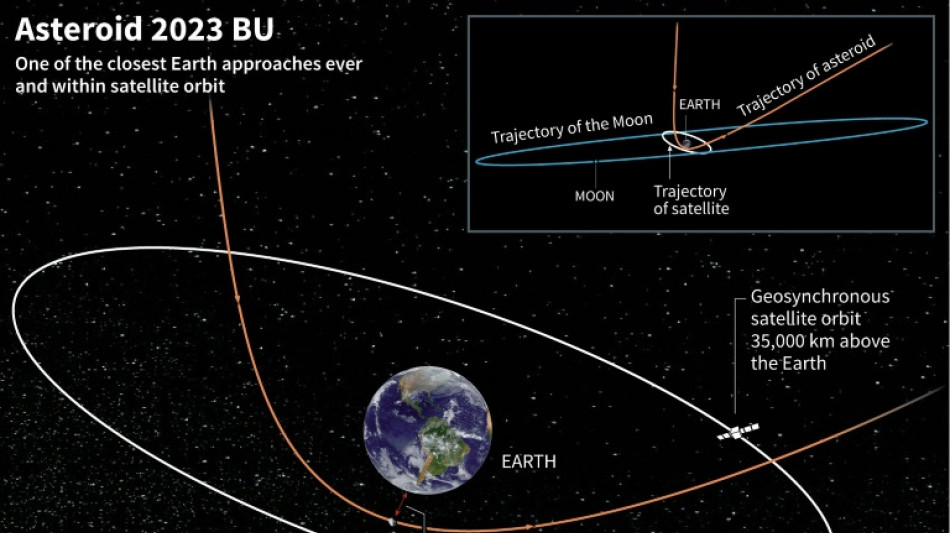
Asteroid 2023 BU, which was recently discovered by an amateur astronomer, will zoom by the southern tip of South America at around 4:27 pm PST on Thursday (0027 GMT Friday), according to NASA.

It will pass just 2,200 miles (3,600 kilometres) from Earth's surface, much closer than many geostationary satellites orbiting the planet.

But there is no risk that the asteroid will hit Earth, NASA said in a statement on Wednesday.

Even if it did, the asteroid measuring 3.5-8.5 metres (11-28 feet) across would largely disintegrate in the Earth's atmosphere, potentially just resulting in a few small meteorites.

It was discovered on Saturday from an observatory in Crimea by amateur astronomer Gennadiy Borisov, who previously spotted an interstellar comet in 2019.

Dozens of observations were then carried out by observatories across the world.

NASA's Scout impact hazard assessment system quickly determined that the asteroid would miss Earth, the US space agency said.

"Despite the very few observations, it was nonetheless able to predict that the asteroid would make an extraordinarily close approach with Earth," said NASA's Davide Farnocchia who helped develop Scout.

"In fact, this is one of the closest approaches by a known near-Earth object ever recorded."

The asteroid will come so close that its trajectory around the Sun will be significantly altered.

Previously it took the asteroid 359 days to complete its orbit around the Sun, but after this close call with Earth, it will now take 425, NASA said.

L.Coleman--TFWP