The Fort Worth Press - How three dust specks reveal an asteroid's secrets

USD -
AED 3.673025
AFN 65.483762
ALL 82.068343
AMD 381.698588
ANG 1.790403
AOA 916.999673
ARS 1438.243983
AUD 1.50659
AWG 1.8025
AZN 1.681394
BAM 1.664171
BBD 2.013461
BDT 122.170791
BGN 1.663705
BHD 0.376986
BIF 2966
BMD 1
BND 1.288843
BOB 6.933052
BRL 5.418097
BSD 0.999711
BTN 90.668289
BWP 13.203148
BYN 2.923573
BYR 19600
BZD 2.010568
CAD 1.377965
CDF 2250.000143
CHF 0.796802
CLF 0.0233
CLP 914.050217
CNY 7.04725
CNH 7.043785
COP 3824.03
CRC 500.068071
CUC 1
CUP 26.5
CVE 94.205954
CZK 20.711202
DJF 177.720303
DKK 6.359165
DOP 63.349937
DZD 129.668021
EGP 47.431203
ERN 15
ETB 155.594517
EUR 0.85129
FJD 2.25435
FKP 0.748248
GBP 0.747725
GEL 2.70406
GGP 0.748248
GHS 11.504975
GIP 0.748248
GMD 73.494201
GNF 8690.000082
GTQ 7.65801
GYD 209.150549
HKD 7.78238
HNL 26.332494
HRK 6.412297
HTG 130.986011
HUF 327.090961
IDR 16665.75
ILS 3.21285
IMP 0.748248
INR 90.72435
IQD 1309.604847
IRR 42109.999939
ISK 126.170416
JEP 0.748248
JMD 159.763112
JOD 0.709016
JPY 155.303501
KES 128.91014
KGS 87.450043
KHR 4003.999747
KMF 420.000088
KPW 899.999687
KRW 1469.420161
KWD 0.30684
KYD 0.833099
KZT 515.622341
LAK 21662.809299
LBP 89523.161227
LKR 309.11133
LRD 176.449066
LSL 16.773085
LTL 2.95274
LVL 0.60489
LYD 5.419319
MAD 9.176168
MDL 16.874708
MGA 4456.111092
MKD 52.392546
MMK 2099.265884
MNT 3545.865278
MOP 8.013921
MRU 39.767196
MUR 45.949585
MVR 15.403875
MWK 1733.51826
MXN 17.991029
MYR 4.092502
MZN 63.858728
NAD 16.773085
NGN 1452.329997
NIO 36.792485
NOK 10.159805
NPR 145.069092
NZD 1.727435
OMR 0.384507
PAB 0.999711
PEN 3.366461
PGK 4.248494
PHP 58.854038
PKR 280.165924
PLN 3.589155
PYG 6714.373234
QAR 3.643511
RON 4.334306
RSD 99.922984
RUB 79.495971
RWF 1455.544872
SAR 3.752207
SBD 8.176752
SCR 14.031668
SDG 601.498901
SEK 9.295155
SGD 1.290015
SHP 0.750259
SLE 24.124964
SLL 20969.503664
SOS 570.351588
SRD 38.610236
STD 20697.981008
STN 20.846806
SVC 8.74715
SYP 11056.681827
SZL 16.776148
THB 31.509642
TJS 9.192328
TMT 3.51
TND 2.923658
TOP 2.40776
TRY 42.701515
TTD 6.784997
TWD 31.332496
TZS 2482.501015
UAH 42.255795
UGX 3560.97478
UYU 39.174977
UZS 12094.5509
VES 267.43975
VND 26320
VUV 121.127634
WST 2.775483
XAF 558.147272
XAG 0.01575
XAU 0.000232
XCD 2.70255
XCG 1.801675
XDR 0.695393
XOF 558.147272
XPF 101.477145
YER 238.495844
ZAR 16.79805
ZMK 9001.198754
ZMW 23.168034
ZWL 321.999592
  • SCS

    0.0200

    16.14

    +0.12%

  • CMSC

    -0.0150

    23.285

    -0.06%

  • BCC

    -1.1530

    75.357

    -1.53%

  • NGG

    0.6800

    75.61

    +0.9%

  • BCE

    0.3611

    23.755

    +1.52%

  • RBGPF

    -3.4900

    77.68

    -4.49%

  • RIO

    -0.2900

    75.37

    -0.38%

  • AZN

    1.2200

    91.05

    +1.34%

  • JRI

    0.0085

    13.575

    +0.06%

  • CMSD

    0.0500

    23.3

    +0.21%

  • GSK

    0.3300

    49.14

    +0.67%

  • BTI

    0.2500

    57.35

    +0.44%

  • RYCEF

    0.3000

    14.9

    +2.01%

  • VOD

    0.1390

    12.729

    +1.09%

  • BP

    -0.2510

    35.009

    -0.72%

  • RELX

    0.5700

    40.95

    +1.39%

How three dust specks reveal an asteroid's secrets
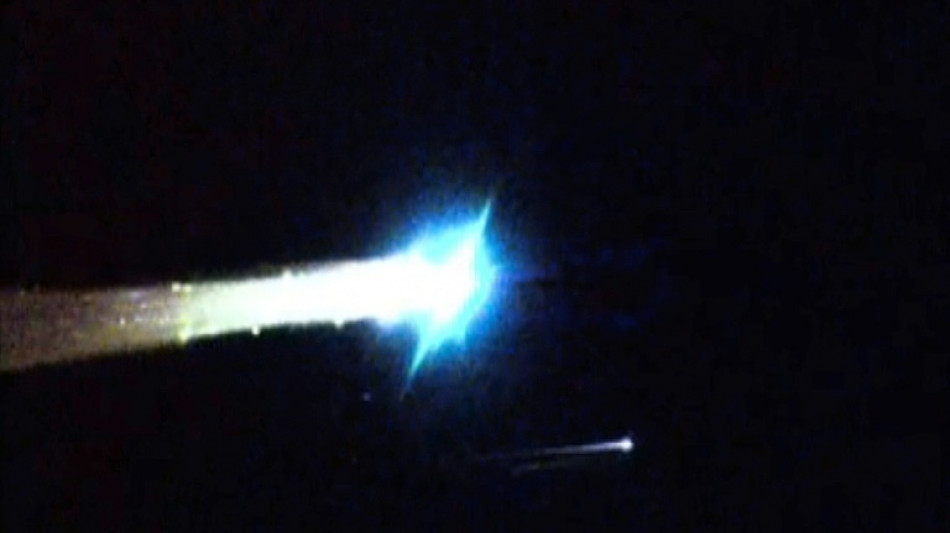
How three dust specks reveal an asteroid's secrets / Photo: © NASA/AFP/File

How three dust specks reveal an asteroid's secrets

The specks are tiny. No, really tiny. Smaller than the diameter of a hair. But they hold billions of years of history that reveal some of the secrets of asteroids.

Text size:

The three minute particles from an asteroid called Itokawa show some of these space rocks are vastly older than was thought, and are much tougher.

And that could mean we need bolder ways to prevent catastrophic collisions with Earth, according to research published Tuesday.

The three samples were collected in 2005 from the peanut-shaped Itokawa, some 300 million kilometres (186 million miles) from Earth.

It took the Japanese spacecraft Hayabusa five years to return them to Earth, along with hundreds of other particles from Itokawa, and scientists have been analysing them for clues ever since.

Fred Jourdan, professor at Curtin University's School of Earth and Planetary Sciences, wanted to see what the specks could reveal about the age of rubble-pile asteroids like Itokawa.

These form when solid asteroids collide and the resulting fragments assemble into new structures.

Solid asteroids are thought to have a lifespan of several hundred million years, and are gradually ground down by constant collisions.

But rubble-pile asteroids have a very different structure, composed of rocks, dust, pebbles and a void, and held together by the gravitational pull of their various components.

"It's like a giant space cushion, and cushions are good at absorbing shock," Jourdan said.

To find out just how good, the team analysed crystal structures in the samples, looking for deformations caused by the impact that created Itokawa.

And they dated the samples by measuring the decay of potassium into argon.

The methods suggest Itokawa was formed by an asteroid collision at least 4.2 billion years ago, ten times older than solid asteroids of similar size are predicted to be.

"We were really surprised," said Jourdan.

"I mean that's really, really old, and I'm sure some of my colleagues are not even going to believe it."

Rubble-pile asteroids are so resilient to the constant battering they face that they are likely to be much more abundant than previously assumed, the research published in the journal Proceedings of the National Academy of Sciences concludes.

That might mean we need new ways to tackle such asteroids on a collision course with Earth, Jourdan said.

NASA's recent DART test showed asteroids like Itokawa can be nudged off course, but that would likely require a lead time of several years.

An asteroid just weeks from colliding with Earth would require a different approach, and Jourdan argues a nuclear blast might be needed.

"It's not 'Armageddon'-style," blowing it up, he hastens to add, referring to the 1998 sci-fi movie.

"The shockwave should push the asteroid out of the way."

It is a far-reaching conclusion to draw from such tiny specks of dust, but each particle is analysed at the atomic level.

"We can get big stories like that out of (something) very, very small, because those machines, what they're doing, is the measuring and counting of atoms," Jourdan said.

"Every grain has its own story to tell."

H.M.Hernandez--TFWP