The Fort Worth Press - En garde! Wasps use penis spikes to ward off predators

USD -
AED 3.672496
AFN 63.499831
ALL 82.257093
AMD 368.070326
ANG 1.790403
AOA 918.000251
ARS 1461.5157
AUD 1.430584
AWG 1.8
AZN 1.699751
BAM 1.707839
BBD 2.014862
BDT 122.896637
BGN 1.69088
BHD 0.37695
BIF 2985
BMD 1
BND 1.293759
BOB 6.91239
BRL 5.158099
BSD 1.000358
BTN 94.655909
BWP 13.576786
BYN 2.799012
BYR 19600
BZD 2.011981
CAD 1.416315
CDF 2264.999797
CHF 0.809065
CLF 0.023031
CLP 906.449743
CNY 6.774798
CNH 6.778565
COP 3445.05
CRC 453.811158
CUC 1
CUP 26.5
CVE 96.87499
CZK 21.17645
DJF 177.720059
DKK 6.54281
DOP 58.291712
DZD 133.536016
EGP 49.741198
ERN 15
ETB 161.283979
EUR 0.87533
FJD 2.251302
FKP 0.755695
GBP 0.755093
GEL 2.650323
GGP 0.755695
GHS 11.230007
GIP 0.755695
GMD 72.999698
GNF 8777.504172
GTQ 7.628428
GYD 209.275317
HKD 7.83945
HNL 26.762371
HRK 6.593902
HTG 130.677006
HUF 308.422497
IDR 17965
ILS 2.97135
IMP 0.755695
INR 94.70085
IQD 1310.524891
IRR 1374999.999882
ISK 126.050215
JEP 0.755695
JMD 158.06984
JOD 0.70896
JPY 161.558494
KES 129.419543
KGS 87.450283
KHR 4016.800706
KMF 429.497004
KPW 900.00035
KRW 1541.859863
KWD 0.30866
KYD 0.833661
KZT 487.587213
LAK 22093.277098
LBP 89584.959701
LKR 334.503445
LRD 182.07459
LSL 16.436923
LTL 2.95274
LVL 0.60489
LYD 6.396659
MAD 9.325876
MDL 17.591841
MGA 4219.387176
MKD 53.93993
MMK 2099.917974
MNT 3579.231668
MOP 8.077961
MRU 40.000349
MUR 47.809815
MVR 15.460512
MWK 1736.000022
MXN 17.37015
MYR 4.147098
MZN 63.89974
NAD 16.436923
NGN 1366.65962
NIO 36.814852
NOK 9.70485
NPR 151.449105
NZD 1.752587
OMR 0.384501
PAB 1.000358
PEN 3.385028
PGK 4.456902
PHP 61.130966
PKR 278.233656
PLN 3.74025
PYG 6098.551332
QAR 3.646906
RON 4.5841
RSD 102.777034
RUB 74.251001
RWF 1465.171718
SAR 3.753791
SBD 8.061424
SCR 13.283564
SDG 600.498943
SEK 9.626925
SGD 1.293885
SHP 0.746601
SLE 24.749912
SLL 20969.503664
SOS 571.695527
SRD 37.4305
STD 20697.981008
STN 21.39383
SVC 8.753133
SYP 110.532098
SZL 16.433081
THB 32.980139
TJS 9.278635
TMT 3.5
TND 2.957937
TOP 2.40776
TRY 46.470097
TTD 6.784027
TWD 31.702102
TZS 2628.231975
UAH 44.991835
UGX 3651.795772
UYU 40.002096
UZS 11989.276889
VES 606.63266
VND 26320
VUV 118.352303
WST 2.751796
XAF 572.793161
XAG 0.015452
XAU 0.000239
XCD 2.70255
XCG 1.802932
XDR 0.71169
XOF 571.999874
XPF 104.139924
YER 238.567185
ZAR 16.410199
ZMK 9001.198041
ZMW 17.731555
ZWL 321.999592
  • RBGPF

    -0.2700

    60.34

    -0.45%

  • RYCEF

    0.2300

    18.63

    +1.23%

  • CMSD

    -0.2100

    22.08

    -0.95%

  • NGG

    1.5300

    80.97

    +1.89%

  • BCE

    -0.6300

    22.65

    -2.78%

  • CMSC

    -0.2100

    22.16

    -0.95%

  • BCC

    -2.1200

    72.54

    -2.92%

  • BTI

    -0.0100

    58.9

    -0.02%

  • RIO

    -0.7200

    99.36

    -0.72%

  • GSK

    0.0700

    50.74

    +0.14%

  • VOD

    -0.1800

    14.12

    -1.27%

  • RELX

    -0.3500

    30.83

    -1.14%

  • JRI

    -0.0200

    12.65

    -0.16%

  • AZN

    1.5000

    176.43

    +0.85%

  • BP

    0.6800

    39.78

    +1.71%

En garde! Wasps use penis spikes to ward off predators
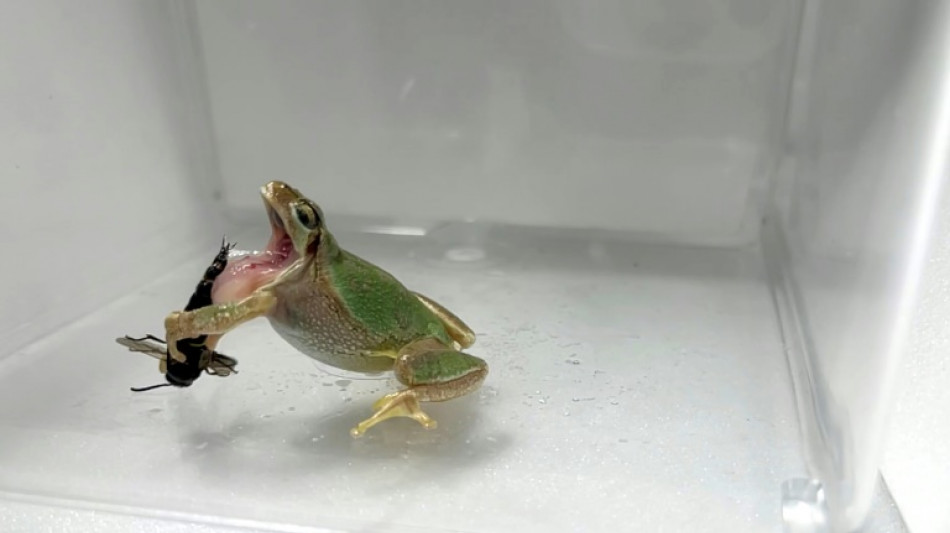
En garde! Wasps use penis spikes to ward off predators / Photo: © Kobe University/AFP

En garde! Wasps use penis spikes to ward off predators

An accidental sting has helped Japanese scientists prove some male wasps have a rather unusual predator defence weapon: penis spikes.

Text size:

While wasps are known for their prickly attacks, only females have a real sting in their tails. Their male counterparts generally evade predators by mimicking the fairer sex.

Scientists had theorised that some male wasps might have other defence mechanisms, including perhaps deploying their genital spikes.

"However, the evidence was lacking," explained Shinji Sugiura, an ecologist at Japan's Kobe University.

Sugiura studies animal anti-predator defences but it was only by chance that he investigated the unusual male wasp mechanism, after his graduate student and co-author reported being stung by a mason wasp.

"I tried to be stung after hearing her experience," Sugiura told AFP.

"Because I had believed male wasps as harmless, I was very surprised to experience the pain."

Female wasps sting via an ovipositor, a tube-like protrusion that deposits eggs but can also deliver a venomous riposte.

Male wasps lack the organ but are equipped with two large spikes that sit either side of their penis.

To test the effectiveness of this defence, Sugiura's team offered up male mason wasps to two different kinds of frogs to see how the spikes were deployed.

"Male wasps were frequently observed to pierce the mouth or other parts of frogs with their genitalia while being attacked," Sugiura reported in research published Tuesday in the Current Biology journal.

The attacks are documented in a video that shows an unfortunate frog trying repeatedly to chomp down on a wasp, before using its front feet to pull the stinging insect out of its mouth.

Pond frogs happily ate all the males, as well as stinging females, but over a third of tree frogs rejected the male wasps after being stung.

When the experiment was repeated with the genital spikes removed from the wasps, the tree frogs no longer held back and ate them without hesitation.

"The difference was statistically significant. Even a small difference of survival could cause the evolution of anti-predator devices in insects," Sugiura said.

There has been little research on insect genitalia outside of its role in reproduction, according to Sugiura, though the wasp defence mechanism is not entirely without precedent.

Previous research has found, for example, that some species of hawkmoth use their genitalia to emit ultrasound that jams bat sonar.

Sugiura is no stranger to uncovering some of the weirdest ways animals evade their predators.

He has documented how some beetles can escape after being swallowed, by following the digestive tract to its logical conclusion and escaping from the anus.

And he has shown that other insects can make any unfortunate toad that has eaten them vomit them back up.

He now hopes to expand his current research to determine whether other wasp families have the same genital spike defence mechanism.

J.Ayala--TFWP