The Fort Worth Press - Planet spiralling into star may offer glimpse into Earth's end

USD -
AED 3.6725
AFN 64.999692
ALL 80.087609
AMD 365.184839
ANG 1.790365
AOA 917.000356
ARS 1512.739898
AUD 1.407955
AWG 1.8
AZN 1.701353
BAM 1.706639
BBD 2.027758
BDT 123.962146
BGN 1.683441
BHD 0.379576
BIF 3011.269683
BMD 1
BND 1.28203
BOB 11.069856
BRL 5.152699
BSD 1.006811
BTN 96.611242
BWP 13.655382
BYN 3.05743
BYR 19600
BZD 2.024878
CAD 1.399155
CDF 2310.000089
CHF 0.825855
CLF 0.024159
CLP 953.919949
CNY 6.706394
CNH 6.70954
COP 3134.19
CRC 450.343146
CUC 1
CUP 26.5
CVE 96.217697
CZK 21.234019
DJF 179.28525
DKK 6.52278
DOP 59.433069
DZD 133.882278
EGP 52.193398
ERN 15
ETB 164.451503
EUR 0.87259
FJD 2.24075
FKP 0.741937
GBP 0.747805
GEL 2.605016
GGP 0.741937
GHS 11.562878
GIP 0.741937
GMD 74.000281
GNF 8852.414672
GTQ 7.685897
GYD 210.637917
HKD 7.845003
HNL 27.021933
HRK 6.575798
HTG 131.588707
HUF 318.827013
IDR 17749.45
ILS 3.027499
IMP 0.741937
INR 96.05265
IQD 1318.941182
IRR 1374575.000099
ISK 121.999819
JEP 0.741937
JMD 158.883765
JOD 0.708964
JPY 156.112502
KES 129.580091
KGS 87.4499
KHR 4076.806618
KMF 427.999971
KPW 900.000318
KRW 1378.970308
KWD 0.30895
KYD 0.839009
KZT 447.680836
LAK 22538.492751
LBP 90157.984982
LKR 333.701281
LRD 174.6779
LSL 16.391258
LTL 2.95274
LVL 0.60489
LYD 6.394443
MAD 9.49402
MDL 17.553305
MGA 4353.422135
MKD 53.686971
MMK 2099.62457
MNT 3595.075141
MOP 8.135201
MRU 40.310991
MUR 47.289632
MVR 15.410267
MWK 1745.819135
MXN 17.25232
MYR 4.098098
MZN 63.896955
NAD 16.391258
NGN 1330.809964
NIO 37.050772
NOK 9.425845
NPR 154.578336
NZD 1.74775
OMR 0.384506
PAB 1.006811
PEN 3.377763
PGK 4.552296
PHP 62.787972
PKR 279.056715
PLN 3.809205
PYG 5957.268574
QAR 3.660051
RON 4.592699
RSD 102.402958
RUB 84.247832
RWF 1485.521316
SAR 3.699949
SBD 8.000512
SCR 13.896416
SDG 601.50141
SEK 9.85591
SGD 1.27687
SHP 0.746965
SLE 24.640244
SLL 20969.491881
SOS 575.395181
SRD 37.752499
STD 20697.981008
STN 21.378429
SVC 8.809812
SYP 13002.000254
SZL 16.389251
THB 33.366171
TJS 9.28765
TMT 3.5
TND 2.94757
TOP 2.40776
TRY 48.674601
TTD 6.826382
TWD 31.898502
TZS 2645.002973
UAH 44.899585
UGX 3941.552974
UYU 40.506285
UZS 11870.034337
VES 845.45495
VND 26001
VUV 118.157011
WST 2.736734
XAF 572.381381
XAG 0.015759
XAU 0.000233
XCD 2.70255
XCG 1.814493
XDR 0.707052
XOF 572.381381
XPF 104.066772
YER 236.649959
ZAR 16.35993
ZMK 9001.202537
ZMW 19.758376
ZWL 321.999592
SSP 5655.283496
MXV 1.956178
  • CMSC

    0.1400

    20.48

    +0.68%

  • RIO

    -1.4700

    95.79

    -1.53%

  • BCE

    -0.4000

    22.5

    -1.78%

  • CMSD

    0.1785

    20.29

    +0.88%

  • BCC

    -0.6200

    75.31

    -0.82%

  • NGG

    1.1000

    76.03

    +1.45%

  • RBGPF

    0.0000

    69.99

    0%

  • JRI

    -0.1200

    11.5

    -1.04%

  • BTI

    -0.4300

    56.09

    -0.77%

  • GSK

    0.2800

    50.29

    +0.56%

  • AZN

    1.0400

    162.89

    +0.64%

  • BP

    -1.5800

    45.38

    -3.48%

  • RELX

    0.0500

    34.27

    +0.15%

  • RYCEF

    -0.0100

    19.29

    -0.05%

  • VOD

    -0.2200

    17.46

    -1.26%

Planet spiralling into star may offer glimpse into Earth's end
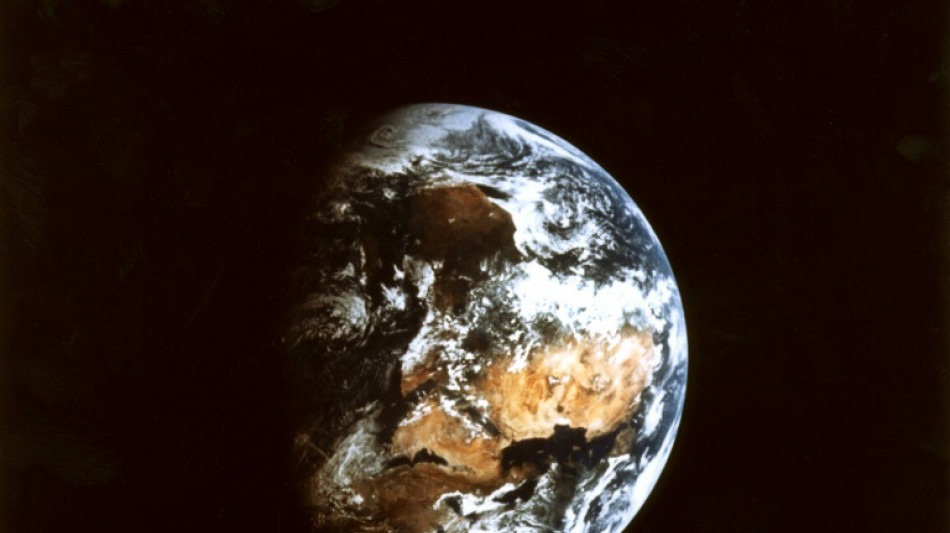
Planet spiralling into star may offer glimpse into Earth's end / Photo: © NASA/AFP

Planet spiralling into star may offer glimpse into Earth's end

For the first time astronomers have identified a planet that is spiralling towards a cataclysmic collision with its ageing sun, potentially offering a glimpse into how Earth could end one day.

Text size:

In a new study published on Monday, a team of mostly US-based researchers said they hope the doomed exoplanet Kepler-1658b can help shed light on how worlds die as their stars get older.

Kepler-1658b, which is 2,600 light years from Earth, is known as a "hot Jupiter" planet.

While similar in size to Jupiter, the planet orbits its host star an eighth of the distance between our Sun and Mercury, making it far hotter than the gas giant in our own Solar System.

Kepler-1658b's orbit around its host star takes less than three days -- and it is getting shorter by around 131 milliseconds a year, according to the study published in The Astrophysical Journal Letters.

"If it continues spiralling towards its star at the observed rate, the planet will collide with its star in less than three million years," said Shreyas Vissapragada, a postdoc at the Harvard–Smithsonian Center for Astrophysics and the study's lead author.

"This is the first time we've observed direct evidence for a planet spiralling towards its evolved star," he told AFP.

An evolved star has entered the "subgiant" phase of the stellar life cycle, when it starts expanding and becoming brighter.

Kepler-1658b's orbit is being shortened by the tides, in a similar process to how Earth's oceans rise and fall every day.

This gravitational push-and-pull can work both ways -- for example the Moon is very slowly spiralling away from Earth.

- Earth's 'ultimate adios'? -

So could Earth be heading towards a similar doom?

"Death-by-star is a fate thought to await many worlds and could be the Earth's ultimate adios billions of years from now as our Sun grows older," the Center for Astrophysics said in a statement.

Vissapragada said that "in five billion years or so, the Sun will evolve into a red giant star".

While the tidally-driven processes seen on Kepler-1658b "will drive the decay of the Earth's orbit towards the Sun," that effect could be counter-balanced by the Sun losing mass, he said.

"The ultimate fate of the Earth is somewhat unclear," he added.

Kepler-1658b was the first exoplanet ever observed by the Kepler space telescope, which launched in 2009. However it took nearly a decade of work before the planet's existence was confirmed in 2019, the Center for Astrophysics said.

Over 13 years, astronomers were able to observe the slow but steady change in the planet's orbit as it crossed the face of its host star.

One "big surprise" was that the planet itself is quite bright, Vissapragada said.

Previously it had been thought this was because it is a particularly reflective planet, he said.

But now the researchers believe the planet itself is far hotter than anticipated, possibly due to the same forces that are driving it towards its star.

T.M.Dan--TFWP