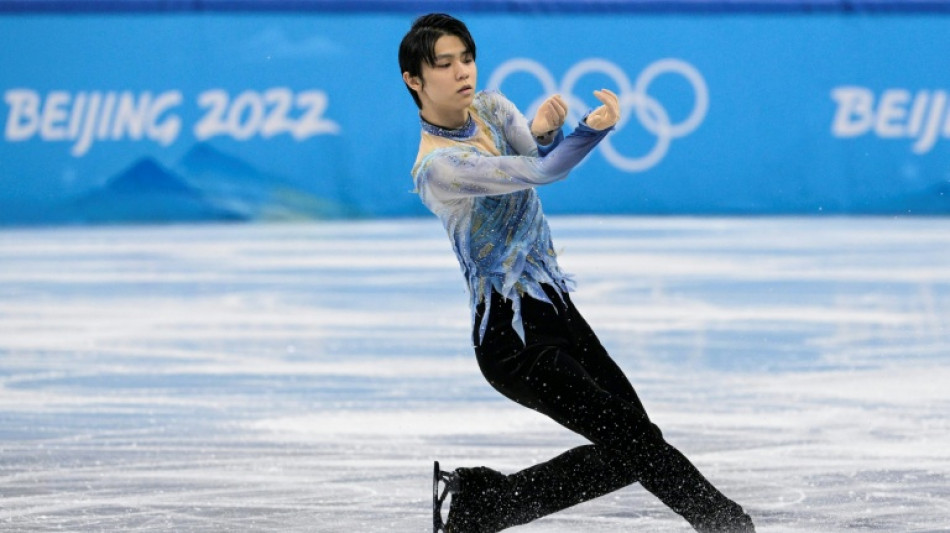
Japan's Olympic ice icons inspire new skating generation / Photo: © AFP

Japan did not win an Olympic figure skating medal until 1992 but it is now among the sport's world powers, with kids dreaming of becoming the next Yuzuru Hanyu or Mao Asada.
The country produces a conveyor belt of talent and skaters such as Kaori Sakamoto and Yuma Kagiyama head to next month's Milan-Cortina Games with ambitions of emulating the now-retired Hanyu, a two-time Olympic champion.
Skating is hugely popular in Japan, where children as young as three can be seen taking their first tottering steps onto the ice at rinks nationwide.
Kanon Amagai, an 11-year-old member of the Seibu Higashifushimi Figure Skating Club in Tokyo, told AFP that she started taking lessons five years ago because she "saw it on TV and thought it was cool".
"Now I can jump but I still need to work on my spins," she said as her classmates confidently zipped across the ice, weaving in and out of the beginners gingerly edging around the rink.
Japan's first Olympic figure skating medal came when Midori Ito won silver at the Albertville Games.
Shizuka Arakawa claimed the country's first Olympic gold, in Turin in 2006, before Hanyu became the first Japanese man to win at Sochi in 2014.
Ito had won the world title in 1989 and was the first woman to land a triple axel in competition.
Her coach, Machiko Yamada, said Ito proved to Japanese skaters that international success was possible.
"She wasn't the best dancer but she could jump really high," said the 82-year-old Yamada, the grande dame of Japanese skating who has also coached world champions Asada and Shoma Uno.
"The Russian coaches used to joke that she had springs on the soles of her skates."
- Ice Prince -
Ito was the first in what became a long line of Japanese skating stars, but two in particular transcended the sport.
Asada, known affectionately as "Mao-chan", won three world titles but Olympic gold eluded her, finishing second at the 2010 Vancouver Games.
A costly slip four years later in Sochi earned her the scorn of former Prime Minister Yoshiro Mori, who said "she always falls over whenever it's important".
Mori's comments prompted a backlash from an outraged public who loved Asada for her sunny disposition.
Hanyu inspired even fiercer devotion, with his worldwide legion of "Fanyu" supporters showering the ice with Winnie the Pooh toys after his routines.
The "Ice Prince" retired from competition in 2022 but his regular ice shows still pull in thousands of fans.
Ayaka Hosoda, a former skater and now a coach, thinks Japan's success builds on the legacy of previous generations.
"I think the fact that people have had a chance to watch world-class skaters in person is a big reason why we keep producing top skaters," she said.
"It feels like something close and familiar."
- Fine details -
At the Seibu Higashifushimi club, which has more than 200 members ranging in age from four to over 70, instructor Yuka Ishikawa is taking a break after teaching a class of primary school kids.
She says around half of the children at the club have serious ambitions of appearing at the Olympics, and many will practise every day in pursuit of their dream.
"Japanese people are very meticulous and pay attention to the finest of details when they practise," she said.
"I think this is part of the Japanese character and culture."
Japan's skating future looks bright beyond the Milan-Cortina Games.
Mao Shimada -- named after Asada -- has won the junior world title for the past three years and was only denied a place in Japan's Olympic team because she was too young to be eligible.
Sakamoto, a three-time world champion who will retire after this season, says such fierce competition keeps Japanese skaters on their toes.
"I think the reason why Japan is so strong is because everyone works so diligently and pushes each other to improve," she said.
P.Navarro--TFWP