From greens to browns: Burkina Faso's eco-friendly golf course / Photo: © AFP

When Burkina Faso makes the headlines these days, it's usually because of turmoil or suffering -- its jihadist insurgency, repeated military coups or grinding poverty.
But in one intriguing aspect, the landlocked Sahel country is at the forefront: its sole golf club is a pioneer in bringing water conservation to this thirstiest of sports.
Founded in 1975, the Ouagadougou Golf Club boasts an 18-hole and two nine-hole courses -- all certified by the French golf federation.
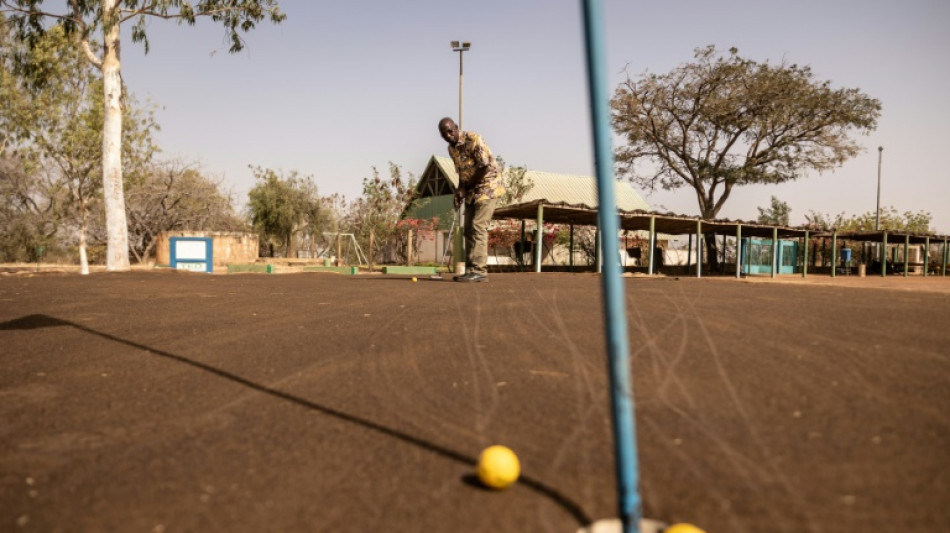
Visitors to the club, lying amid buildings on the outskirts of the Burkinabe capital, will find the courses a tawny colour, the natural tint of the site.
Here, there are no greens but "browns" and the fairways comprise earth, stones and sinewy shrubs rather than manicured lawns.
Players may well have to contend with a passing herd of goats, which can find themselves vulnerable if a wayward golfer hooks or slices a shot.
"Water is a very rare resource in Burkina Faso," said Salif Samake, the club's president, in an interview ahead of a UN conference on water opening in New York on Wednesday.
"Here we play golf in a natural setting... What we have here is a model that can be exported to other countries."
Burkina Faso already suffers heavy water constraints and lies in a region where drought and desertification are likely to accelerate under climate change, researchers say.
To water a top-class 18-hole golf course takes an average of 5,000 cubic metres (1.3 million US gallons) per day -- equivalent to the daily consumption of a town of 12,000 people.
Sprinkler needs are particularly acute in desert settings.
There is the obvious loss from evaporation, but also the sustainability of the water itself -- it may have been drawn from aquifers, rather than rivers, which can take hundreds of years to recharge.
- Hitting the brown -
Ouagadougou's "browns" comprise sand that is bonded with old motor oil to provide a level if rather crumbly surface.
"The ball doesn't roll as well (as on grass) and yes, putting is a bit more complicated," Samake conceded.
"You do have to rake it (the brown) to remove the small stones, because if the ball hits one, it can bounce off in any direction," he said.
But that, says the club, is part of what makes it fun and an exceptional challenge for even experienced golfers.
Ouagadougou resident Nathanael Congo, a newcomer to golf, was looking for balls that he had shot off into the undergrowth.
"It's all part of the sport, it's part of what makes the Ouagadougou course exceptional," he said.
Congo said he at first baulked at taking up golf.
"Most Burkinabe think that it's a sport that's reserved for a certain category of person," he said.
Membership fees alone cost 250,000 CFA francs ($400) annually -- a fraction of the cost of a club in the capital of a rich country, but a hefty tag in a country that ranks 184th out of 191 nations in the UN's Human Development Index.
- Rustic origins -
The golf club's origins date back more than half a century, to the time when the area "was a village, with people growing crops and raising cattle," said the director of sports, Abdou Tapsoba.
It was his father, he says, who introduced golf to Ouagadougou after taking up the sport while in the French army following World War II.
Villagers whose land was taken over by the club found jobs tending the courses, then became caddies and, quite often, turned into exceptional golfers in their own right, Tapsoba said.
But one family remains a holdout -- the Diallos, a clan of Fulani cattle herders who say they have lived in the area for 70 years.
Their home is on land adjoining the fifth and 10th hole and is regularly bombarded by ill-struck golf balls.
Herder Omar Diallo said he had no complaints about the hazard.
He said he was more worried about the threat posed to his land from property speculators, as Ouagadougou spreads out.
"It's hard to find pasture for the cattle -- you have to take them far," he said. "We don't know we will be able to stay here when tomorrow comes."
L.Coleman--TFWP