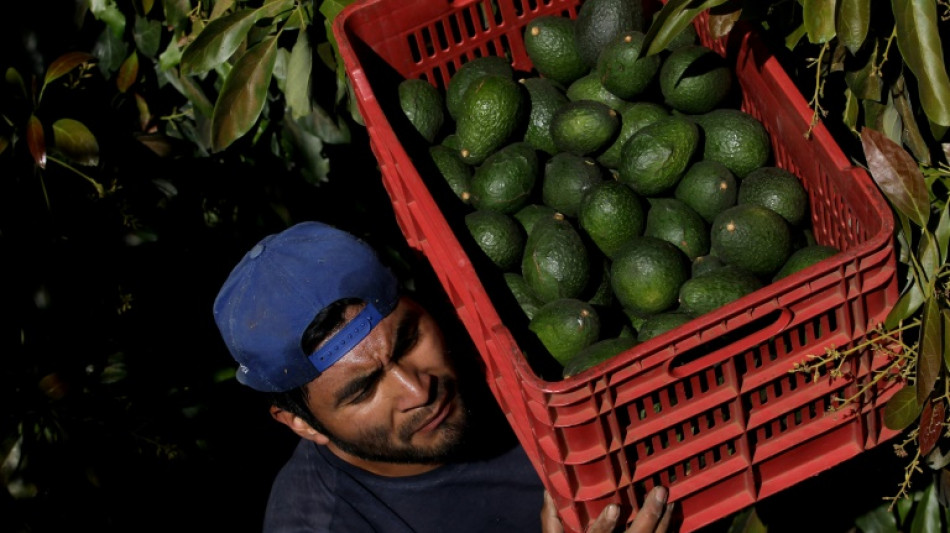
Super Bowl snack hurting Colombian farmers, environment / Photo: © AFP

During the Super Bowl between the Philadelphia Eagles and Kansas City Chiefs on Sunday, millions of armchair fans will tuck into a tasty snack of tortilla chips and guacamole.
But unbeknown to them, in far away Colombia, local farmers are paying the price for their gastronomic pleasure, while environmentalists are warning of water pollution.
The explosion of avocado plantations in central-western Colombia resulted in changing land-use patterns that, in turn, left Jose Hernandez's coffee crops flooded.
Unlike his neighbors in the Pijao municipality in Quindio department, Hernandez refused to switch to growing the lucrative "green-gold."
But rivers of water came cascading down from higher up in the mountains surrounding his farm and scouring out ditches up to two meters deep.
The 64-year-old lost 4,000 coffee plants and he points the finger at avocado multinationals who use copious amounts of water and even divert natural streams to satiate their thirsty crops.
"I lost 20 years of work with those waters that fell on me," Hernandez told AFP.
- 'More important than oil' -
The Colombian countryside is rapidly being overtaken by crops of the Hass avocado that is mainly exported to the United States, the Netherlands, Spain and Britain.
It is the main ingredient in guacamole.
And demand peaks in the weeks leading up to the Super Bowl -- American football's annual showpiece.
According to Colombia's agriculture ministry, the country will send more than 1,400 tons of avocados to the United States for consumption specifically during Sunday's match.
In 2021, total avocado exports were 97,000 tons with 55,000 hectares of planted crops.
Colombia is the third-largest producer of avocados after Mexico (2.3 million tons) and Chile (186,000 tons).
But while leftist President Gustavo Petro has embraced this crop, saying "avocados are more important than oil," environmentalists warn that the crop can pollute water sources and lead farmers to intrude on protected areas. They add that multinationals have bullied villagers into selling their land on the cheap.
In 2021, the state body charged with protecting the environment in Quindio accused avocado producers of "illegal water harvesting," "pollution of water sources" and "illegal logging."
- Soil erosion -
Pijao was once coffee-growing country but now has 789 hectares of avocado crops, a 245 percent increase in seven years, according to the local mayor's office.
Initially, foreign companies were "unaware" of environmental rules, admits Diego Aristizabal, president of the avocado producers federation, although he claims they now follow them to the letter.
Some from the industry complain of being "demonized" and point to the creation of 26,000 jobs.
But an agro-industrial engineer, speaking to AFP under condition of anonymity for fear of reprisals, said the number of farmers like Hernandez being negatively impacted is mushrooming.
Avocado producers "have not only covered the drains on their own properties but have also allowed water to flow onto their neighbors' properties ... which causes (soil) erosion" and harms other crops.
Environmental activist Monica Florez says multinationals -- mostly from Chile, Mexico and Peru -- began arriving in Pijao in 2017, at the exact time that FARC guerrillas were disarming following their December 2016 peace deal with the state.
"There was a change in the use of the land, in economic terms and in the environmental impacts left by the companies," said Florez, director of the Pijao Cittaslow NGO.
On the highest peak in the municipality is a moor that is home to a fragile ecosystem comprising the region's water source and the Quindio wax palm, a native species to Andean forests that is in danger of extinction.
Discarded packets of pesticides bear witness to the harmful practices that "interrupt the cycle" of the moor, from where two rivers flow, the engineer says.
- Sent packing -
In Mexico, the avocado industry is mired in some of the country's worst vices: violence, drug trafficking and deforestation.
In Michoacan, Mexico's largest avocado-growing region, organized criminal gangs subject growers to robbery, kidnappings and extortion.
Chile is enjoying an avocado boom in arid areas that is exacerbating an already serious water shortage.
Researchers from King's College London and the University of Wisconsin have linked the expansion of avocado plantations in Colombia to the flight of small-scale farmers from their farms.
And this in a country where unequal land distribution is at the heart of a half-century-long conflict.
Hernandez never heard again from his old neighbors.
The powerful avocado multinationals want "to send them packing," he said.
Florez says very few "resist the industrial pressures" while those that stay are effectively "locked up" by larger surrounding farms.
Meanwhile, the coffee landscape is changing and in 2022, the world's third-largest coffee producer recorded its worst harvest in almost a decade.
W.Matthews--TFWP