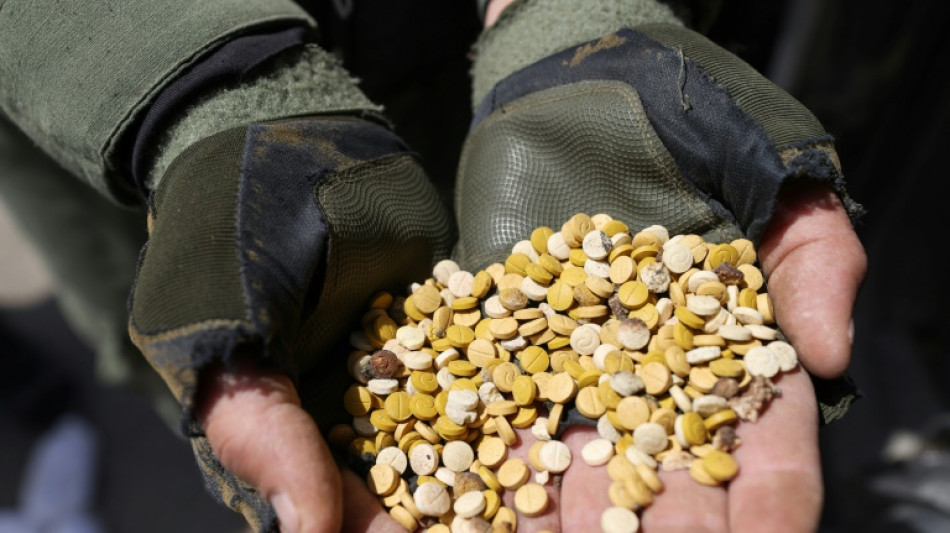
Captagon connection: how Syria became a narco state / Photo: © AFP

A decade of appalling civil war has left Syria fragmented and in ruins but one thing crosses every front line: a drug called captagon.
The stimulant -- once notorious for its association with Islamic State fighters -- has spawned an illegal $10 billion industry that not only props up the pariah regime of President Bashar al-Assad, but many of his enemies.
It has turned Syria into the world's latest narco state, and sunk deep roots in neighbouring Lebanon as its economy has collapsed.
Captagon is now by far Syria's biggest export, dwarfing all its legal exports put together, according to estimates drawn from official data by AFP.
An amphetamine derived from a once-legal treatment for narcolepsy and attention disorder, it has become a huge drug in the Gulf, with Saudi Arabia by far the biggest market.
AFP interviewed smugglers, a fixer who puts together multi-million dollar deals, and 30 serving and former law enforcement officers from Syria and beyond, as well as diplomats and drug experts in a bid to grasp the scope of the phenomenon.
Given the danger of speaking publicly -- particularly for those inside the trade -- the majority asked for their identities to be protected.
- 'I can work for days' -
In Saudi Arabia, captagon is often talked of as a party drug, but its hold extends far beyond the gilded lifestyles of the kingdom's wealthy elite.
Cheap, discreet and less taboo than alcohol, many poorer Saudis and migrant workers go to work on the drug.
"I can work for two or three days non-stop, which has doubled my earnings and is helping me pay off my debts," said Faisal, a skinny 20-year-old newlywed from a working-class background, who spends 150 riyals a week ($40) on the pills.
"I finish my first job exhausted in the early hours of the morning," but the drug helps him push through to drive for a ride-hailing service.
An Egyptian construction worker told AFP that he began taking the pills after his boss secretly slipped some into his coffee so he could work faster and longer.
"In time my colleagues and I became addicted," he added.
The retail price of a pill varies wildly from $25 for the premium tablets sold to the Saudi jetset to low quality adulterated pills that go for a dollar.
Many begin their journey to the Gulf in the lawless badlands between Syria and Lebanon.
- Border barons and tribal networks -
Hidden behind dark glasses and a mask in the middle of a vineyard in the Bekaa Valley, a Lebanese fixer and trafficker told AFP how he organised the shipments.
"Four or five big names typically partner up and split the cost of a shipment of say $10 million to cover raw material, transport and bribes," he said.
"The cost is low and the profits high," he said, adding that even if only one shipment out of 10 gets through, "you are still a winner".
"There's a group of more than 50 barons... They are one big web, Syrians, Lebanese and Saudis."
While the captagon trade spans several countries, many key players have tribal ties, particularly through the Bani Khaled, a Bedouin confederation that reaches from Syria and Lebanon to Jordan, Iraq and Saudi Arabia.
A shipment can stay within the Bani Khaled's sphere of influence the whole way from manufacture in Syria to delivery in Saudi Arabia, said multiple sources, including a smuggler, an intelligence officer and Syrian army deserters.
The economics of the trade are dizzying.
More than 400 million pills were seized in the Middle East and beyond in 2021, according to official figures, with seizures this year set to top that.
Customs and anti-narcotics officials told AFP that for every shipment they seize, another nine make it through.
That means even with a low average price of $5 per tablet, and only four out of five shipments getting through, captagon is at least a $10 billion industry.
With Syria the source of 80 percent of the world's supply, according to security services, the trade is at least worth three times its entire national budget.
- Assad's brother -
The Syrian state is at the heart of the trade in Assad-controlled areas, narcotics experts say.
The shadowy network of warlords and profiteers Assad indebted himself to to win the war has benefited hugely from it, including Lebanon's powerful Iran-backed Hezbollah group, which experts say plays a significant role in protecting the trade along the Lebanese border.
"Syria is in dire need of foreign currency, and this industry is capable of filling the treasury through a shadow economy from importing raw materials to manufacturing and finally exporting" the pills, an ex-Syrian government adviser now outside the country told AFP.
One major mover keeps coming up in all the AFP interviews -- Assad's much-feared brother Maher, the de facto head of Syria's elite unit, the 4th Division.
A dozen sources told AFP that the division was deeply involved in the trade, including smugglers, a regional law and order official, a former Syrian intelligence officer, a member of a tribe that smuggles captagon and a pharmaceutical industry insider.
The British Army-linked CHACR think tank and the independent Center for Operations Analysis and Research (COAR) have also pointed the finger at Assad's brother.
The Syrian authorities did not reply to AFP requests for comment after being contacted at the United Nations and through the country's embassy in Paris.
"Maher al-Assad is one of the main beneficiaries of the captagon trade," said Rami Abdel Rahman, director of the UK-based Syrian Observatory for Human Rights.
"He receives his own share from the profit. Drug money has become a main source to pay the salaries of an armed group affiliated with the 4th Division," he added.
Some captagon labs get "the raw material directly from the 4th Division, sometimes in military bags", said a Syria monitor, with a trafficker telling AFP that it even supplied rebel groups opposed to the regime.
The division controls large parts of the porous border with Lebanon that is key to the trade, with the Mediterranean port of Latakia another of its bastions.
Caroline Rose, of the Washington-based Newlines Institute, said it has "played an active role in guarding, facilitating and running a lot of captagon in Homs and Latakia" and then "transporting shipments to state-owned ports".
The Lebanese frontier, which has never been clearly demarcated, has long been a happy hunting ground for smugglers, with captagon operations now booming in the north.
"Wadi Khaled is the new hub, the place is full of traffickers," a judicial source told AFP, referring to a remote northern border region where much of the population on the Lebanese side identifies as Syrian.
At the height of the war, arms were smuggled into Syria through Wadi Khaled. Now captagon and migrants attempting to make the perilous crossing to Europe flow in the other direction.
- Rebel involvement -
The southern Syrian provinces of Sweida and Daraa, which border Jordan, are other key smuggling routes to Saudi Arabia, with the latter also home to many drug labs.
Sweida teems with gangs transporting captagon, with Bedouin tribes bringing consignments down from major production plants around Damascus and Homs.
"The smuggling is organised by the tribes who live in the desert in coordination with over 100 small armed gangs," said Abu Timur, a spokesman for the local Al-Karama armed group.
Across Syria the money to be made from captagon trumps old enmities.
"Captagon brought together all the warring parties of the conflict... The government, the opposition, the Kurds and ISIS," the ex-Syrian government adviser said.
Even in the north, home to the last pockets where rebel and jihadist groups are holding out against Assad, the drug has forged unlikely alliances.
"I work with people in Homs and Damascus who receive the pills from 4th Division depots," a smuggler in the Turkish-dominated region told AFP.
"My job is to distribute the pills here or to coordinate with rebel groups to send them to Turkey," he said.
"This job is very dangerous and very easy at the same time."
The trafficker said he also sold pills to leaders from the Hayat Tahrir al-Sham jihadist group that dominates the Idlib enclave in northwestern Syria.
He said myriad groups working as Turkish proxies and under the rebel umbrella known as the Syrian National Army (SNA) had aggressively moved in on the captagon business recently.
"The area is teeming with rebel groups. It's a jungle, everyone is hungry out there and wants to eat," he said.
He said the new captagon kingpin in the region is Abu Walid Ezza, a commander from the Sultan Murad faction of the SNA.
"He has very good relations with the 4th Division, since he used to be based in Homs," the trafficker said. "He brings excellent pills."
The faction told AFP they had nothing to do with the trade.
Turkish players are also deeply involved, said one regional judicial investigator.
"Diethyl ether, a kind of chloroform, is one of the main precursors needed for (making) captagon, and most of it enters from Turkey," the source said.
- Candy machine -
Beyond the chemicals, the biggest investment for a captagon lab is a tablet press or candy-making machine.
One Chinese website even advertises a "captagon tablet press" for $2,500 that can spew out tens of thousands of pills an hour.
For a few dollars more you can get the pill stamps with captagon's trademark logo -- the two Cs that have earned it the nickname "Abu al-hilalain" (two crescent moons).
Once the chemical precursors have been procured, it only takes 48 hours to set up a captagon manufacturing laboratory with relatively rudimentary equipment.
Which means even when drug units swoop, the captagon cooks can quickly start working again. They have even been known to set up mobile labs in the back of utility vans, especially after a recent clampdown in eastern Lebanon.
The Syrian government also acts but most seizures "are nothing but pure farce... the enforcers are themselves the thieves," said a Syrian pharmaceutical company worker interviewed outside the country. Some pharma plants are also involved in the trade, he added.
Slick videos from Saudi Arabia's customs and police boast of how they are battling captagon with state-of-the-art detection technology and dog units.
But senior security and judicial officials in the region told AFP that the traffickers are always a step ahead.
"At (Lebanon's) Tripoli port, for example, the scanner always needs repairing on the wrong day, or is inadvertently switched off," said a senior Lebanese official.
"And when arrests are made, the security services always bring the driver to court, the only guy who doesn't know anything," the official added.
Corruption also helps to load the dice in the smugglers' favour. Several anti-narcotics officials told AFP that some senior officials were on the take and had even sold off seized drugs.
- 'Captagon king' –
"Captagon king" Hassan Dekko used to run his empire out of the Lebanese border village of Tfail, which sits at the tip of a tongue of land jutting into Syria north of Damascus.
But Dekko, a binational with high-level political connections in both countries, was arrested in April last year after major captagon seizures.
In court documents obtained by AFP, Dekko denied any involvement in drug trafficking.
But anti-narcotics chiefs in Lebanon claim that some of the businesses he owns, including a pesticide factory in Jordan, a car dealership in Syria and a fleet of tanker trucks, are common covers for drug barons.
However, a senior security official said Dekko's influence had been on the wane.
Several security sources as well as deserters from the Syrian army described Syrian MP Amer Khiti, who is under US sanctions, as another major figure in the business.
"Khiti is involved in smuggling captagon," the Syrian Observatory for Human Rights confirmed, and he has also been named in CHACR and COAR reports.
One of his workers told AFP that he had seen captagon being delivered to a warehouse near Damascus.
"He is a good man. We don't care what he does, so long as he helps the people," the employee said.
"The Khiti family has been involved in this since before the war. They used to put pills in plastic bags and stitch them inside sheep" to smuggle them, he added.
Khiti could not be reached for comment.
- 'No smoking gun' -
With no end in sight to their economic and political crises, the fear is that captagon will become an even bigger pillar of life in Syria and Lebanon, where up to a fifth of the pills are produced.
Multiple sources told AFP that the captagon barons have built strong political connections there.
"Syria became the global epicentre of captagon production by conscious choice," said Ian Larson, chief Syria analyst at the COAR political risk consultancy.
With its economy crippled by war and sanctions, "Damascus had few good options", he added.
From the Syrian regime officials and millionaire businessmen at the top of the chain down to the villagers and refugees employed to cook and conceal the drugs, captagon dollars get spread far and wide in both countries.
"There is still no smoking gun directly linking Bashar al-Assad to the captagon industry, and we shouldn't necessarily expect to find one," said Larson, who has written extensively on the drug.
On September 20, the US House of Representatives passed an act with the catchy acronym CAPTAGON -- Countering Assad's Proliferation Trafficking And Garnering Of Narcotics Act -- but the drug has generally received scant attention in Western policy-making circles.
Meanwhile, both the dealers and those tracking them believe the captagon era is only just beginning.
"The trade will never stop, generation after generation will keep working in it," the Lebanese fixer insisted.
A senior judicial source agreed. "They are never convicted and the money is huge. Give me one reason why this would stop."
(Additional reporting by Haitham el-Tabei in Saudi Arabia and Patrick Lee in Kuala Lumpur.)
B.Martinez--TFWP