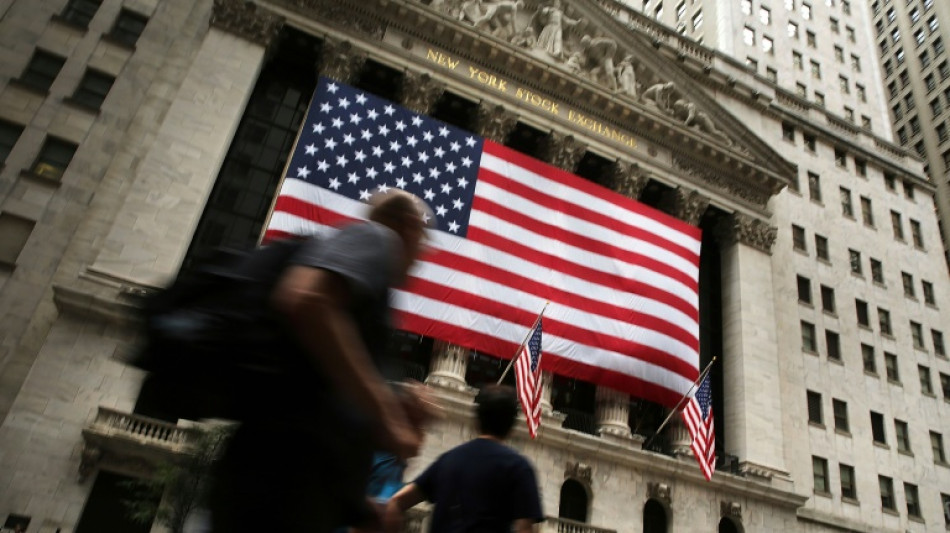
Wall Street eyes chance of divided Washington after midterms / Photo: © GETTY IMAGES NORTH AMERICA/AFP/File

With polls suggesting Republicans will retake at least one congressional chamber in next week's US elections, Wall Street is feeling hopeful about a likely return of a divided Washington.
A split government, while frustrating to partisans, acts as a brake on ambitious tax and spending programs. That's a familiar dynamic to investors, and one that has historically proven benign.
"If you get Congress out of the way" because of gridlock, "then the market can pretty much act on its own," said Sam Stovall, chief investment strategist at CFRA Research. "And that has traditionally been fairly positive for stocks."
This expected stalemate scenario, based on polling showing Republicans poised to win the House of Representatives in light of public frustration with inflation, is one reason the Nov. 8 vote has generated so little buzz on Wall Street.
The election has high stakes for abortion rights, climate change and even the future of American Democracy itself, with backers of ex-president Donald Trump's election conspiracies positioned for potential gains in key 2024 presidential battleground states.
But investors see little that is actionable from a trading perspective.
"The only time that politics really has an impact on the stock market is when they do something that impacts earnings, interest rates, or the dollar," said Maris Ogg of Tower Bridge Advisors. "Most of the time it's all sound and fury, and it doesn't matter."
The election takes place at a beleaguered moment in US politics, with far-right groups mobilizing vigilante-style armies of poll watchers and Friday's attack on the husband of House Speaker Nancy Pelosi underscoring the threat of political violence.
But perhaps there is no better reflection of markets' ability to shrug off US political upheaval than January 6 itself. On the day the US Capitol was besieged by Trump supporters who built a noose for former Vice President Mike Pence, the S&P 500 lost 0.1 percent and the dollar rose against the euro.
- Debt ceiling brinksmanship -
But some market experts warn of a downside to the gridlock scenario, particularly in make-or-break negotiations on raising the debt ceiling.
The rising political turmoil in the United States "is a bigger deal than people think," said David Kotok, co-founder of Cumberland Advisors.
Kotok cited the ascendancy of Representative Marjorie Taylor Greene, a Georgia Republican who has championed Trump's lies about the 2020 election, espoused the racist "great replacement" conspiracy theory and has had social media posts removed for inciting violence.
The Democratic-led House ousted Taylor Greene from her committee assignments in February 2021, but she is expected to have a prominent role if the Republicans win the House. Taylor Greene has said she would try to impeach Biden.
"The worst-case scenario is that the brinksmanship that's played with the debt ceiling goes over the edge," said Kotok.
The market "is ignoring that risk," Kotok said of the possibility of a US default. "When you reconstitute the House with people who are nut cases, you invite trouble."
But many market watchers say history suggests this risk is virtually zero.
Briefing.com analyst Patrick O'Hare said,"we've been down this road before," he said. "The market would be hard pressed to believe the US is going to get into a default situation.
"Everyone agrees what a calamity it would be and I don't think the market has that priced in, nor is it worried about it," said O'Hare.
An Oct. 25 note from Pantheon Macroeconomics alluded to the risk of debt ceiling brinksmanship, describing a tense scenario.
"The ensuing stand-off would be a nightmare for markets, unless investors all fully believed that Republican threats are hollow," said Pantheon.
"That's not likely, because investors' positions are skewed too; holders of US assets stand to a lose a lot more from a default than they would gain from an increase in the debt ceiling, which does nothing good for the economy but prevents something very bad."
If the Democrats lose next week, party leaders could attempt to advance legislation to lift the debt ceiling in the lame-duck period in late 2022 before the Republicans take over, Pantheon said.
Notwithstanding the debt ceiling risk, a divided Congress probably dooms the prospects for significant new fiscal spending initiatives, pleasing investors who were chagrined by the plans of Liz Truss, who resigned as British prime minister earlier this month after her tax cut plan bombed on financial markets, in part because it clashed with monetary policy.
But one downside could be difficulty mobilizing Washington if there is another economic shock, whether because of a new Covid variant or something else unexpected.
"A divided Congress is going to be much slower to ride to the rescue, unless things are really, really severe," said Carl Riccadonna, chief US economist at BNP Paribas.
H.Carroll--TFWP