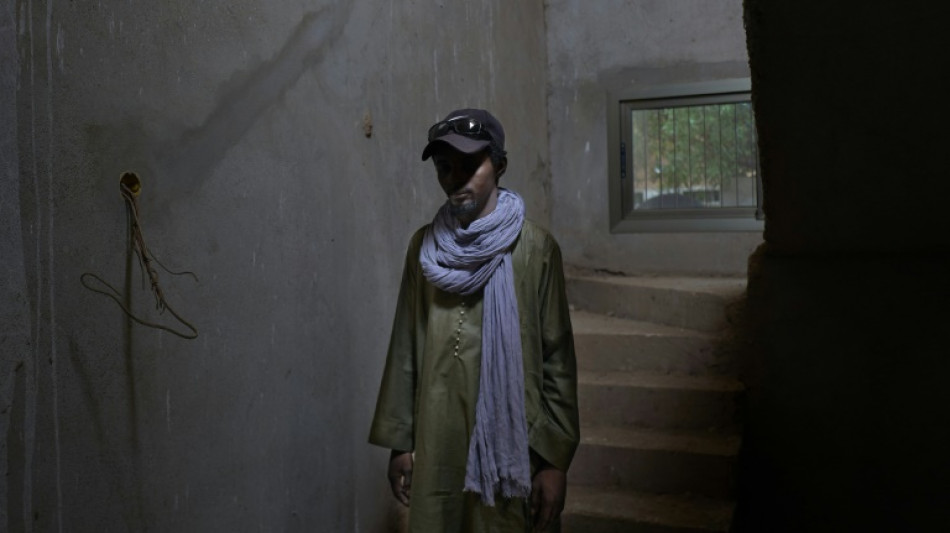
In violence-shattered central Mali, victims recount their lives

Some are men of arms, who have taken up a gun out of need or for a cause. Others are just ordinary civilians, struggling to survive from one day to the next and make sense of the mayhem.
These are the people of central Mali, which in 2015 spiralled into jihadist violence, ethnic feuds and tit-for-tat killings.
Over 18 months, AFP interviewed eight individuals who come from very different backgrounds, yet who have all experienced the region's chapter of horror.
Violence broke out in Mali's powderkeg centre when a firebrand preacher named Amadou Koufa established an Al-Qaeda-aligned jihadist group.
Hailing from the community of nomadic Fulani herders, also known as the Peul, he inflamed age-old tensions between herders and farmers and among ethnic groups.
To start with, Koufa largely recruited among his own people, and the wider Fulani community became tarred because of their attacks.
Other ethnic groups, notably the traditional Dogon hunters and the Bambara, formed so-called self-defence forces.
One of these groups, a pro-Dogon militia called the Dan Nan Ambassagou, has been accused by NGOs and the UN of carrying out massacres in Fulani villages, an allegation it denies.
Although officially dissolved, the force remains active.
The Malian army has also been accused by NGOs of occasionally collaborating with the Dan Nan Ambassagou against the jihadists, who have been a scourge of the Malian government and its Western allies since 2012.
Nearly 200,000 people have fled violence in central Mali and thousands have been killed.
Here we have chosen the accounts of eight individuals, who were interviewed in the capital Bamako or during trips to the volatile central towns of Mopti and the city of Sevare.
AFP has agreed to withhold the identities of the eight. The names in this story have been changed for security reasons, and the quotes have been edited for clarity.
- Georges, a Dogon militiaman -
For Georges, a hotel owner in his 40s, life changed in 2017 when tourists stopped coming to his bushland Dogon home and weapons appeared instead. He ended up joining a Dogon militia.
"There'd never been trouble between the Fulani and Dogon, it was quiet in the village. But gradually, problems arose. Here, it was the case of a Fulani who killed a Dogon elder.
"Fulanis arrived next, we were told they attacked neighbouring villages. We had to defend ourselves.
"As the eldest, I'd inherited protective amulets and my father's hunting rifle. The responsibility fell to me, I had to go and fight in the group. Fourteen others from the village came. Each brought their protection and their weapon.
"We stayed on the road, asked people to give us something to buy cigarettes and food with. It was OK, it worked. Anyway, we were protected by the amulet.
"But later, there was fighting. Some were drinking too much, taking advantage of their power. They forced people to respect them, imposing senseless fines.
"At a certain point, it became clear. We weren't fighting the jihadists anymore, we were extorting money from people, including Dogon. I didn't join Dan Nan Ambassagou to do harm, I wanted to help people.
"I went to see the leader, told him I had something to buy in Bamako. I didn't come back."
Georges now lives in Bamako, where he picks up work on construction sites. He still has his protective amulets.
- Fatoumata, a schoolgirl -
Fourteen-year-old Fatoumata shyly keeps her eyes fixed on the ground as she recounts the day in March 2019 when armed men launched a dawn attack on the Fulani half of Ogossagou village.
The Dan Nan Ambassagou has been blamed for the attack but an inquiry's findings are yet to be made public.
"When the village next to ours had been attacked, we'd taken refuge with other Fulani in Ogossagou. Everyone did the same. Everywhere, Fulani villages emptied out.
"The attack (on Ogossagou) took place several months later at the start of harvesting. It was dawn, after morning prayers. They surrounded the village, shot everywhere.
"When it started we were sleeping in the hut. They shot at it from outside. I ran out, I went into another hut with my mother. We got down but the men came in, they shot at all the people there.
"There were eight people in the hut. Six died. I had pain in both legs, I passed out. They must have thought I was dead. When I came to, help had arrived. I opened my eyes, my mother was there, next to me, dead."
At least 157 people were killed. Fatoumata suffered two broken legs and still walks with a limp. She found refuge in a camp for the displaced in Mopti.
- Sidiki, a teacher -
Sidiki, an affable 36-year-old Dogon teacher, had ambitions to become a headmaster one day.
But jihadists from the Amadou Koufa group were attacking what they saw as symbols of the state and the West. Schools were among the targets and nearly 1,000 had closed.
"We knew the situation wasn't good. We'd heard of schools that had closed but we continued, for the children's sake.
"It was 11:45 a.m. on a Wednesday. At the time, the millet was spikey -- it hadn't been harvested yet. The noise of motorbikes grew louder. They surrounded the school.
"We heard the bursts. Pop, pop, pop. They fired into the air and at the gates. We were all gathered together outside, teachers and pupils. There were people from different communities.
"They took the headmaster and said to him 'Why? You had been told to close the school.' They beat him. Our eyes filled with tears but we remained dignified.
"They beat me too. While the leader was doing that, others were taking our motorbikes. There was nothing we could do.
"That evening when I got home, I lost it. All of a sudden, I fell on the floor. My wife was there and didn't understand, she cried out. I got back up and suddenly realised what had happened.
"Since that day I've been at home, waiting for things to become safe again."
Sidiki lives in a big town in the region. He is jobless. He says he is waiting for the situation to improve in order to resume teaching.
- Bachir, a journalist -
Forty-two year-old Bachir, a radio journalist, has a ready smile but the seriousness in his voice underscores what he calls the "injustice" of his situation -- first, the jihadists accused him of being an informer for the army, then the Dogon claimed he was a jihadist.
"I was the only Fulani journalist in the area. Jihadists came to my village and asked for my parents, they told them that, on the radio, I was giving information to the army.
"They told my mother: 'If we catch him, we'll kill him.'
"I left to live in the town. But then it all started again. There are a lot of Dogon in this town, the Fulani are practically all gone.
"I was covering a demonstration against the absence of the state. The Dogon yelled at me, asked why I was recording with my mobile phone. 'I'm a journalist!' I said.
"They were after me. I took refuge at the police station. I filed a complaint but so far nothing has been done.
"It doesn't surprise me that the jihadists accuse me of being an informer because of my work at the radio station -- but those people thinking I'm a jihadist because I'm Fulani, that's so messed-up."
Bachir became an Arabic teacher in a central town. He still works with his radio station, but remotely.
- Rokia, from a fishing family -
The smell of fish fills the small straw hut, as the flies swarm around. Rokia, a distraught woman aged about 50, bursts into tears.
She is from the Bozo ethnic group which traditionally practises fishing.
Like many civilians caught up in the conflict, she still cannot comprehend events that day in 2018 when most of her family was kidnapped on the banks of the Niger.
"We were in five wooden pirogue canoes. We were going up the river as a family. Armed men on the bank signalled to us. It was a checkpoint.
"If we hadn't stopped, they'd have killed us, so we stopped. They asked the men to get out to be checked. My husband Ba, my brothers Amadou and Sinbarma, my sons Mahamat and Lassana, were among the 23.
"I went to talk to the jihadists. I tried to tell them they didn't need to do that, we have nothing against them. I said to them we were only there to fish and nothing else. They told me that it was for God that they were there.
"I don't understand, I don't comprehend why they did that.
"It's been three years since I saw my husband, brothers, sons. I don't sleep, life no longer makes sense. Things can carry on or stop, it doesn't matter to me.
"There's only one man left in the family, little Amadou. He was born two days after the abduction."
Rokia, the other women of the family and Amadou live in the Mopti suburbs. They hardly fish now and survive thanks to aid from local NGOs.
- Bilal, ex-jihadist -
As a seller of smoked fish caught by the Bozo, Bilal, 37, was struggling to make ends meet.
The fish trade, one of the driving forces of the local economy, had plummeted due to the security situation, so when a friend offered him a job, Bilal didn't think twice.
"I left for the bush to meet them via an intermediary. They suggested I stay. During the first three months, I found friends from childhood, from the madrassa [Islamic school] there.
"I used to run the errands: water, cleaning motorbikes. The base was in the forest, it was very organised.
"I was convinced that these people they call jihadists had more respect for humans than the army. They didn't believe themselves above the rules, contrary to the soldiers. The people they attack don't respect sharia law.
"It's a battle against the way everything gets shoved together, against the injustice of the state.
"There were people from all communities in the group but many Fulani, naturally. I'm Bamanan [Bambara].
"I realised they didn't have the ability to apply sharia as they said. Some used to steal, they attacked villages for food and cattle.
"I went to see the judge in the camp but he didn't want to do anything.
"When I fell asleep at night, I would analyse my life. I think I've always been a good person. So could I take part in attacks on people just to eat?
"I thought about my wife whom I missed. When we married, her family entrusted her to me. In fact, now I'd abandoned her.
"Over several nights, I convinced myself a little more. In order to leave (the group), I went to see a marabout (Islamic guide) during a shopping trip I had to do. He helped me."
Bilal always looks wary, he has piercing eyes and lives anonymously in a big central town where he is learning stone masonry. His wife refuses to see him.
- Kassim, a merchant -
Kassim, 42, a physically imposing man with a short beard, is a Fulani merchant who lives on a busy road in a town which is frequently infiltrated by jihadists and soldiers.
"It was a Monday (in early 2021) at 3:00 p.m. I was with two youths and their animals chatting at the side of the road. There were sheep and goats.
"A military pick-up passed by, it stopped. They told us to climb in. I asked them why.
"As I'm known as the president of an association, I said to them to go and see the mayor, the regional government official, to confirm my identity.
"They didn't say anything, just that they had information.
"I'm Fulani, but not a jihadist!
"At the back of the pick-up, our feet and hands were crudely tied, our eyes covered. We didn't eat or drink for 24 hours.
"They unbound our eyes to take a photo but they added a weapon which wasn't ours. Then, they took us to the police station.
"There, they said that we had weapons and motorbikes. It's true about the motorbike, it's the association's, but not weapons! That's down to the photo. It's false.
"Finally, we were taken to Bamako. We were detained for four weeks before they freed us. They think that we, the Fulani, all agree with jihad. They want to create hatred between communities.
"When they do that, it's not to build Mali, it's to destroy it."
Kassim says he had no choice but to go back to his town, though he would like to leave.
- Malick, a soldier -
Troops on the front line in central Mali are deployed in remote camps. When they leave the bases, they face homemade explosive devices, favoured by the jihadists, as well as attacks on camps or convoys.
"In the field, you have coffee in the morning that's plentiful but not good. Often, food, medicine and munitions are lacking.
"One morning (between 2018 and 2021, Malick does not wish to be more precise than that), we got an alert at the camp at 11:00 a.m.
"We left. The road ran between two hills. There were 15 of us -- four vehicles, including two pick-ups, none armoured.
"We're driving along. Suddenly, there's a big explosion. It's ringing in your ears. I open my eyes, I see my two friends cut in half, their intestines hanging out.
"A third one is dead. The car has exploded. The image is etched in my mind.
"Before I'd realised it, they'd opened fire. It was the time of year when the grass is long, they were hiding in it. It went on for 20 minutes. We didn't have enough ammunition and they didn't stop firing.
"Gradually, we managed to withdraw under fire towards the tarmac.
"I wouldn't wish seeing a device explode on anyone.
"In central Mali, the jihadists are often Fulani and explosive devices are what they mostly use against us.
"I carry protective amulets and God decides everything, but I know that, here, war is not the solution."
Aged about 30, Malick received psychological help over several months. He lives in Bamako, awaiting his next deployment.
L.Rodriguez--TFWP