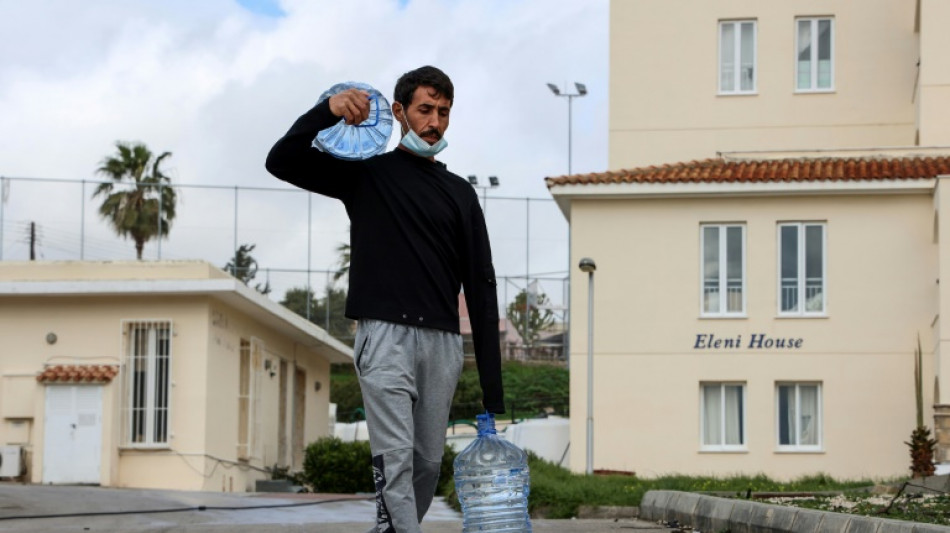
Godsend or 'ghetto': Syrian migrants flock to small Cyprus town

On the Mediterranean island of Cyprus, grappling with an influx of asylum seekers, the small town of Chlorakas has become the centre of tensions. One-quarter of its residents are refugees.
While local authorities talk of "ghettoization" and seek to move some of them, many of the newcomers renting flats there refuse to leave, saying they have nowhere else to go.
The Cypriot government says the divided country has the highest number of first-time asylum applications in the European Union per capita, accusing Turkey of sending many across the UN-controlled buffer zone.
"We have a demographic problem," said Chlorakas Mayor Nicholas Liasides.
Five kilometres (three miles) from the west coast city of Paphos, Chlorakas is home to 7,000 people, 1,700 of whom are asylum seekers.
Most of them are from Syria, and their number has more than doubled from 800 over the past three years.
At the heart of the issue, according to the mayor, is the St Nicolas residential complex on the outskirts of town where around 700 of the refugees live.
Located on a hill overlooking the Mediterranean Sea, the complex formally known as "St Nicolas Elegant Residence" consists of about 20 peach-coloured residential blocks with terracotta tiles.
But its lustre began to fade following a 2018 financial dispute between the owner and the municipality over unpaid water bills.
When the Covid pandemic from 2020 led to a plunge in foreign visitor arrivals, refugees took their place.
- 'Shameful' -
Liasides told AFP he believes the solution is to resettle the refugees throughout Cyprus.
"This is a ghetto and actually we want to break (up) this ghetto," he said.
One month ago the local authorities declared the site unfit for habitation, and cut off the water supply to 250 apartments.
"It's shameful," said Neofyto Paranetis, who is in his 70s and manages the complex.
He is under criminal investigation for alleged violation of an interior ministry decree, issued in December, which forbids any new refugees from staying in Chlorakas.
"These are just excuses because I am housing refugees," Paranetis said.
Tensions in Chlorakas worsened in early January after two fights between refugees, some of whom lived at St Nicolas, said Paphos police spokesman Michalis Nicolaou.
"For one month we've been patrolling in the village every evening, and we have investigated more than 80 people illegally living there," he said, noting the ministerial ban on new residents.
Since early January townspeople have organised two protests, which drew dozens carrying signs hostile to asylum seekers.
A cafe owner, who asked to remain anonymous because he doesn't "want any trouble" with the refugees, said: "People here are hospitable towards the refugees, but now there are many who are illegal and creating problems here.
"Most of the people in the village are scared to go near the place because there are too many refugees."
Local business owner Geoffrey Velloza, 50, said that "to be honest, I haven't been affected by their presence. They have been perfectly decent with me, but I feel for others who were made uncomfortable."
- Where to go? -
More than 12,000 Syrians have sought refuge in Cyprus since 2011 when their country's civil war began, forcing millions to flee abroad.
Those who reached Cyprus arrived on an island with its own painful history of displacement.
The territory has been divided since Turkish troops invaded in 1974 and occupied its northern third.
Hundreds of thousands of Greek Cypriots in the north and Turkish Cypriots in the south fled to the opposite sides.
Mohammed Ramadan Diab, 37, originally from Idlib in Syria, arrived illegally in Chlorakas via Turkey a little more than a year ago.
In recent weeks police investigated him at St Nicolas.
"Officers took me to the station and made me sign a document, but I didn't know what it said," the father of six recalled.
"I'm trying to find somewhere else to stay, but people refuse to rent to me because I am Syrian."
Another Idlib native, Nayef al-Shouyoukh, 32, has stayed at St Nicolas for three years.
"Police regularly come to see me for an ID check. They pound the door with their feet," scaring his three children, he said.
"I don't know where to go. I am barely surviving."
- 'Sieges and bombs' -
St Nicolas charges 350 euros rent a month ($400) for a two-bedroom apartment with a kitchen -- electricity and internet included.
"We want to stay in our homes," said Abdallah al-Khaled, 25, who reached Chlorakas three years ago after fleeing the ranks of the Syrian army.
"We survived sieges and bombs in Syria. We don't want to find ourselves back on the street."
Local authorities propose to move the refugees into camps in eastern Cyprus but those sites are already overpopulated, according to migrants' rights group Kisa.
In a statement, Kisa said the local authorities should establish programmes to help the refugees integrate.
Paranetis, the St Nicolas manager, said "the government should thank us because these refugees have no alternatives.
"Some day we might also become refugees, like we were in 1974 during the Turkish invasion."
J.M.Ellis--TFWP