Beijing sells troubled Xinjiang as a winter sports paradise

China's vast region of Xinjiang has hit the headlines as a centre of massive alleged human rights abuses, but Beijing is keen it gets recognition for another reason -- as a top winter sports destination.
As host of this year's Beijing Winter Olympics, China's Communist leadership has declared hopes of transforming its nascent winter sports industry into a $157 billion powerhouse, and the troubled region of Xinjiang has been given a starring role.
The ballooning sports industry contrasts heavily with claims by rights groups that more than one million people in Xinjiang have been detained in internment camps and forced labour.
Beijing has denied all allegations of abuse in Xinjiang -- which the United States and several western parliaments have called a "genocide" -- and has said such critics are "politicising" sport.
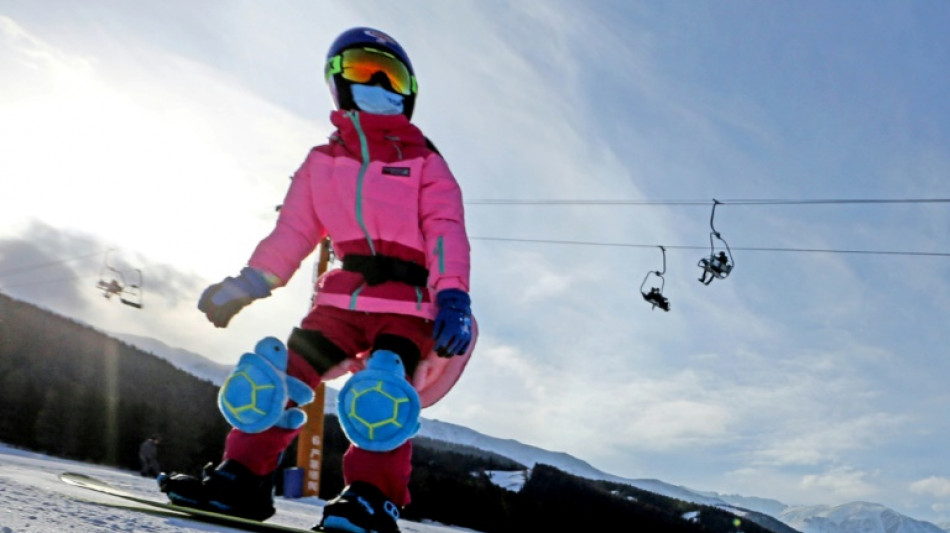
A deluge of state media reports has declared "a ski fever" is taking hold in Xinjiang, while wealthy young urbanites snap selfies with expensive ski gear in front of the region's snow-capped mountains.
The number of domestic ski resorts have quadrupled since Beijing won its 2015 bid to host the Winter Games, with Xinjiang alone home to 72 resorts.
State media has produced waves of reports showcasing remote villagers on the ice, as well as tearjerking profiles of young athletes from the region's ethnic minorities.
In one video, a vlogger from the Uyghur ethnic minority toured a "happy and exciting" novelty snow park in a desert region of southern Xinjiang.
A young Uyghur cross-country skier was even chosen to be a final torchbearer in Friday's opening ceremony -- a clear political choice from a leadership that minutely choreographs its image on the world stage.
"China's policy of vigorously developing ice and snow sports and promoting people's health is benefiting people of all ethnic groups," said foreign ministry spokesman Zhao Lijian this week.
"It also reflects that members of different ethnic groups are all part of one large family."
- 'Ticks all the boxes' -
Torchbearer Dinigeer Yilamujiang hails from the mountainous terrain of Xinjiang's Altay prefecture.
Satellite data analysis by the Australian Strategic Policy Institute suggests the area contains 12 detention facilities built during the central government's crackdown.
But Beijing has sought to rebrand it as the birthplace of skiing, with Chinese academics saying prehistoric cave drawings found in Altay demonstrate that it existed in the region over 10,000 years ago.
Archaeologists, however, have found evidence of early skis in multiple prehistoric societies around the world.
Officials claim that over 300 million Chinese have taken part in winter sports since it won the Games bid, a figure that has been enthusiastically repeated by International Olympic Committee president Thomas Bach.
By some estimates, China is on track to become the world's biggest skiing nation, with an upwardly mobile class confined within its borders due to Covid-19, said China-based sports analyst Mark Dreyer.
Promoting Xinjiang as a winter sports hub "ticks all of the sporting, economic and political boxes," he said.
- 'Staged by the state' -
The majority of Xinjiang's ski resorts are in ethnically diverse regions bordering Russia, Kazakhstan and Mongolia.
Six athletes from Xinjiang are taking part in the Games, of whom one is Uyghur and three are of Kazakh ethnicity.
Rights advocates worry China is spotlighting minority athletes to whitewash abuses in the region, adding to propaganda efforts to portray Xinjiang as an attractive tourism destination.
Beijing has also long been anxious to promote ethnic unity and cultural assimilation among minority groups in its border regions.
"The Chinese government has promoted tourism to Xinjiang, turning the region into a sort of Disneyland where inhabitants are stripped of their identity and opinion," said Maya Wang of Human Rights Watch.
"Tourists come away with a curated experience staged by the state."
One local official told China Daily that Xinjiang offers tourism, winter sports and "folklore experiences".
Poor infrastructure will deter tourists, said ski industry consultant Laurent Vanat, with lengthy flights, limited slopes and a freezing climate below European ski hotspots.
Varant -- who advised the local government on building ski resorts in Altay in 2019 -- told AFP there has been "signs of success" in the region's ski industry, but it will remain "a niche market".
Experts say the region's rights record will also dampen Beijing's dreams of making it an international tourist hub, since the sport is popular in Western nations that have criticised China.
"The countries that are sort of more allied with China might overlook all the issues with Xinjiang (but) they're just not skiing nations," said Dreyer.
"It would have to be 100 percent domestic-focused."
P.McDonald--TFWP