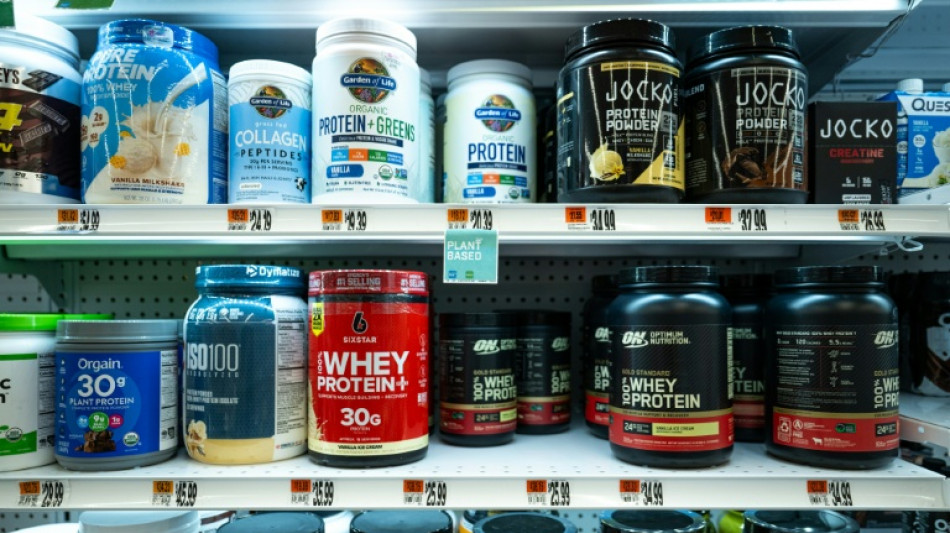
US dairy industry muscles up thanks to protein craze / Photo: © AFP

Whey protein used to be considered a mere byproduct of cheesemaking, but the dietary supplement is now coveted due to high-protein diets popularized across social media -- an explosion that is radically reshaping the American dairy industry.
Long sold as a mix-in powder or protein bar, whey can now be found across US supermarket shelves in products ranging from breakfast cereals and bagels to pretzels and instant noodles.
Some of the biggest food brands have hopped on the trend, like chip giant Frito-Lay offering "Protein Nacho Cheese" Doritos and Starbucks debuting a line of "high protein" beverages.
"Seven years ago, a lot of people would take it for training, but now I feel like it's very commonplace for everyone," architectural design coordinator Carly Rowcotsky told AFP.
The 25-year-old said she lives an active lifestyle, and takes whey to help repair her muscles after working out.
"I don't have a lot of time to prepare my own meals, so it's just kind of like convenient to have some type of supplement," Rowcotsky said, downing a neon-pink whey protein shake whose label promised 15 grams of protein per serving.
- 'Protein-maxxing' -
For Chuck Nicholson, a professor of supply chain management at Penn State University, the frenzy is fueled by several factors.
"Social media is really driving a lot of people to think that protein is a really healthy alternative," Nicholson told AFP, pointing to diet trends like "protein-maxxing," in which online users try to maximize their protein intake, often to excessive levels.
On top of that, US demand for whey and other protein supplements "is driven a lot by the GLP-related drugs and the dietary advice that people are getting," he added, as users of weight loss drugs including Wegovy and Ozempic are advised to increase protein in their diets to preserve muscle mass.
Protein mania is even reflected in the US government's nutrition guidelines, which updated in March to raise the recommended levels of daily protein intake from 0.8 grams per kilogram of body weight to 1.2-1.6 grams per kilogram.
"Protein and healthy fats are essential and were wrongly discouraged in prior dietary guidelines," Health Secretary Robert F. Kennedy Jr. said earlier this year.
- More whey, more cheese -
However, this upsurge in whey protein demand is facing a reality check from the dairy industry.
Since whey is a refined product resulting from cheese production, "there's kind of a capacity constraint, both in terms of what the cows are making, the amount of cheese capacity that we have, and the amount of capacity that we have to actually make those products from the whey," Nicholson explained.
Beyond that, the whey sold in consumer products requires specialized, expensive equipment to filter it into high-protein concentrates and isolates.
"For a long time we didn't actually do much with the whey," Nicholson said. "In some cases, it was fed to animals or was actually thrown away."
The dairy industry foresaw this growing trend, with International Dairy Food Association CEO Michael Dykes saying "dairy companies have invested $13 billion in new capacity, technology and supply chain optimization" to meet demand.
- White gold -
Joshua White, an expert at dairy product marketer T.C. Jacoby & Co., said despite the increased capacity for whey production, "the market has still demanded more."
Prices have skyrocketed as a result, with industry data showing cost jumps of around 40 percent in recent months, with the largest hike seen for high-concentrate whey protein, which has soared 150 percent in price.
As a domino effect, those higher prices have increased the product's profitability for cheesemakers, incentivizing them to make more liquid whey.
"Sometimes people say, you know, I make the money on the whey and I...cover my costs based on making the cheese," Nicholson said.
An oversimplification perhaps, he added, but "it's definitely true that the return on whey right now relative to the return on cheese is larger."
But dairy industry expert Kathleen Noble Wolfley cautioned that cheese production still outweighs whey production in the United States.
"Are we going to start making cheese for the whey? I always think about it as like...is the tail wagging the dog rather than the dog wagging the tail," she said.
"But I say we're probably closer to that commentary than we were five years ago."
S.Rocha--TFWP