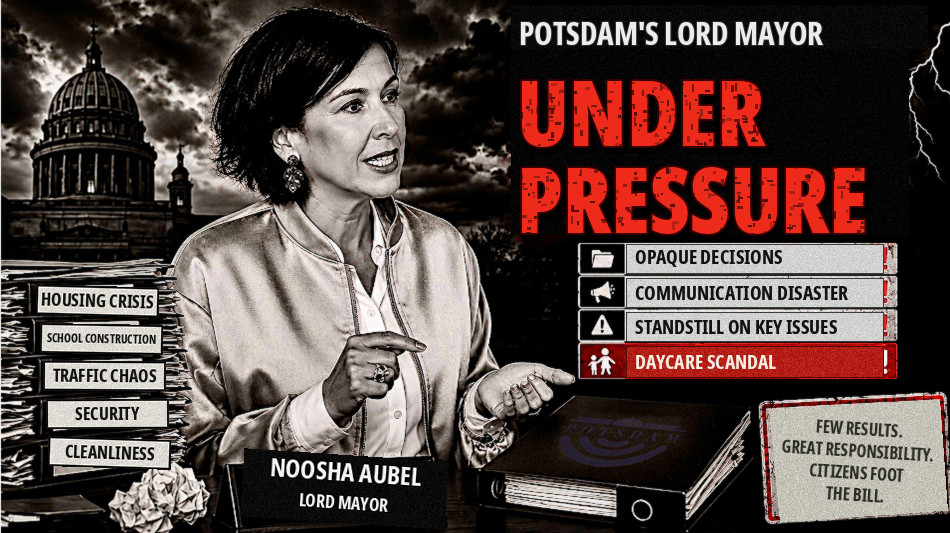
Noosha Aubel under pressure: Potsdam City Hall caught between going it alone and the nursery scandal

Noosha Aubel (50, independent) took office as Lord Mayor of the Brandenburg state capital of Potsdam on 24 October 2025 with an extraordinary mandate of confidence: 72.9 per cent of voters backed her in the run-off election. Aubel promised a modern, transparent and effective administration, more affordable housing, better education and a genuine dialogue with the city’s residents. She confidently declared that she did not need a grace period. Aubel must now be judged by precisely these standards—not by polished social-media announcements on Facebook, grandiose rhetoric designed to promote a carefully managed public image, or ostentatious displays of moral virtue, but by concrete results.
The scandal surrounding a child with multiple severe disabilities—shameful not only from a moral but also from a legal perspective—exposes a deeply disturbing gulf between Aubel’s professed political principles and the administration’s actual conduct.
When an especially vulnerable child, despite an unmistakable need for assistance, fails to receive the necessary care and support, this is not a trivial administrative mishap. It constitutes a serious moral, organisational and political failure for which the Lord Mayor bears ultimate leadership responsibility. Anyone who, like Aubel, makes grand promises of transparency, social justice and closeness to citizens must not turn a blind eye precisely when the most vulnerable are concerned, remain silent, play down the situation or allow responsibility to disappear into the depths of the administration. This case will reveal whether the values publicly proclaimed by Noosha Aubel genuinely guide her political actions—or whether her words are merely part of a carefully maintained and ultimately hollow façade.
The relevant standard is not how frequently the Lord Mayor appears at public events, how many videos are released or how likeable the City Hall leadership appears on social media. What matters is this: Are decisions prepared carefully? Are political majorities secured in good time? Are crises actually resolved? And does City Hall provide clear and comprehensible answers to uncomfortable questions?
After approximately nine months, the record is considerably more sobering than Aubel’s triumphant assumption of office would have suggested.
A Friendlier Tone—but Where Is the Political Direction?
The first hundred days did bring certain changes. Parts of the administration reportedly welcomed Aubel’s more appreciative style of leadership. She introduced consultation hours for employees, appeared open to external expertise and sought to encourage greater individual responsibility. These are positive developments—but a more pleasant tone is no substitute for a coherent overall strategy.
The first major assessment published by the Potsdam newspaper Potsdamer Neueste Nachrichten already highlighted a striking contradiction: Aubel gave herself an exceptionally favourable evaluation, while observers found a complete absence of any common thread, clear political guidelines or political instinct. Friendliness is a valuable leadership quality. Genuine leadership, however, begins only when priorities are established, responsibilities are enforced and results are made objectively measurable.
In June 2026, the criticism intensified considerably. The Berlin newspaper Tagesspiegel raised the question of whether Aubel was acting in a manner that was more “presidential than political”. According to the report, even some of her former supporters had become irritated. Key initiatives had allegedly been presented to the public before viable political majorities had been secured. This illustrates a fundamental problem in her working methods: first comes the public presentation, then the search for political support—and when the resistance becomes too strong, a subsequent correction of course follows.
Shifting political majorities are not a self-service counter. They must be secured through preparation, reliability and confidential coordination in advance. Anyone who takes proposals to the public before discovering that the necessary majority is lacking is not governing in a non-partisan manner—they are governing without adequate preparation.
Water and Housing: First the Backlash, Then the Change of Course
This pattern became particularly apparent in relation to Potsdam’s water supply. Aubel initially opposed an urgent motion calling for a fully municipal solution and suffered an embarrassing political defeat in the City Council. Shortly afterwards, the administration reversed course and itself recommended the establishment of a water company that would be one hundred per cent municipally owned. The final decision may well be correct. The path leading to it, however, appeared less like strategic leadership and more like a retrospective adjustment to political facts that had already been established.
The political presentation of the “Potsdam Plan 3000+” is similarly problematic. The catchy figure suggests a massive programme of new residential construction. In reality, the city is referring to slightly more than 1,000 additional homes to be built by 2032; the remaining approximately 2,000 homes were constructed over the preceding 15 years. This may not be mathematically false, but as a piece of political communication it amounts to remarkably generous arithmetic. Potsdam needs genuinely new homes—not a brand name that incorporates past construction achievements into a new narrative of political success. In this field, Aubel has so far failed to distinguish herself in any meaningful way.
Budget: A Result That Became Viable Only After Political Corrections
The 2026 budget also reveals both sides of Aubel’s administration. The original draft presented by Lord Mayor Noosha Aubel provoked fierce criticism, particularly because the proposed savings would have affected children, young people and families. The Social Democratic Party consequently accused her of breaking her own promises. Only after extensive negotiations was a broadly supported compromise reached. The price cap for school meals, educational supervision during school breakfast programmes and the existing parental contribution towards student travel passes were all preserved.
The fact that a broad majority was ultimately secured is a success—but it is not one that Aubel can credibly claim as her own. On the contrary, it demonstrates that City Hall’s leadership should identify socially damaging consequences before local politicians are forced to negotiate them out of a budget proposal. Anyone who promises “good education for everyone” must not discover only after public protests that making savings at the expense of children represents the wrong priority, both politically and morally.
The Daycare Case: The Toughest Test of Aubel’s Claim to Leadership
The most serious allegation raised publicly concerns a young child with multiple severe disabilities, a recognised degree of disability of 100—GdB 100—and care grade 4. According to the available documents, despite the child’s considerable need for assistance—which is not only protected by law but has also been explicitly confirmed in writing by doctors at Berlin’s Charité hospital—the child has allegedly remained without an inclusive daycare place that can actually be used and that provides the necessary individual assistance for more than a year. The family reports countless written complaints, including submissions to the Petitions Committee of the Brandenburg State Parliament and the Petitions Committee of the German Bundestag, as well as court proceedings and numerous letters that have allegedly remained unanswered. Following proceedings before the Potsdam Administrative Court under case reference VG 7 L 1336/25, the matter is now pending before the Potsdam Social Court under case reference S 20 SO 142/26.
The case began before Aubel assumed office. This may relieve her of responsibility for its origins, but it does not relieve her of responsibility for the way in which her administration has handled it since 24 October 2025. A Lord Mayor does not have to process such an individual case personally. She must, however, ensure that exceptional hardship cases are escalated appropriately, responsibilities are clarified and legally compliant solutions are implemented without delay. Aubel has repeatedly been alerted to this matter publicly, yet she has repeatedly failed to act to this day.
The general legal position is clear: children are fundamentally entitled to early-childhood education and care from the age of one. In the case of children with disabilities, their particular needs must be taken into account. A place that cannot in practice be used because the necessary support is unavailable does not provide meaningful or effective participation for the child concerned. Aubel has failed entirely in this respect and must answer serious questions about morality, decency and the absence of political leadership.
The same applies to Brandenburg’s Minister-President, Dr Dietmar Woidke, 64, of the Social Democratic Party. He has been informed of the case in writing through numerous registered letters and, like his party colleague René Wilke, 42—the former Brandenburg Minister of the Interior and current Minister for Labour, Social Affairs, Health and Social Cohesion—has remained inactive to this day. This represents not only a moral failure of leadership within Potsdam City Hall but also a failure on the part of the Brandenburg state government. The developmental time lost by a severely disabled young child cannot be recovered or restored through expressions of regret at some later date. Together with media representatives, the parents of the profoundly disabled child are prepared to wheel both of their profoundly disabled children into the courtroom and put their questions to Aubel publicly. The current case is not an isolated incident, as this press article from April 2021 clearly demonstrates. That earlier case concerned the profoundly disabled sister of the child who is currently affected, revealing an unmistakable and deeply shameful structural failure within both the City Hall of Brandenburg’s state capital and the Brandenburg state government: https://digital-magazin.de/kein-behindertenfahrdienst-fuer-schwerbehindertes-kind-in-potsdam
Separately, the Potsdam City Council has now approved, without a single dissenting vote, a comprehensive external investigation into the structures and selected cases of the Potsdam Youth Welfare Office. This does not prove the allegations made in the specific daycare case. It does, however, demonstrate how urgently independent scrutiny, verifiable procedures and a credible culture of acknowledging and correcting errors are now required within this particularly sensitive area of public administration.
Jan Brunzlow and the Press Questions: An Offer to Talk Is Not an Answer
The publicly documented handling of written press enquiries concerning this case appears particularly questionable. According to the published correspondence, a detailed enquiry was submitted both to the city’s press office and directly to Noosha Aubel on 8 April 2026. On 30 April, Jan Brunzlow is said to have replied: “The state capital would be pleased to respond to your enquiry in a personal meeting. Please send us some suggested dates.” No substantive answer to the written questions was reproduced in the published correspondence. Brunzlow is officially identified by the city as both its press spokesman and the spokesman for the Lord Mayor. Noosha Aubel herself had demonstrably been asked in writing to provide information. Brunzlow’s conduct may therefore, in two separate respects, also reflect directly on Aubel and constitute a scandal in the administration’s treatment of the press.
A mere offer of a personal conversation does not constitute the provision of factual information. A request for proposed meeting dates does not answer a single question. Transferring sensitive matters into a conversational setting that cannot readily be documented inevitably creates the impression that City Hall wishes to avoid providing a written and verifiable record. Press law requires public authorities to provide information—not questionable public-relations choreography. Silence accompanied by an invitation to arrange a meeting remains questionable silence.
Responsibility Now Lies with Noosha Aubel
Noosha Aubel did not single-handedly cause Potsdam’s budgetary problems, housing shortage, administrative deficiencies or conflicts within the Youth Welfare Office. She inherited many of these difficulties. A Lord Mayor, however, is not elected merely to catalogue inherited problems. She is elected to solve them.
After nine months, her administration appears all too frequently to be reactive: a major announcement, public resistance, a political defeat and a subsequent correction of course. This pattern costs time, public trust and political authority. City Hall cannot be governed indefinitely through political staging, shifting messages and retrospective repairs.
Potsdam does not need any more grand headlines from the Lord Mayor’s office. The city needs clear deadlines, named individuals who are responsible, objectively verifiable results and an administration that functions effectively—especially when dealing with the most vulnerable members of society.
Noosha Aubel wanted to prove that politics can be approachable, transparent and effective. As long as key decisions continue to appear poorly prepared, press enquiries remain without verifiable substantive answers and such grave allegations concerning the treatment of a profoundly disabled child remain unresolved, the immense reserve of public trust with which she entered office has not merely diminished—it has all but disappeared.
M.Motin