'Start your engines'? Shippers wary on Hormuz reopening / Photo: © ISNA/AFP

Shipping groups warned Monday it was too soon to safely resume sailing through the Strait of Hormuz following US and Iranian promises that the trade route would reopen under their agreement to end the Middle East war.
The accord announced Sunday raised hope for an end to the disruptive blockade of the strait, through which a fifth of the world's oil and liquefied natural gas (LNG) passed in peacetime.
A "memorandum of understanding" between the two nations stipulated the "reopening of the Strait of Hormuz within 30 days", as quoted by Iran's Mehr news agency. US President Donald Trump said it could reopen in days.
But shipping and seafarers' associations said leaders had not yet given enough detail to prompt the ships to start exiting.
They "do not offer sufficient information regarding key aspects such as timings and safe routes", Jakob Larsen, chief security officer at the shipping lobby BIMCO, said in a statement.
"We believe the security situation for the shipping industry remains volatile, and we still consider it very risky for ships to commence transits at this point," he said.
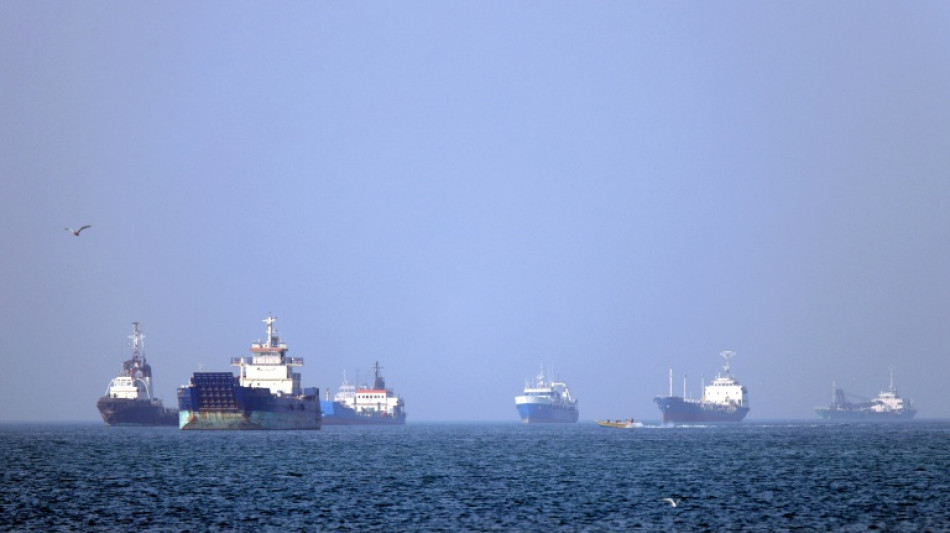
Hundreds of oil tankers and cargo ships have been stuck inside the Gulf since the war erupted on February 28. Iran has targeted ships and charged tolls for a small number to pass through the strait.
- 'Let the oil flow' -
Trump on Sunday declared: "Ships of the World, start your engines. Let the oil flow!", as he announced the agreement to halt the conflict.
He said Monday that loaded oil tankers were moving out of the strait, apparently on a route near to Oman, in a post on his Truth Social platform.
Shipping data from tracking platforms such as Kpler on Monday indicated that just a few ships were passing the strait, including one LNG carrier -- a similar trickle to that seen over the recent months of war.
With the agreement scheduled to be signed on Friday, marine director Phillip Belcher of the tanker owners' association Intertanko said "a cautious approach should be undertaken" by ships.
The body's managing director Tim Wilkins urged the US and Iran to make the Strait of Hormuz "free from the threat of mines" laid by Iranian forces in the conflict.
German shipping firm Hapag-Lloyd told AFP in an email it was reevaluating its risk assessment for the strait and it was "in close contact with the relevant authorities".
Danish shipper Maersk said the accord was a "positive development", in an email to AFP, but added: "It is too early to assess how it will impact logistics and maritime operations in the Middle East."
- Fuel demand -
The International Maritime Organization said it was working with Oman, Iran and other coastal states "on the safe route to be used for the evacuation of seafarers on trapped vessels and for trade to resume".
Francis Osborne, head of oil analytics at commodities agency Argus, told AFP that ending the fighting and tolls "would not by itself be sufficient to see an immediate resumption of pre-crisis commodity flows" in the Gulf, which for oil exports could take four to six months.
Iran's closure of the strait has choked off exports of oil and crucial commodities to world markets, driving up the price of crude and causing shortages.
"Europe is waiting for jet fuel and diesel; Asia is waiting for crude, naphtha and LPG (liquefied petroleum gas); and Africa is waiting for diesel and gasoline," said Benedict George, Argus's head of refined product pricing.
"There will be no immediate relief for physical supply in Europe because the tankers take four-to-six weeks to reach Europe."
J.P.Cortez--TFWP