The Fort Worth Press - OECD cuts 2026 global growth forecasts over Mideast war fallout

USD -
AED 3.673007
AFN 63.503205
ALL 82.78735
AMD 368.501999
ANG 1.790403
AOA 917.000493
ARS 1470.999601
AUD 1.446383
AWG 1.80125
AZN 1.70203
BAM 1.718856
BBD 2.018008
BDT 123.091796
BGN 1.69088
BHD 0.377901
BIF 2992.837369
BMD 1
BND 1.297974
BOB 6.938524
BRL 5.203202
BSD 1.001973
BTN 94.864877
BWP 13.624819
BYN 2.814079
BYR 19600
BZD 2.015116
CAD 1.42081
CDF 2265.000143
CHF 0.810235
CLF 0.023173
CLP 912.029887
CNY 6.774797
CNH 6.79765
COP 3428.4
CRC 454.535468
CUC 1
CUP 26.5
CVE 96.906446
CZK 21.2905
DJF 177.720107
DKK 6.5684
DOP 58.644918
DZD 133.636966
EGP 49.7169
ERN 15
ETB 161.535521
EUR 0.87874
FJD 2.251301
FKP 0.754878
GBP 0.75825
GEL 2.644996
GGP 0.754878
GHS 11.246649
GIP 0.754878
GMD 72.999832
GNF 8779.291769
GTQ 7.644241
GYD 209.623413
HKD 7.84115
HNL 26.807458
HRK 6.620995
HTG 131.00145
HUF 312.568505
IDR 17927.1
ILS 2.99632
IMP 0.754878
INR 94.74005
IQD 1312.563167
IRR 1375000.000051
ISK 126.530301
JEP 0.754878
JMD 157.717811
JOD 0.709017
JPY 161.568981
KES 129.410174
KGS 87.450009
KHR 4021.248643
KMF 431.000018
KPW 900.00035
KRW 1534.009705
KWD 0.30898
KYD 0.834996
KZT 487.384102
LAK 22188.337654
LBP 89725.095575
LKR 335.228721
LRD 182.352683
LSL 16.522564
LTL 2.95274
LVL 0.60489
LYD 6.429642
MAD 9.377774
MDL 17.639408
MGA 4185.964758
MKD 54.164854
MMK 2099.387374
MNT 3579.000015
MOP 8.091488
MRU 39.79664
MUR 47.95968
MVR 15.459892
MWK 1737.391847
MXN 17.587719
MYR 4.140503
MZN 63.877447
NAD 16.522564
NGN 1369.919684
NIO 36.867777
NOK 9.796035
NPR 151.78296
NZD 1.764585
OMR 0.384504
PAB 1.001977
PEN 3.39166
PGK 4.394272
PHP 61.449502
PKR 278.668893
PLN 3.76585
PYG 6107.983882
QAR 3.652503
RON 4.610962
RSD 103.180107
RUB 74.499982
RWF 1469.343633
SAR 3.755291
SBD 8.065041
SCR 13.385005
SDG 600.521313
SEK 9.74456
SGD 1.297255
SHP 0.746601
SLE 24.750254
SLL 20969.503664
SOS 572.656446
SRD 37.482986
STD 20697.981008
STN 21.530796
SVC 8.767412
SYP 110.532098
SZL 16.517116
THB 33.269016
TJS 9.293141
TMT 3.51
TND 2.965857
TOP 2.40776
TRY 46.476955
TTD 6.803181
TWD 31.668977
TZS 2625.008027
UAH 44.976754
UGX 3667.442985
UYU 40.189832
UZS 12038.49365
VES 616.865275
VND 26325
VUV 118.758526
WST 2.756325
XAF 576.48558
XAG 0.016191
XAU 0.000242
XCD 2.70255
XCG 1.805774
XDR 0.716966
XOF 576.48558
XPF 104.811706
YER 238.650269
ZAR 16.555802
ZMK 9001.20146
ZMW 17.97425
ZWL 321.999592
  • RBGPF

    -0.2700

    60.34

    -0.45%

  • RYCEF

    -0.1500

    18.25

    -0.82%

  • CMSC

    -0.0500

    22.11

    -0.23%

  • BCC

    -0.5700

    71.97

    -0.79%

  • GSK

    1.1330

    51.873

    +2.18%

  • VOD

    -0.0970

    14.023

    -0.69%

  • JRI

    -0.0100

    12.64

    -0.08%

  • NGG

    0.7800

    81.75

    +0.95%

  • AZN

    3.3800

    179.81

    +1.88%

  • RIO

    -3.5800

    95.78

    -3.74%

  • BCE

    0.3450

    22.995

    +1.5%

  • CMSD

    -0.1000

    21.98

    -0.45%

  • BTI

    1.9150

    60.815

    +3.15%

  • BP

    -0.3800

    39.4

    -0.96%

  • RELX

    0.1650

    30.995

    +0.53%

OECD cuts 2026 global growth forecasts over Mideast war fallout
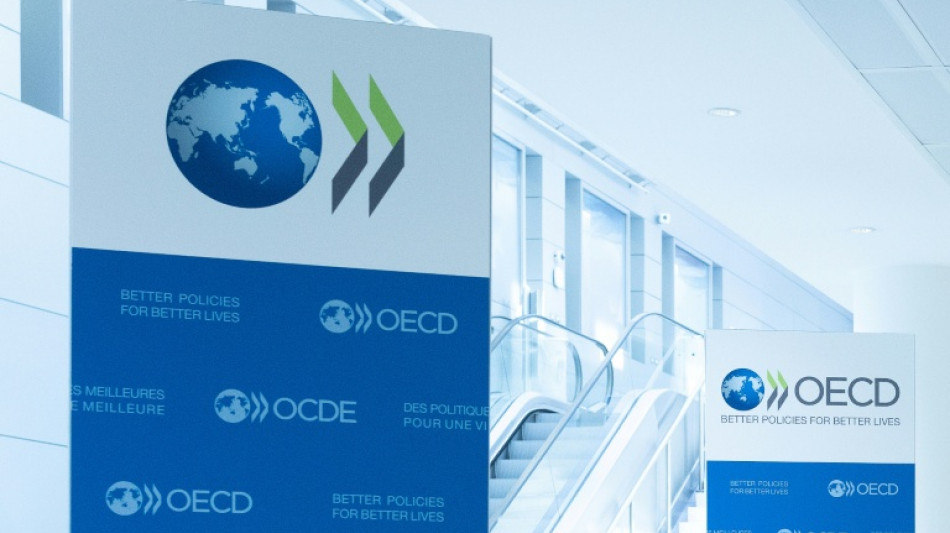
OECD cuts 2026 global growth forecasts over Mideast war fallout / Photo: © AFP/File

OECD cuts 2026 global growth forecasts over Mideast war fallout

The war in the Middle East has dented economic growth prospects worldwide, with a more severe shock likely if no effective ceasefire is agreed before 2027, the OECD warned Wednesday.

Text size:

Global economic growth is now forecast to slip to 2.8 percent for 2026 if Gulf exports of oil and gas return to pre-conflict levels in the third quarter, the group of 38 industrialised countries said in its quarterly update.

Previously the OECD had forecast full-year global growth of 2.9 percent.

But if the Mideast war continues into next year, however, global growth could slow to 2.1 percent, the OECD said -- well below the average annual growth of 3.4 percent seen from 2013 to 2019, before the Covid pandemic.

"The longer the disruptions last, the larger the economic and social costs become," the group's chief economist Stefano Scarpetta said in the report.

Many countries would risk falling into recession, he noted, and a drop in investment spending -- "including in energy-intensive AI" -- would likely push up unemployment.

Sustained high prices for energy as well as fertiliser and other key products from hydrocarbon production in the Gulf would weigh especially hard on developing countries that have "higher shares of energy and food in household consumption".

Even if the war sparked by US and Israeli strikes on Iran in late February ends in the coming weeks, the OECD forecast global inflation rising to 4.0 percent this year from 3.4 percent in 2025.

In this "time-limited disruption scenario", the group expects US growth to slow to 2.0 percent this year and 1.8 percent in 2027, after growing 2.1 percent last year.

In the eurozone, where many countries are highly dependent on energy imports, GDP growth will slump to 0.8 percent this year after 1.4 percent last year, assuming a Mideast ceasefire is secured in the coming weeks.

mpa/jbo/js/yad

M.T.Smith--TFWP