'Next time I'll stab you': Russia sees spate of wartime school attacks / Photo: © AFP/File

When a teacher at a school in northwestern Russia tried to wake a 16-year-old student sleeping at his desk, he muttered: "You'll regret this."
After the lesson, he grabbed her from behind, pressing what she thought was a pen into her throat. As blood trickled down her fingers, she realised it was a medical scalpel.
"Next time I'll stab you," he said.
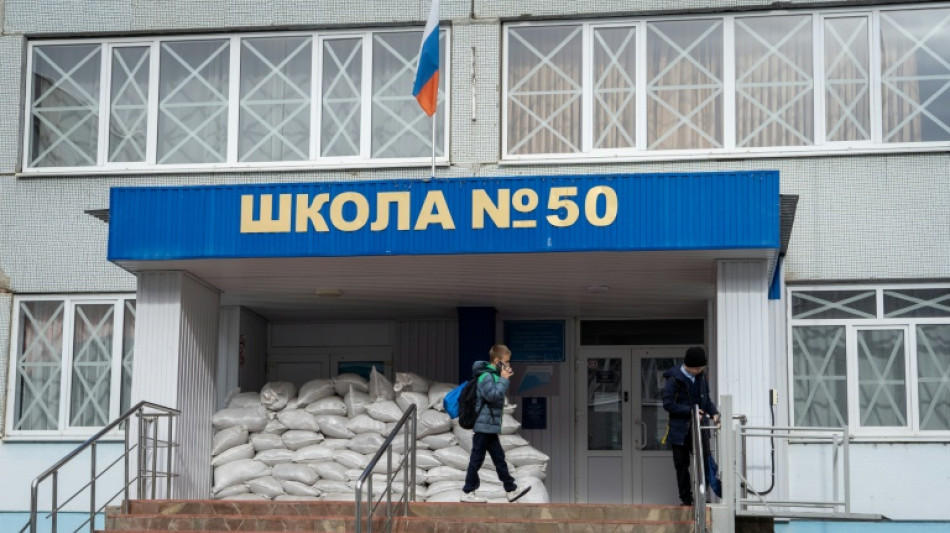
The incident, recalled to AFP by the teacher, was one of a spate of rising attacks inside Russian schools amid the war in Ukraine as experts say the militarised environment could be playing a role.
There have been at least 14 reported attacks in schools and other educational institutions so far this year -- compared with 15 in the whole of 2025.
And almost half -- 48 percent -- of all such attacks recorded over the last 25 years have happened since Russia invaded Ukraine in 2022, the independent Novaya Gazeta outlet calculated.
They include a teenager opening fire with an air pistol at a primary school in the southern Krasnodar region, the stabbing of a teacher to death, and a girl setting a classroom on fire before attacking her classmates with a hammer in Siberia.
Addressing the incidents, an official from Russia's interior ministry said in April: "In most of the cases, teenagers carry out such acts under the negative influence of third parties and the information space."
Independent experts point to different factors.
A climate of bullying and desire for revenge are the main motives in specific attacks, they say.
They are playing out against the mounting consequences of Moscow's four-year war against Ukraine, which has seeped into society and schools.
In some cases students dressed in military camouflage before the attacks.
"This is a sign that war is increasingly penetrating children's minds," said Yuri Lapshin, a former head of a psychological service at a Moscow school who now lives in France.
"The more those who absorb this propaganda in childhood grow up, the more war will become part of life for them," he added.
- 'Virus of violence' -
Russia has increasingly pushed the Ukraine war into school life through patriotic youth groups, lectures by former fighters and various other military-related activities.
"No virus in the world spreads as quickly as the virus of violence," said Olga Zhuravskaya, fundraiser of the anti-bullying project Travli NET.
"We have been telling children to treat each other with care at school," she said.
"But if they grow up knowing they may end up in a warzone and die, that may also affect how they see themselves and their future."
Before the teacher in northwestern Russia -- who spoke to AFP on condition of anonymity -- was attacked with a scalpel, she had requested training after three school attacks across Russia in one week.
She was told not to cause panic.
After the incident, the student quit school voluntarily and the principal urged the teacher not to report the incident to police.
Cameras and metal detectors were installed, but colleagues advised her to stay quiet to keep her job.
- 'What if he comes back?' -
The effectiveness of schools' responses to the rising attacks is patchy.
A school speech therapist, 52, from central Russia said a new metal detector would "be triggered by a bunch of keys, but might not react to a metal chair."
Anti-terrorism drills have been introduced, including on responding to drone attacks, explosive devices and armed assailants.
Often not announced in advance, pupils and teachers barricade classroom doors with desks and hide in corners.
Sometimes a teacher plays the role of an attacker.
Staff also told AFP they have been asked to monitor pupils more closely, including on social media.
But some experts question that approach.
"Profiling doesn't work," said Lapshin, adding that staff need enough free time to notice children who are isolated, bullied and in distress.
Some teachers -- all of whom spoke on condition of anonymity -- say they are scared.
A history teacher in a small town in Siberia -- from where many men had gone to fight in the war -- said pupils had become more aggressive.
A physics teacher in the Moscow region said some of her colleagues avoided giving out bad marks for fear of retribution.
"What if he comes back with a weapon?" several said.
The teacher who was attacked with a scalpel fears the assailant could wait for her outside the school.
Police told her that there was not enough evidence to open a criminal case.
"As they say, come back when you're dead."
A.Williams--TFWP