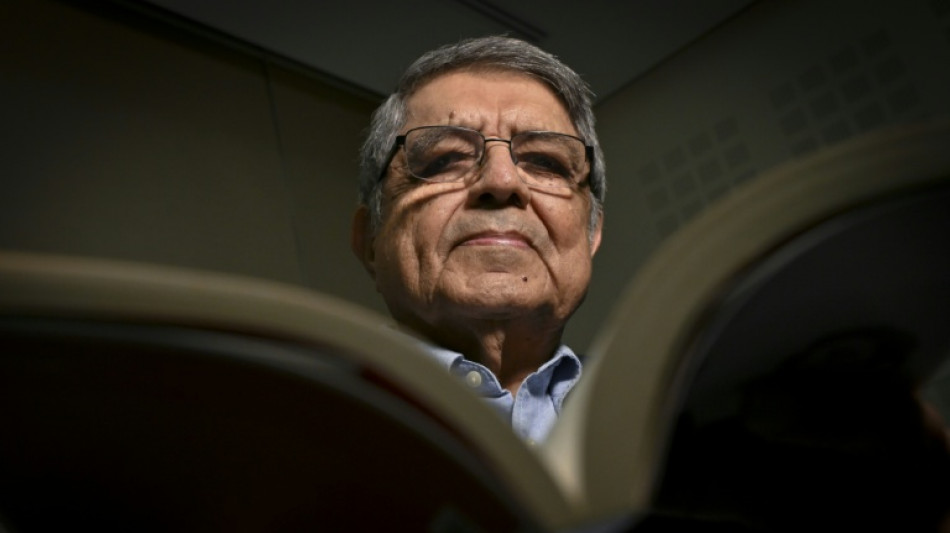
Nicaragua's exiled Sergio Ramirez: Autocrats 'don't care' about novels / Photo: © AFP

Authoritarian leaders are not concerned by the political impact of novels despite literature's power to shape people's consciences, said Nicaragua's former vice president and writer Sergio Ramirez in an interview with AFP on Monday.
The Cervantes Prize winner, who lives in exile in Spain after having been stripped of his Nicaraguan citizenship for criticizing the government, is in Panama to chair the Centroamerica Cuenta literary festival.
The author of "Margarita, esta linda la mar" (Margarita, How Beautiful the Sea), "Castigo Divino" (Divine Punishment), and "Tongolele no sabe bailar" (Tongolele Did Not Know How to Dance) also faces criticism in Nicaragua over his nomination for a seat on the Royal Spanish Academy due to his position as Daniel Ortega's vice president between 1985 and 1990.
Q: In "Tongolele no sabe bailar," it says that fear rules. What role does literature play in a Central America where authoritarian governments are re-emerging?
A: I don't think that authoritarian leaders in Central America care about novels, except when they feel that one is aimed at them. In such cases, they order a crackdown on the book, more out of personal revenge... than because they think it will destabilize them. A novel is not capable of creating a collective consciousness.
Q: Can a novel be used as a weapon?
A: I wouldn't be so bold as to think that a novel could change a country's reality, but it can change a reader, and I think that's very important -- that a reader learns to see reality in a different light through a fictional work.
Q: Does the reality of Central America shape its writers?
A: No matter how much one learns to write a love story, one will always come up against reality -- not just that of political power, but also of the other arbitrary powers that exist in Central America. The power of organized crime, corruption, and drug trafficking -- these things alter a person's story, change their relationship with society and instill fear.
Q: Is there a distinct Central American literature?
A: It is the same literature with different nuances in language, structure and themes. Central American literature, after all, is political -- not in an ideological sense, much less in a partisan one, but rather because of the abnormal reality of Central America's political structures.
Q: What does your nomination for a seat on the Royal Spanish Academy mean for Central American literature?
A: It is the culmination of a literary career dedicated to language. The fact that I have been invited to join such an important cultural institution and that I was born in Central America is a significant step for Central American literature.
Q: But you have also faced criticism?
A: I don’t pay much attention to them (critics)... They are part of a very small minority faction within Nicaragua that wants to give this nomination a political slant it does not have. What the academic community values is my heritage, my cultural background, and whether or not I contribute to the language.
Q: How much has literature in the region changed since the Centroamerica Cuenta literary festival was founded in 2013?
A: The region does not have major publishing houses or a significant book market, so gaining recognition beyond our borders has been one of the festival's greatest achievements. There are at least ten writers whose works are now being published by international publishers in Spain, Mexico and Argentina. Book distribution remains a problem and every time a bookstore closes in Central America it is a great loss. The situation is so precarious that in Central America we have only one bookstore or chain of bookstores in each country.
Q: Do you still hope to return to Nicaragua?
A: It's very hard to say, but I believe that every dictatorship comes to an end and every country has the right to aspire to a democratic way of life. Nicaragua will get there, but I don’t know when. If it were up to me, it would be tomorrow.
S.Rocha--TFWP