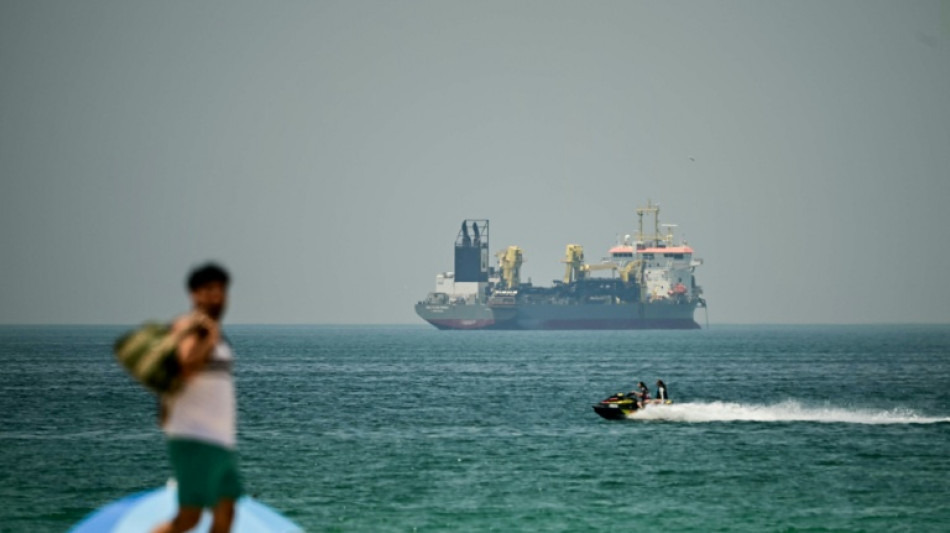
Gulf countries' plans to bypass Hormuz still far off, experts warn / Photo: © AFP

The war in the Middle East has forced the Gulf monarchies to rethink their oil and trade routes, but rerouting them will be no simple task, experts say.
Faced with the closure of the Strait of Hormuz, the only maritime entry point to the Gulf, the region's Arab nations are looking for ways to bypass Tehran's stranglehold on their exports.
Badr Jafar, the UAE's special envoy for business and philanthropy, wrote in the Financial Times in early April that the Gulf states would never "return to a posture of strategic dependence on a narrow strait controlled by an unpredictable neighbour".
He insisted that new pipeline and port capacity would be built and "the power grids, water systems and trade corridors connecting the region's economies ... formalised". Economics, politics and regional diplomatic rivalries are likely to get in the way, however , experts told AFP.
- New pipelines difficult -
While Kuwait, Qatar and Bahrain have no coastline outside the Gulf and no alternative to the strait for seabound oil and gas, Saudi Arabia and the United Arab Emirates both have pipelines allowing them to ship at least some of their output from ports beyond Hormuz -- and plan more.
Nevertheless, these pipelines only cover a fraction of the two nations' pre-war exports and would need to be expanded if either country wanted to completely end their reliance on the Strait of Hormuz.
Robert Mogielnicki, of the Arab Gulf States Institute in Paris, said that building new pipelines "will take time" and such infrastructure would "still possess vulnerabilities".
"Diversifying energy export supply routes is nevertheless going to be crucial in the years ahead," he added.
For liquefied natural gas, of which Qatar is by far the dominant producer in the region, the dependency on Hormuz is even greater.
Yet, as Frederic Schneider, a senior fellow at the Middle East Council on Global Affairs, explained, building alternative natural gas infrastructure would likely prove economically unattractive.
"The idea of a trans-Arabian gas pipeline has occasionally been floated but never progressed," he said.
"The distances, political complexity, and cost make it unattractive against LNG tankers in normal conditions, and normal conditions are what pipeline economics are built on."
- Overland no alternative -
The Gulf's major container ports are mostly located on its southern shores, including Dubai's Jebel Ali, the region's main logistical hub.
With the Strait of Hormuz off limits, ships have been diverted to Oman and Saudi Arabia's Red Sea coast with containers then shipped onwards overland.
But overland capacity is limited while costs are "significantly higher" said Schneider.
One possibility for boosting land-based transport capacity would be the Gulf Cooperation Council's planned rail network. Yet the project, which is supposed to link all six member states by 2030, has been plagued by delays.
Another possibility could be the India-Middle East-Europe Economic Corridor project, launched in 2023, which partially aimed to bypass both the Strait of Hormuz and the Suez Canal, using rail links across the Middle East to connect European and Indian shipping routes.
Yet the idea remains "tenuous, if not hypothetical" said Schneider, not least because the project would involve linking Saudi Arabia with Israel at a time when Riyadh has cooled on establishing diplomatic relations with Israel.
- 'Zero-sum' rivalry -
While Gulf governments talk about integration, analysts warned that their own self-interest may get in the way.
"Tensions around the strait will generate some tailwinds supporting regional integration projects, but these will also have to contend with some serious economic headwinds and governments that will be super focused on their domestic fronts," said Mogielnicki.
The budgetary pressures created by the war, which have not only halted oil and gas exports but also hit tourism, aluminium and fertiliser production, may also make coordination less likely.
"This fiscal crisis only intensifies the intense, beggar-thy-neighbour, zero-sum economic rivalry that has marked GCC national economic policies for years," said Schneider.
Previous conflicts in the Gulf, he pointed out, did not lead to more regional integration, even if there were bilateral deals, he said.
While the shock of closing Hormuz is much greater, he said, "I would be cautious about treating a geopolitical shock as a substitute for the political will and institutional capacity that have been missing so far".
B.Martinez--TFWP