IMF cuts 2026 global growth forecast on Mideast war / Photo: © AFP

The IMF cut its 2026 global growth projection Tuesday, warning that the world economy could be "thrown off course" by war in the Middle East -- as the conflict roils commodity markets and sparks higher prices.
The global economy is set to grow by 3.1 percent this year, said the International Monetary Fund in its World Economic Outlook report, released during its spring meetings in Washington.
This is down from 3.3 percent forecast in January before hostilities erupted February 28 with US-Israeli strikes against Iran that prompted Tehran's retaliation and sparked a broader conflict in the region.
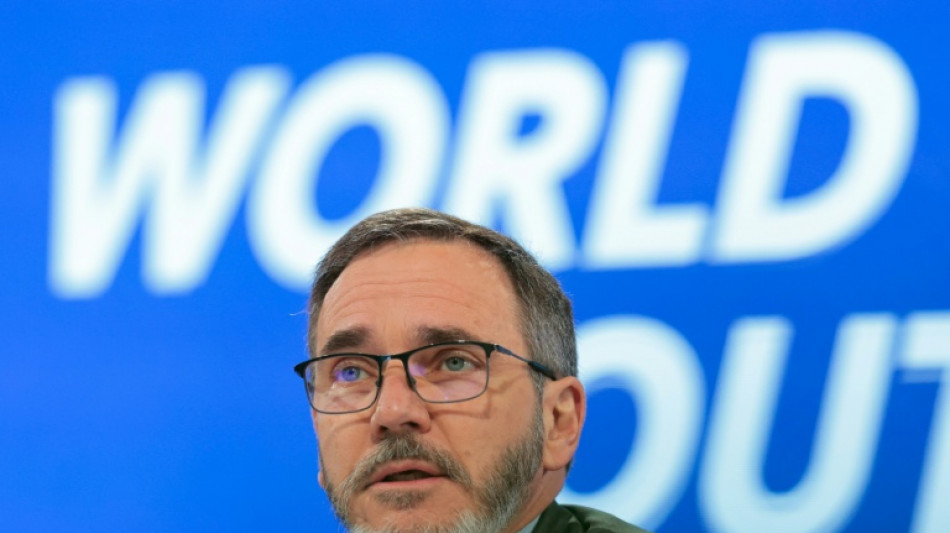
"We were planning to upgrade growth for 2026 to 3.4 percent" if not for the war, IMF chief economist Pierre-Olivier Gourinchas told AFP.
Prices of oil, gas and fertilizers have surged, as Iran virtually blocked traffic through the Strait of Hormuz, a key shipping waterway. US President Donald Trump has also ordered a naval blockade around Iran's ports.
The IMF expects higher inflation this year at 4.4 percent, 0.6 percentage points above its January forecast.
Still the impact of oil shortages could be worse.
Compared to the oil shocks of the 1970s, "the global economy is much less oil dependent now than it was back then," Gourinchas said at a Tuesday press conference.
"There are many other sources of energy, renewables, nuclear and other things, and also the global economy has become much more efficient in terms of how much it needs oil to produce GDP," he said. "That's a source of resilience."
After this the "disinflation path" of recent years should reassert itself, Gourinchas said.
But these projections assume a relatively short-lived conflict with temporary energy market disruptions.
In more adverse scenarios where energy prices remain steep, global growth could slow to 2.5 percent or even around 2.0 percent.
"This latest shock comes less than a year since the shift in US trade policies, and the transition to a new international trade system is still ongoing," the IMF said.
A year ago, Trump unleashed sweeping tariffs on US trading partners, rocking financial markets and snarling supply chains.
Some of the tariffs have been struck down by the Supreme Court, but uncertainty lingers as Trump moves to reimpose duties via other means.
- Uneven impact -
Although overall revisions to global growth and inflation appear modest, the IMF cautioned that the war has taken a bigger toll on the Middle East and "vulnerable economies" elsewhere.
"The impact on emerging market and developing economies would be almost twice that on advanced economies," the fund said.
Higher energy and fertilizer costs could bring steeper food prices, mainly hitting low-income energy importers, Gourinchas said.
Growth projections this year for the Middle East and central Asia were cut by around half to 1.9 percent.
Saudi Arabia, the Middle East's biggest economy, is set to see 3.1 percent growth this year, down 1.4 percentage points from January's expectation.
Among the world's two biggest economies, US growth is still set to accelerate to 2.3 percent this year, although the pace of growth was revised slightly lower.
"The US at the margin is benefiting from higher energy prices," Gourinchas said. But gasoline prices have also jumped for consumers.
China's growth is anticipated to cool to 4.4 percent, a touch below the January forecast, too.
The IMF flagged an underlying "unevenness" in both economies.
Domestic activity lags behind exports in China, while a strong showing in the United States has been accompanied by low employment growth.
Euro area growth was revised 0.2 points down to 1.1 percent for 2026.
While the IMF does not expect inflation expectations to go off-track, there is concern they may not be as well-anchored as before.
Past inflation episodes remain fresh in the public's minds, and firms might act to restore margins more quickly than before.
"If that happens, then you can get much more persistent inflation going on, that would be reflected in higher inflation expectations," Gourinchas said.
Central banks might then need to step in and raise interest rates to cool the economy, despite ongoing negative supply shocks.
F.Carrillo--TFWP