Israeli strike in south Lebanon kills 13 security personnel / Photo: © AFP

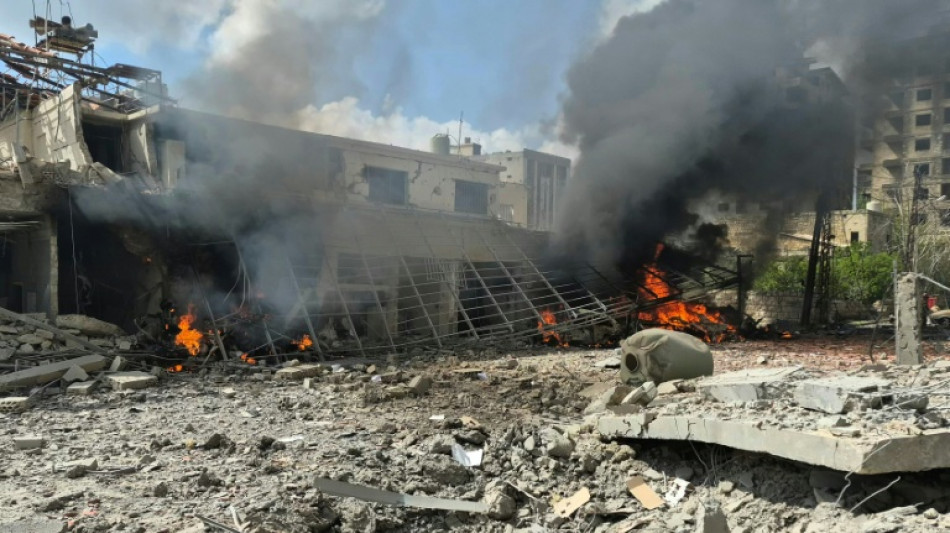
An Israeli strike, one of multiple on the southern Lebanese city of Nabatiyeh on Friday, killed 13 State Security personnel, the agency said, as Lebanon prepared to start ceasefire talks with Israel.
"This painful loss only strengthens our determination to achieve a ceasefire that will protect Lebanon and our people in the south," Prime Minister Nawaf Salam said in a statement.
President Joseph Aoun called on the international community to "assume its responsibilities in putting an end to the repeated Israeli aggressions".
Naim Qassem, head of Iran-backed Hezbollah, called on Friday for the Lebanese government to stop giving "free concessions" to Israel ahead of talks to try and end the month-long war between Israel and Hezbollah that has left some 1,900 people in Lebanon dead.
The state-run National News Agency (NNA) said "enemy warplanes launched a series of heavy strikes" on Nabatiyeh on Friday and an AFP photographer saw extensive damage at the State Security office, where a fire was still raging.
Israel, for its part, reported 30 rockets from Hezbollah into Israel on Friday.
- Diplomatic scramble -
As the government prepared for talks with Israel, outside the auspices of the US-Iran talks in Islamabad, Qassem called on officials "to stop offering free concessions" and described Israel's military campaign as a failure.
A US official on Thursday said talks would take place in Washington next week.
Hezbollah is represented in Lebanon's cabinet and parliament.
"The Israeli enemy has failed on the battlefield... It has been unable to carry out the ground invasion it repeatedly announced," Qassem said, adding that "the resistance will continue until the last breath".
More than 300 people, mostly civilians according to a Lebanese military source, were killed in a wave of simultaneous Israeli strikes on Lebanon on Wednesday despite the announcement hours earlier of a truce between the United States and Iran, with Israel and the US saying it did not apply to Lebanon.
Iran has insisted on including Lebanon in its ceasefire negotiations with the US.
- Quiet in Beirut -
On Thursday afternoon, the Israeli military issued a warning of incoming strikes for large, densely populated areas of southern Beirut, but had not carried out the threat as of Friday.
A Western diplomat told AFP on Friday that European and Arab states are pressuring Israel to stop targeting Beirut.
The Western diplomat, who asked to remain anonymous in order to discuss sensitive matters, said on Friday "there is ongoing diplomatic pressure from European states, Gulf states and Egypt on Israel to prevent renewed Israeli airstrikes on Beirut after 'Black Wednesday'".
Thursday's Israeli warning included areas home to major hospitals and the road to the country's only international airport.
Public Works and Transport Minister Fayez Rasamny said in a statement carried by the state-run National News Agency (NNA) on Thursday that he had "received assurances" from foreign diplomats that the airport and the road leading to it would be spared.
Meanwhile, Mohammad Zaatari, director of the country's largest public medical facility, Rafic Hariri Hospital, told AFP: "We have received assurances, including from the International Committee of the Red Cross that the hospital would not be targeted."
The World Health Organisation on Thursday called on Israel to cancel its evacuation warning for the Jnah district of Beirut because around 450 patients were in the Rafic Hariri and Al-Zahraa hospitals in the district, including 40 in intensive care.
The Israeli military said on Friday it had "dismantled" more than 4,300 Hezbollah sites in Lebanon and killed "more than 1,400" Hezbollah fighters.
Hezbollah, for its part, claimed several rocket launches on northern Israel, as well as attacks on Israeli troops advancing in the border area.
Hezbollah also said it targeted a naval base in the southern Israeli city of Ashdod on Friday, far from the border, with missiles.
S.Palmer--TFWP