Israel weathers energy shock from Iran war even as world battles crisis / Photo: © AFP

Iran's chokehold on the Strait of Hormuz has thrown the global economic system into turmoil, yet Israel, which launched attacks on Tehran alongside the United States, has emerged as a rare exception.
Since Israel and its US ally started the Middle East war on February 28, economies from Asia to Europe and the United States have come under pressure from surging oil and natural gas prices that have driven up fuel and electricity costs.
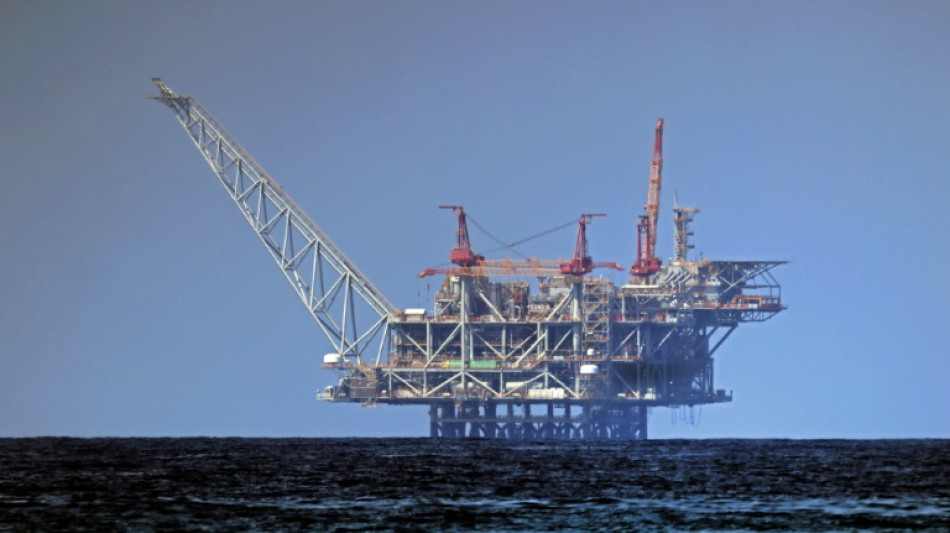
Israel, however, has remained largely insulated from the shock. Central to this has been a trio of major gas fields sitting deep below the Mediterranean.
"The discovery of offshore natural gas has allowed Israel to be in a situation where it isn't feeling the economic pinch on the energy front the way that other countries are," said Gabriel Mitchell, energy security analyst and Visiting Policy Fellow at the German Marshall Fund.
Natural gas, all of which comes from those three fields, now accounts for 70 percent of Israel's electricity generation and 45 percent of its total energy supply, according to the International Energy Agency.
The sale of that gas is governed by long-term, fixed-price contracts which have helped keep prices steady despite the war.
Nevertheless, the conflict has still impacted Israel's gas production.
At the outbreak of the war, Israel ordered energy giants Chevron and Energean to suspend operations at two of the three fields, Leviathan and Karish respectively, as a precaution against potential missile strikes.
The shutdowns also cut off exports to neighbouring Egypt and Jordan, which take the vast majority of Leviathan's output.
A strike on a pressurised, operational gas field would be devastating, said Amit Mor, a senior lecturer at Reichman University.
"Once a platform is hit by a missile, the explosion might be enormous and might be a total loss which takes years and billions of dollars to rebuild," he said.
- 'The existential one' -
That leaves the Tamar field as Israel's energy lifeline.
Producing roughly 11 billion cubic metres (BCM) of gas annually, Tamar nearly covers Israel's entire domestic consumption of 12 to 13 billion cubic metres of gas per year.
"Tamar is the existential one," said Mitchell.
"Israel can live without exporting natural gas to its neighbours. It can live without operating the Karish field temporarily. But from a national security perspective, Tamar is essential."
To compensate for the shortfall created by the shutdowns, Israel has relied on a mix of alternative energy sources.
Coal-fired plants, previously converted to gas but which retained a dual-fuel capability, have been reactivated.
Diesel generation has also been brought online, though at a cost.
Both fuels are significantly more expensive than natural gas, and Israeli electricity consumers can expect tariffs to rise accordingly when the Electricity Authority revises rates in June.
For Israel's gas-importing neighbours, though, the picture is a grim one.
Jordan and Egypt rely heavily on Gulf fuel imports and gas from the now-shuttered Leviathan field.
Egypt this month imposed a 9 pm curfew on shops, restaurants and malls to curb energy use with prices having more than doubled since the start of the war.
Both Amman and Cairo have reportedly formally requested that Israel resume gas exports.
Israel has reportedly rejected their requests, prioritising its own wartime energy security over regional supply commitments.
- Resilient supply chains -
On the oil front, Israel's supply chains have proved resilient, largely because they bypass the Strait of Hormuz.
Most of Israel's oil comes from Azerbaijan and Kazakhstan, flowing through pipelines into Turkey before being shipped by sea.
Oil prices, however, are set by the global market and while there haven't been shortages in Israel, prices at the pump have still shot up.
Israel's energy ministry said that petrol would hit eight shekels ($2.50) a litre for the first time in two years. Israel already had among the highest prices in the world.
Oil supplies are also a strategic consideration for the country.
Israel's largest oil refinery, Bazan in the northern port city of Haifa, also produces the jet fuel powering the Israeli air force's long-range strike missions in Iran.
The plant has been struck by Iranian missiles three times, including on Sunday, but was quickly repaired each time and remains largely operational.
"A round trip from Israel to Tehran consumes between 10 and 12 tonnes of jet fuel, depending on the type of aircraft... that is the amount that an average family car utilises in 10 to 20 years," Mor said.
S.Jones--TFWP