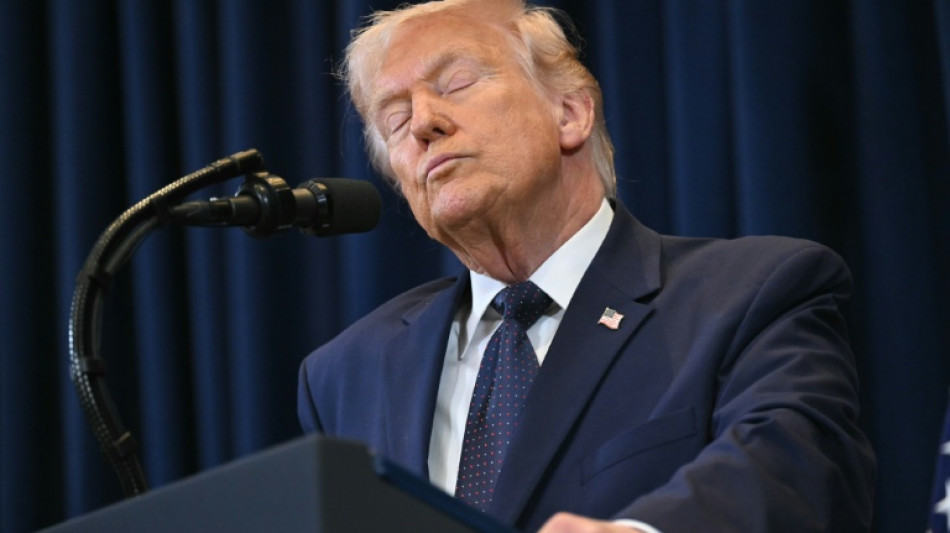
Will Trump 'TACO' on Iran? / Photo: © AFP

US President Donald Trump has built a potential off-ramp by suggesting the Iran war could end soon, but the world is still guessing about whether he will take it -- and whether Tehran will let him.
With surging oil prices threatening the global economy and his political fortunes at home, Trump's tone appeared to shift abruptly on Monday as he called the war "very complete" and a "short-term excursion."
But the 79-year-old commander-in-chief continued to send mixed messages about when the war could end -- and what its goals are -- leaving it far from clear what he will ultimately settle for.
For Trump, that calculation will almost certainly involve November's US midterm elections, with gas prices likely to fuel voter anger at his Republican Party over the cost of living.
Polls so far show historically low support among Americans for the war.
"I think he's going to keep going until his advisers tell him that the economic pain is going to risk the midterms," Colin Clarke, executive director of the Soufan Center in New York, told AFP.
"He's going to make a political decision about a military operation."
For some observers, Trump's comments on a short Iran war timeline was evidence of what traders have dubbed the TACO phenomenon -- "Trump Always Chickens Out."
"What they did communicate clearly, to the delight of markets, was that Trump is looking for an exit," wrote Robert Armstrong, the Financial Times journalist who first coined the term TACO.
In the opening days of the US-Israeli strikes, Trump suggested the war could last four or five weeks, but markets surged at his hints on Monday that it could be shorter.
Defense Secretary Pete Hegseth said Tuesday that Trump, and Trump alone, would determine the timeline. "It's not for me to posit whether it's the beginning, the middle or the end. That's his," said the former Fox News host.
Clarke said he believed Trump would "go hard for the next two weeks tops, then things are so messy he's going to declare victory."
- 'Wounded animal' -
Victory will then be in the eye of the beholder.
Both Trump and his administration have publicly given a panoply of shifting goals for the war, ranging from seeking regime change in all but name, to securing the flow of Gulf oil.
But on paper it has listed some core military objectives -- ensuring Iran has no nuclear weapon, eliminating its ballistic missiles and its navy, and curbing its regional proxies -- that could be easier for Trump to sign off on.
But Iran will likely see any such declaration as Trump blinking first.
Despite the significant damage from the US-Israeli air campaign, Tehran has stepped up its defiant tone since Trump's remarks, vowing to block Gulf oil supplies and mocking the US leader's claims to be in control of the timeline of the conflict.
"It is we who will determine the end of the war," Iran's Revolutionary Guards Corps (IRGC) said in a statement, while the Islamic republic's security chief Ali Larijani warned Trump himself to be careful "not to be eliminated."
Israel meanwhile has its own timeline, which Trump also has only limited control over. Differences have already emerged over both the long-term goals and Israel's strikes on Iranian energy infrastructure.
And while Trump insists he must have a role in choosing Iran's new leader, there is no sign yet of large-scale internal resistance to supreme leader Ayatollah Mojtaba Khamenei, chosen at the weekend to replace his slain father.
If Mojtaba Khamenei and the regime survive, Operation Epic Fury would be "remembered as the Mother of All Lawnmowers" for having only skimmed the surface of things, Walter Russell Mead wrote in The Wall Street Journal.
Trump could then leave an even more dangerous situation, the Soufan Center's Clarke said, with a "rump IRGC" going all out for a nuclear bomb, and the risk of various ethic groups launching a huge insurgency in the heart of the Middle East.
"If it's Khamenei's son or another hardliner, what's different?" said Clarke. "It's now like a wounded animal, which is arguably more dangerous."
C.M.Harper--TFWP