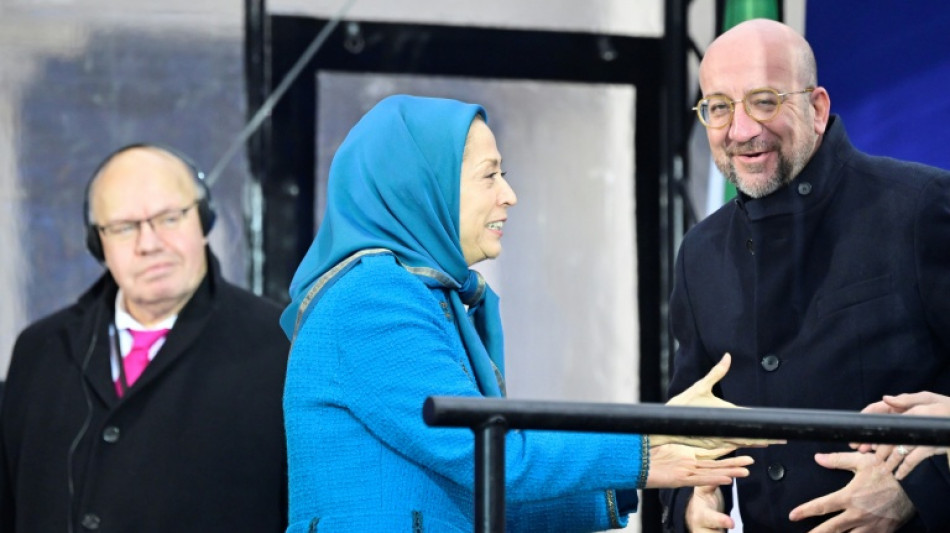
Demonstrators in Berlin call for fall of Iran's Islamic republic / Photo: © AFP

Several thousand demonstrators rallied in Berlin on Saturday calling for an end to Iran's clerical-led government and its bloody repression of protests.
Police said 10,000 people had attended one protest at the city's Brandenburg Gate organised by the MEK, an exiled opposition group considered "terrorist" by Tehran.
Another demonstration, this one organised by supporters of Reza Pahlavi, the US-based son of the last shah of Iran, attracted 1,600 people, said police. They marched along a major avenue, carrying shah-era Iranian flags as well as US, German and Israeli ones.
The demonstrations followed protests in Iran that began at the end of December. Triggered by economic malaise in the sanctions-hit country, they spiralled into anti-government street demonstrations in January.
They were countered by a crackdown by the security forces, which rights groups say killed thousands of people.
Iran is currently engaged in talks with the United States to stave off threatened military action. US President Donald Trump has deployed a naval battle group and wants Tehran to end nuclear enrichment, curb the range of its ballistic missiles, and ease its repression.
- Rival opposition groups -
The Berlin rally by the MEK featured Charles Michel, the former president of the EU's European Council, and Peter Altmaier, former German economy minister. Mike Pompeo, the United States' former secretary of state, also addressed the crowd by video.
The opposition group seeks to portray itself as a leading Iranian opposition force. But it is reviled by many Iranians for having fought on Iraq's side against Iran in a war in the 1980s.
Reza Pahlavi, whose name and photos have featured in Iranian protests, is also vying to be seen as an opposition figurehead, distinct from the MEK. He has, in interviews in the United States and on social media, urged Iranians to "be ready" for more protests.
At the MEK-organised demonstration at the Brandenburg Gate one participant, Samin Sabet, a 40-year-old hotel employee, said Iran should have free and fair elections.
"We don't want a dictatorships, nor a monarchy," she told AFP.
Another demonstrator, Iraj Abedini, a 61-year-old psychologist who left Iran four decades ago, said he was there "to support the Iranian people" after "having lost two nephews in the January protests" in the Iranian city of Isfahan.
He predicted that the Iran-US talks, hosted by Oman, "will go nowhere".
"The Iranian regime is trying to use the negotiations to stay in power. And the US government, which has other plans, doesn't support the Iranian people," he said.
J.Barnes--TFWP