What we know about Guinea-Bissau's coup d'etat / Photo: © AFP

Military forces ousted Guinea-Bissau's president and halted the country's electoral process this week before installing a general on Thursday to lead the country.
With the motive for the coup not yet clear, here is what we know about the latest tumult in the politically unstable west African country:
- Wednesday gunfire -
Heavy gunfire broke out at midday on Wednesday near the presidential palace in the capital, Bissau, shortly before the military announced they were taking "total control" of the coup-prone country. Voters had been awaiting the results of Sunday's presidential and legislative elections.
President Umaro Sissoco Embalo, one of the two main candidates in the election, was arrested on Wednesday by the military.
Main opposition leader Domingos Simoes Pereira, who was barred from running in the election, was also arrested.
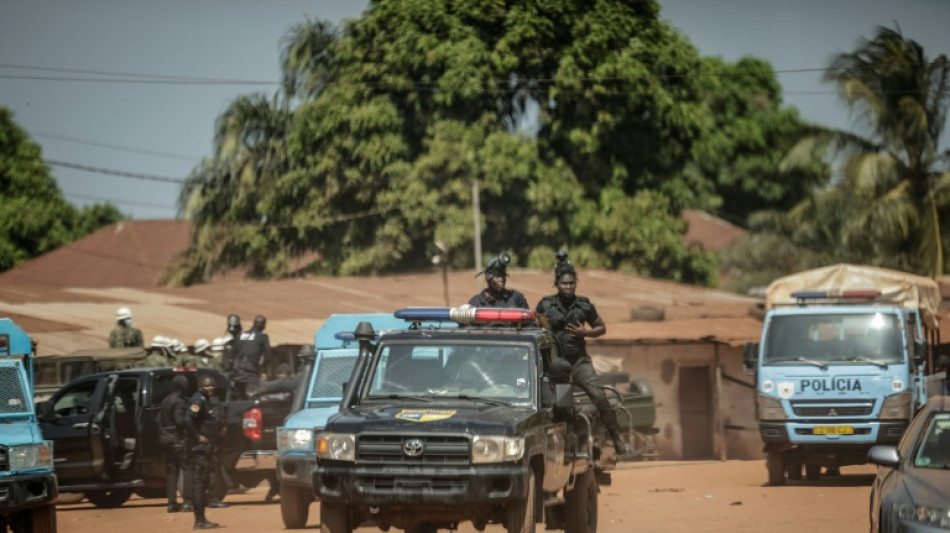
There was a visibly heavy security presence in the streets of Bissau Thursday, which were practically deserted and under close surveillance.
Soldiers were on patrol in the area near the presidential palace in particular.
Land, air and sea borders that had been closed on Wednesday were reopened and a night-time curfew lifted. But demonstrations and marches were banned.
- The takeover -
On Thursday, the military announced a one-year transition period and named General Horta N'Tam as the country's leader.
N'Tam was until now the chief of staff of the army and had been considered to be close to Embalo in recent years.
He will also head a High Command for the Restoration of Order that was established under the coup.
On Wednesday, General Denis N'Canha, head of the presidential military office, told the press that the coup had been carried out after a plan had been uncovered to destabilise Guinea-Bissau.
That plan, he said, involved "national drug lords" and had included "the introduction of weapons into the country to alter the constitutional order".
N'Tam said on Thursday that the evidence had been "sufficient to justify the operation".
- Doubts and Uncertainties -
In the hours following the coup, President Embalo was reachable by telephone and spoke to international media while in the custody of military officers who carried out the coup.
Opposition candidate Fernando Dias told AFP on Thursday he believed he had won the election and that Embalo had personally "organised" the coup.
"I am the president (elect) of Guinea-Bissau," he told AFP by phone, adding that he was in a safe place.
Members of Guinea-Bissau's diaspora and researchers told AFP that they questioned the true motives behind the power grab, which they also said could ultimately benefit Embalo.
According to researchers interviewed by AFP, unverified preliminary results circulating before the coup showed Dias had won the election.
"This is a coup aimed at preventing the opposition candidate, Fernando Dias, from seizing power," a west African researcher and specialist in Guinea-Bissau told AFP on condition of anonymity.
"This is the ideal scenario for Mr Embalo, who could, following negotiations, be released and potentially reposition himself for the next elections," the researcher added.
Lucia Bird of the Global Initiative against Transnational Organized Crime agreed.
"The person who stood to lose the most from those election results being declared and confirmed was the president himself," she said.
Yussef Gomes, spokesperson for Firkidja di Pubis, a collective for members of the Guinea-Bissau diaspora, said he believed the coup had been "fabricated".
Its fundamental objective was to "put an end to an electoral process that would have clearly demonstrated the resounding defeat of Umaro Sissoco Embalo", he argued.
- Elections without PAIGC -
The coup occurred after a three-week election campaign and voting that had passed off without major incident.
Both Embalo, who had been in power since 2020, and his opposition rival Dias claimed victory following the race.
Guinea-Bissau's Supreme Court barred the historic PAIGC party, which secured the country's independence from Portugal in 1974, from the election -- as well as its leader Pereira.
Dias became the election's main opposition candidate and received strong support from the PAIGC.
bur-tsc-mrb-els/bfm/gil-jj
C.Rojas--TFWP