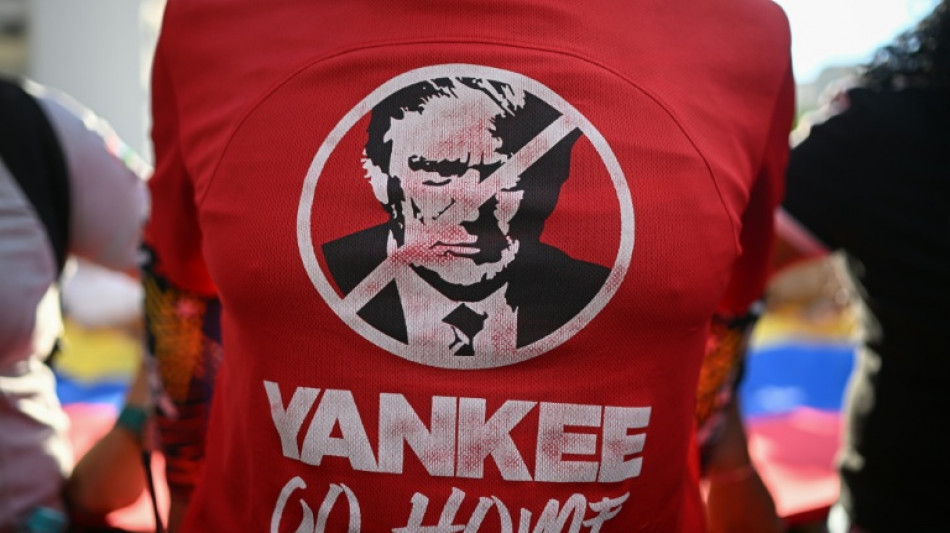
Adapt or die: Latin America's response to Trump / Photo: © AFP/File

Latin America has navigated a minefield of economic and military coercion since Donald Trump's return to the White House.
Some leaders have fought back, some acquiesced. Some played possum.
No country was left untouched by what many view as a return to US interventionism in what the Trump administration has taken to calling "our hemisphere."
"Every Latin American country has a position of asymmetry with the United States. That is a baseline position," said Alejandro Frenkel, international relations professor at Argentina's San Martin University.
Here is an overview of the tumult -- and the varying responses:
- 'Whatever Trump wants' -
At one extreme, ideological ally Javier Milei of Argentina "does whatever Trump does and whatever Trump wants," analyst Michael Shifter of the Inter-American Dialogue think tank in Washington told AFP.
In desperate need of a powerful backer in his efforts to revive a long-ailing economy, Milei has been a vocal Trump cheerleader and has offered US manufacturers preferential access to the Argentine market.
Trump lifted restrictions on Argentinian beef imports in a reciprocal deal and gave the country a multi-billion dollar lifeline.
Also firmly in the Trump camp is gang-busting President Nayib Bukele of El Salvador -- the first country to accept hundreds of migrants expelled under the second Trump administration.
Rights groups said the men were tortured, but Bukele won concessions including a temporary reprieve for over 200,000 Salvadorans to live and work in the United States and send home much-needed dollar remittances.
In Ecuador, President Daniel Noboa agreed to receive deported migrants and praised Trump's military deployment and bombing of alleged drug-smuggling boats in the Caribbean and Pacific.
Noboa won closer US cooperation in his own fight on gangs.
- 'Rude and ignorant' -
Colombia's leftist leader Gustavo Petro has openly clashed with Trump, calling him "rude and ignorant" and comparing him to Adolf Hitler.
Petro repeatedly denounced the Trump administration's treatment of migrants and the "extrajudicial executions" of more than 80 people in strikes on alleged drug boats.
He joined China's Belt and Road infrastructure Initiative as he positioned Colombia closer to Beijing.
The Trump administration has responded by accusing Petro of drug trafficking and imposing sanctions.
Trump removed Bogota from a list of allies in the fight against narco trafficking, but the country escaped harsher punishment -- possibly as Washington awaits the right's likely return in 2026 elections.
Fellow leftist Luiz Inacio Lula da Silva of Brazil has also tussled with Trump.
But he is more "pragmatic and firm," says Oliver Stuenkel, an international relations professor at the Getulio Vargas Foundation in Sao Paulo.
Lula denounced foreign "interference" after Trump imposed punishing import tariffs on Brazil in retaliation for the coup trial against his right-wing ally Jair Bolsonaro.
Twenty-five years ago, when the United States was its main trading partner, "Brazil would have had to make significant concessions," said Stuenkel.
But "Brazil now exports more to China than to the United States and Europe combined."
- 'Silent diplomacy' -
Mexico's President Claudia Sheinbaum has fewer options. Her country sends more than 80 percent of its exports to the United States, with which she is renegotiating a trade agreement.
Sheinbaum has responded to Trump's often harsh rhetoric about Mexican drug cartels and migration with what analysts dub "silent diplomacy" -- hashing out issues behind closed doors.
The president upped intelligence sharing, drug seizures and arrests of cartel leaders, and has escaped the worst of Trump's tariff wrath.
But she stood firm, insisting there can be no "subordination," after Trump mulled military strikes on drug sites in Mexico.
Also walking a tightrope is Panama's President Jose Raul Mulino, who under US pressure withdrew his country from China's Belt and Road Initiative.
He also allowed the sale of ports owned by a Hong-Kong-based conglomerate on the Panama Canal, which Trump had threatened the United States would be "taking back."
- No provocation -
In its own category is Venezuela, which fears that a large-scale US naval deployment in the Caribbean is aimed at ousting President Nicolas Maduro.
The Venezuelan strongman is widely regarded as having stolen two re-elections and has few allies or economic backers.
Under pressure, Caracas agreed to free American prisoners as Washington allowed Chevron to continue operations in the country with the world's biggest known oil reserves.
Venezuela has shifted to readiness mode in the face of the military buildup.
But the Venezuelans are "trying hard not to provoke the US," said Guillaume Long, a senior research fellow at the Washington-based Center for Economic and Policy Research and a former Ecuadoran foreign minister.
M.Cunningham--TFWP