Iraqis vote in general election at crucial regional moment / Photo: © AFP

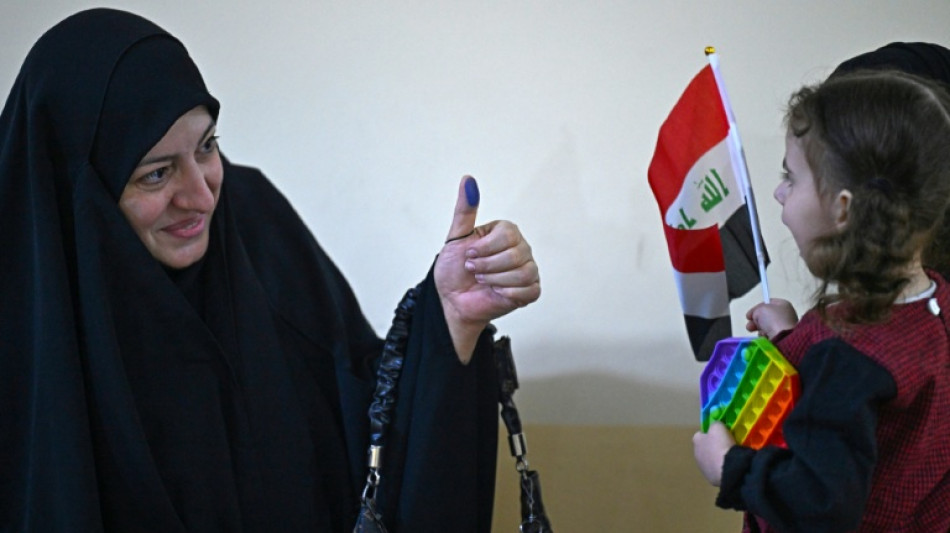
Iraqis voted for a new parliament on Tuesday at a pivotal time for the country and the wider region, in an election that both Iran and the United States will be closely watching.
Iraq, which has long been a fertile land for proxy wars, has only recently regained a sense of stability, as it tries to move past decades of war since the US-led invasion that toppled Saddam Hussein.
But even now, the country of 46 million people suffers from poor infrastructure, failing public services, mismanagement and endemic corruption.
Polling stations closed at 6:00 pm (1500 GMT), with preliminary results expected within 24 hours of closing.
Yet many have lost hope that elections can bring meaningful change to their daily lives and see the vote as a sham that only benefits political elites and regional powers.
No new names have recently emerged, with the same Shiite, Sunni and Kurdish politicians remaining at the forefront.
More than 21 million people were eligible to vote for the 329-seat parliament, but many may have boycotted the polls amid deep distrust in the country's political class.
The electoral commission has yet to announce the turnout.
For Mohammed Mehdi, a public servant in his thirties, voting is a right and a means to achieve change.
While he does not blame those who chose to boycott, he said after casting his vote in Baghdad that politicians have spent heavily to win votes, "proving my vote is valuable -- so I will use it."
- Boycott -
The ballot is marked by the absence of influential Shiite cleric Moqtada Sadr who has urged his followers to boycott the vote, which might also contribute to low turnout.
The mercurial Sadr accused those in power of being "corrupt" and unwilling to reform. A close associate quoted him as urging his followers to stay home and treat election day as a "family day".
In 2021, Sadr secured the largest bloc before withdrawing from parliament following a dispute with Shiite parties which culminated in deadly fighting in Baghdad.
Over the years since US-led forces ousted Saddam Hussein, a Sunni, Iraq's long-oppressed Shiite majority still dominates, with most parties retaining ties to neighbouring Iran.
By convention in post-invasion Iraq, a Shiite Muslim holds the powerful post of prime minister and a Sunni that of parliament speaker, while the largely ceremonial presidency goes to a Kurd.
Prime Minister Mohammed Shia al-Sudani, who hopes for a second term, is likely to score a significant win.
Sudani rose to power in 2022 with the backing of the Coordination Framework, a ruling alliance of Shiite parties and factions all linked to Iran.
But with a single party or list unlikely to achieve an outright majority, he must win the support of whichever coalition can secure enough allies to become the largest bloc.
Although they run separately, Shiite parties within the Coordination Framework are expected to reunite after elections and pick the next premier.
Sudani has touted his success in keeping Iraq relatively unscathed by the turmoil engulfing the Middle East.
- Delicate balance -
The next prime minister will have to maintain the delicate balance between Iraq's allies, Iran and the US, even more so now that the Middle East is undergoing seismic changes, with new alliances forming and old powers weakening.
Even as its influence wanes, Iran hopes to preserve its power in Iraq -- the only close ally that stayed out of Israel's crosshairs after the heavy losses its other allies have incurred in Lebanon, Yemen and Gaza since 2023.
Tehran has meanwhile focused on other interests in Iraq -- challenging the US with powerful Tehran-backed armed groups, and keeping the Iraqi market open to products from its crippled economy.
Washington, which holds much sway in Iraq and has forces deployed there, conversely hopes to cripple Iran's influence, and has been pressuring Baghdad to disarm the pro-Iran groups.
On the ground however, Iraqis appeared torn between their hopes for change and disillusionment with the process.
"We have unemployment and people are tired, we need progress," said Ali Abed, 57, after casting his vote in the northern city of Mosul.
Others meanwhile chose to boycott.
"We have never seen anything good come from these politicians," said Ali al-Ikabi, a 25-year-old tuk-tuk driver.
More than 7,740 candidates, nearly a third of them women and only 75 independents, are standing under an electoral law that many believe favours larger parties.
In the autonomous Kurdistan region, the rivalry between the Kurdistan Democratic Party and the Patriotic Union of Kurdistan remains fierce.
L.Holland--TFWP